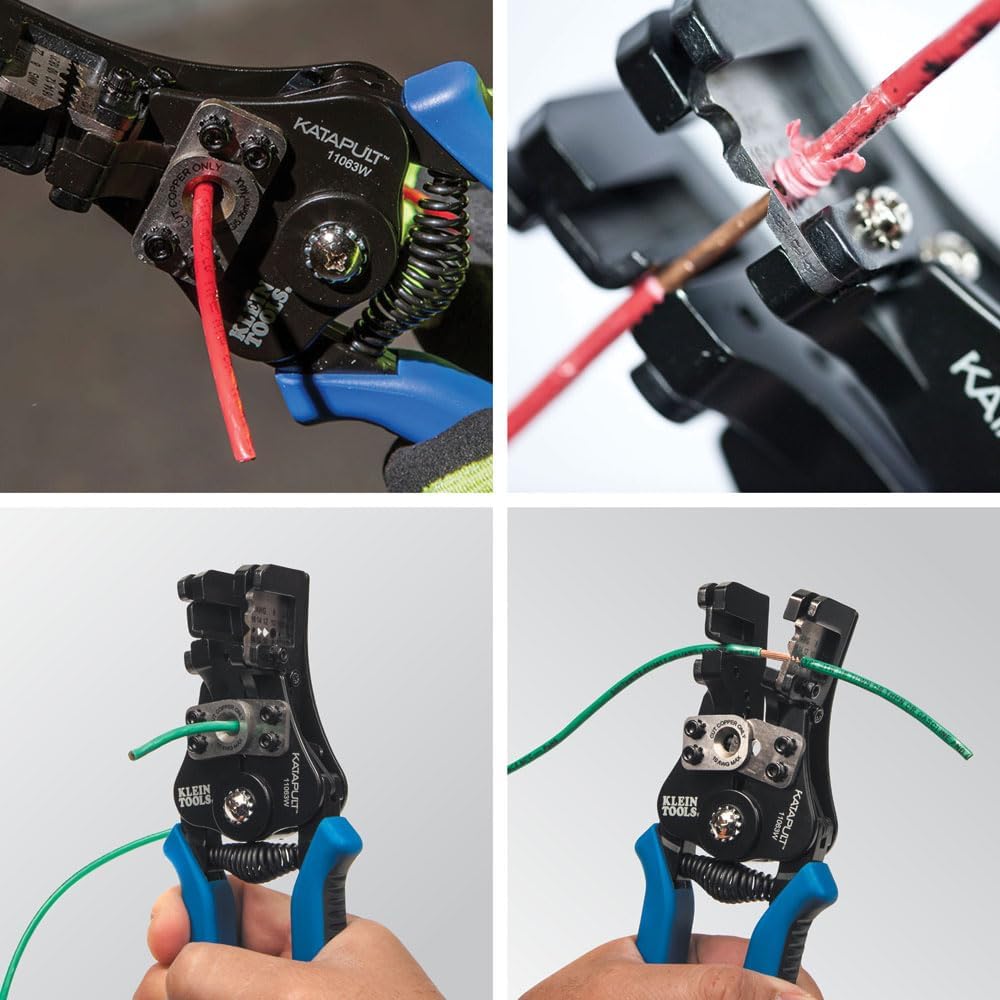
If you’ve ever nicked a conductor on a 12 AWG home-run and had to cut back two inches of already-measured wire, you understand exactly why a quality wire stripper matters more than it seems like it should. For anyone just getting oriented: a wire stripper is a hand tool that removes the plastic insulation jacket from electrical wire without cutting or scoring the copper conductor underneath. AWG — American Wire Gauge — is the numbering system used in the U.S. to describe wire size; the smaller the number, the thicker the wire. A 10 AWG circuit wire feeding a 30-amp HVAC disconnect is noticeably thicker than the 14 AWG branch circuit wire behind a bedroom outlet. Getting the stripping notch wrong — using the 12 AWG slot on a 14 AWG wire, for example — either leaves a ring of insulation behind or nicks the copper. Both are problems. Nicked conductors can fail inspection, create resistance hot spots, or fail under load. This guide breaks down the stripper categories you’ll encounter, what the spec differences actually mean in practice, and how to make a defensible tool decision when you’re equipping yourself or a crew for commercial work.
AWG Range: Why It’s the First Thing to Check on the Spec Sheet
A wire stripper’s AWG range is its most fundamental spec — more important than brand loyalty, more important than price. Every stripping tool is engineered around a set of wire gauges, and using a tool outside its rated range is where conductors get damaged.
For residential work, the practical range is 14 AWG to 10 AWG: 14 and 12 AWG for most branch circuits, 10 AWG for 30-amp circuits (dryers, HVAC, EV Level 2 chargers on smaller services). Per NFPA 70 National Electrical Code, 2023 Edition, Article 310 — Conductors for General Wiring, those three gauges cover the overwhelming majority of wiring in single-family and light commercial installations.
Commercial and industrial work broadens the picture. Pull boxes in a commercial build often contain 8 AWG or 6 AWG feeders. Control wiring in panels and instrumentation loops runs to 22 AWG or 24 AWG — gauges that a standard residential stripper can’t handle without crushing the insulation rather than slicing it cleanly. If you’re doing panel builds, VFD installs, or any work involving low-voltage control circuits alongside power wiring, you need a stripper — or two strippers — that collectively cover 24 AWG through 8 AWG at minimum.
By the numbers — common AWG ranges by job type:
| Job Type | Typical Wire Range | Minimum Stripper Coverage |
|---|---|---|
| Residential branch circuits | 14–10 AWG | 14–10 AWG |
| Commercial feeder + control | 22–6 AWG | 22–6 AWG |
| EV/solar DC wiring | 10–6 AWG (often THHN or USE-2) | 10–6 AWG |
| Panel/controls/instrumentation | 24–18 AWG | 24–16 AWG |
Multifunction strippers that claim “10–24 AWG” in a single tool exist, but as Electrical Construction & Maintenance (EC&M) notes in their coverage of hand tool ergonomics on commercial job sites, tools trying to span that full range in a single pivot often compromise jaw geometry at the extremes. The practical workaround most experienced electricians land on: a mid-range fixed stripper for power wire (10–14 AWG) and a dedicated fine-gauge tool or self-adjusting stripper for control wire (16–24 AWG). That two-tool approach costs more up front and adds belt weight, but it protects conductors across the full range.
Self-Adjusting vs. Fixed-Notch: The Real Trade-off
This is the debate that shows up constantly in trade forums and supply house conversations, and the answer isn’t as clean as either camp claims.
Fixed-Notch Strippers
Fixed-notch strippers have dedicated cutting slots for each gauge, stamped or machined into hardened steel jaws. You match the wire to its slot, close the tool, and rotate or pull. The stripping action is fast, tactile, and consistent once you develop the muscle memory.
What they do well: Speed on repetitive work. When you’re roughing in a whole floor of identical 12 AWG circuits, fixed-notch tools let experienced hands move without thinking. According to Klein Tools Wire Stripper Product Specification Sheets (2025), the cutting edges on their commercial-grade fixed-notch strippers are induction-hardened — a specification that aggregated long-run user reviews consistently associate with sustained edge retention over years of daily commercial use. Fixed tools are also simpler to maintain and less likely to suffer a mechanism failure at an inconvenient time.
Where they fall short: They require gauge identification before every strip. On a panel full of unlabeled wire with mixed gauges, or when you’re tired at hour nine, mismatched notch selection happens. They also don’t adapt to slightly oversized insulation — some wire brands run dimensionally generous on the insulation OD, and a tight notch on a slightly fat 12 AWG can score the copper even when you’re in the right slot.
Self-Adjusting Strippers
Self-adjusting strippers use a ratcheting or spring-actuated mechanism that senses the conductor diameter and automatically sets the cutting depth to just clear the copper. You close the handles, the jaws find the wire, the blade cuts to the right depth, and the insulation sleeve is either held or ejected.
What they do well: Reduced nick risk on unfamiliar wire, mixed-gauge panels, and fine-gauge control wire where the margin for error is smaller. The Wirecutter (New York Times), in their “The Best Wire Strippers” review updated in 2025, notes that self-adjusting mechanisms genuinely reduce conductor damage on mixed-gauge work. The pattern across that publication’s aggregated testing is that electricians doing panel trim-out and device work — where you’re jumping between 12 AWG, 14 AWG, and occasionally 18 AWG pigtails — report fewer nicked conductors with self-adjusting tools.
Where they fall short: Speed. Self-adjusting mechanisms add a step — close slowly to let the jaws sense the wire, then complete the stroke. On high-repetition rough-in work, experienced electricians using fixed tools are typically faster. Self-adjusting tools also have more moving parts. Any mechanism adds potential failure modes that a fixed tool simply doesn’t have. Per Ideal Industries Stripmaster and T-B Series Technical Data (2025), mechanism maintenance — keeping the pivot clean and lightly lubricated in dusty conditions — is a real service requirement on long commercial jobs.
The practical decision frame: If your work is primarily rough-in and you’re running the same gauge all day, a quality fixed-notch tool wins on speed and simplicity. If your work involves panel trim-out, device installation, mixed-gauge panels, or control wiring, the self-adjusting mechanism earns its place and its price premium.
The Tools That Show Up on Commercial Job Sites
Naming specific tools requires context: the right choice depends on the work, the budget authorization, and whether you’re equipping one journeyman or a small crew. The following three tiers cover the realistic range from capable entry-level to professional-grade premium.
Entry-Level Capable: Klein Tools 11055
Klein
$21.97
In stock on Amazon
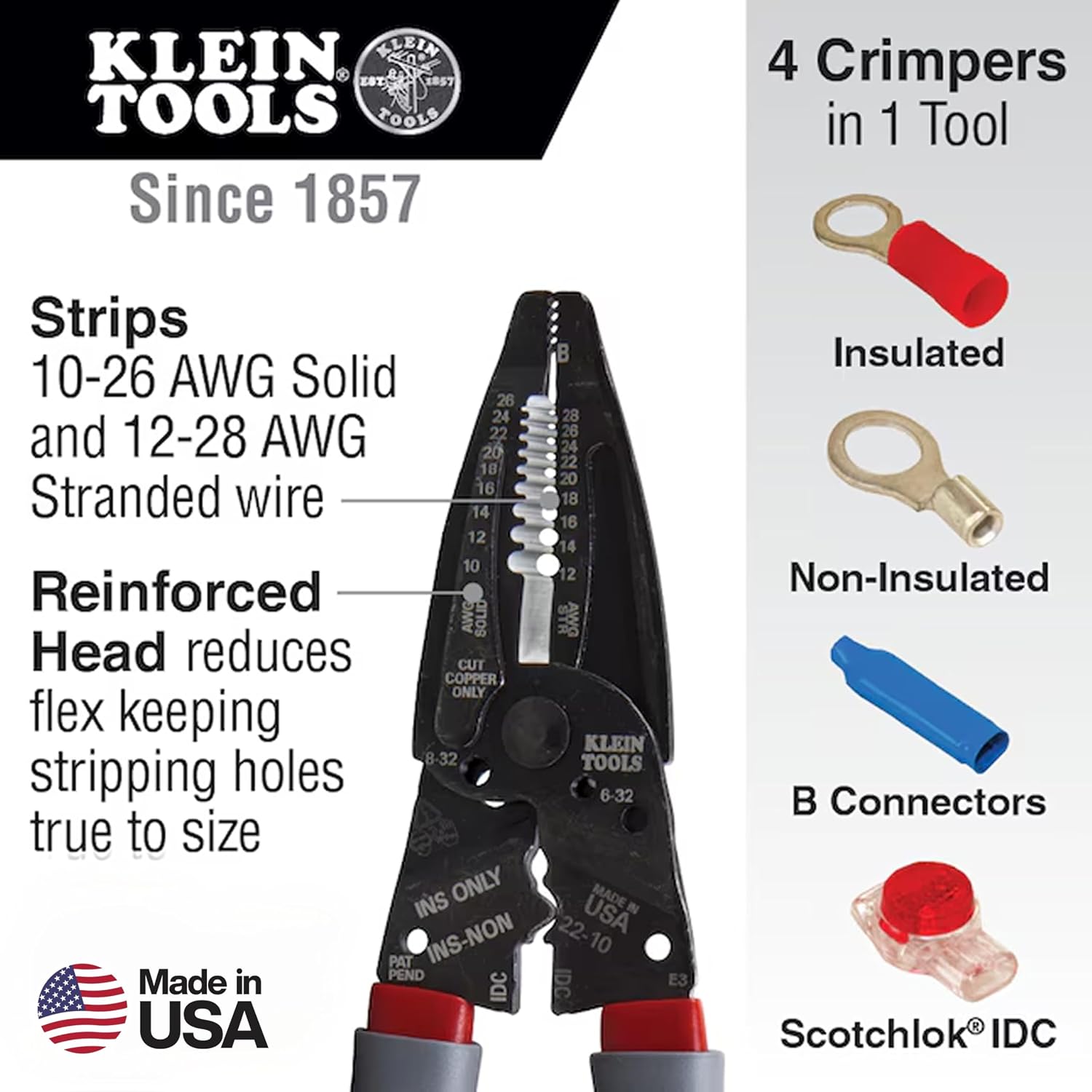
Check price on AmazonKlein’s 11055 is the baseline fixed-notch stripper that appears in more tool belts than any other single model. Per Klein Tools Wire Stripper Product Specification Sheets (2025), the published range is 10–18 AWG, with a combination wire cutter built into the jaw. Cutting edges are induction-hardened steel. At this price point it is the standard apprentice kit recommendation, and owners consistently report it holds up through years of residential work. Its limitation for commercial use is the upper AWG boundary — 10 AWG is the practical limit, which does not cover 8 AWG or 6 AWG feeder work. For a journeyman whose work stays in the residential and light commercial bracket, it remains a defensible primary tool. For commercial work involving feeders or fine-gauge control wire, it is a supplement to a broader kit rather than a standalone solution.
Best for: Apprentices, residential rough-in, single-gauge repetitive work. Limitation: Does not cover 8 AWG feeders or sub-18 AWG control wire.
Klein
$21.97
In stock on Amazon
Check price on AmazonMid-Range Workhorse: Ideal Industries 45-120 Series
Klein
$29.97
In stock on Amazon
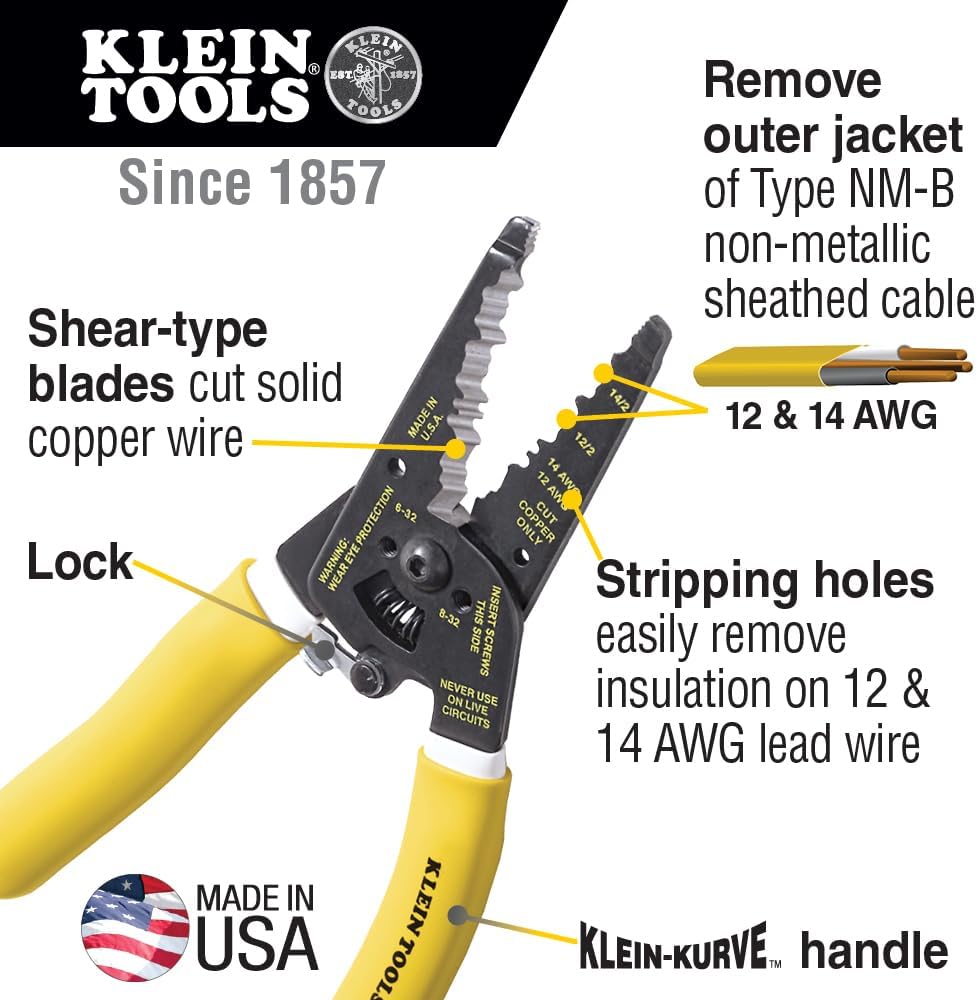
Check price on AmazonIdeal’s fixed-notch strippers extend the range for commercial use. The 45-120 series covers 10–20 AWG; the 45-318 variant extends coverage to 8 AWG for feeder work. According to Ideal Industries Stripmaster and T-B Series Technical Data (2025), jaw material is drop-forged steel — a meaningful durability step over stamped-steel alternatives found in import tools. Across aggregated reviews on electrical supply distributor sites, the pattern is consistent: these tools are preferred in commercial and light industrial settings where the full gauge range matters and tool longevity is evaluated over a multi-year horizon rather than a single project. The 45-318’s 8 AWG capability addresses the feeder gap that stops the Klein 11055 short, making it the more complete fixed-notch option for commercial work.
Best for: Commercial rough-in, mixed-gauge branch circuits, feeder terminations up to 8 AWG. Limitation: Fixed-notch mechanism still requires correct gauge selection by the operator.
Klein
$29.97
In stock on Amazon
Check price on AmazonSelf-Adjusting Premium: Ideal Industries Stripmaster (45-165)
Klein
$34.97
In stock on Amazon
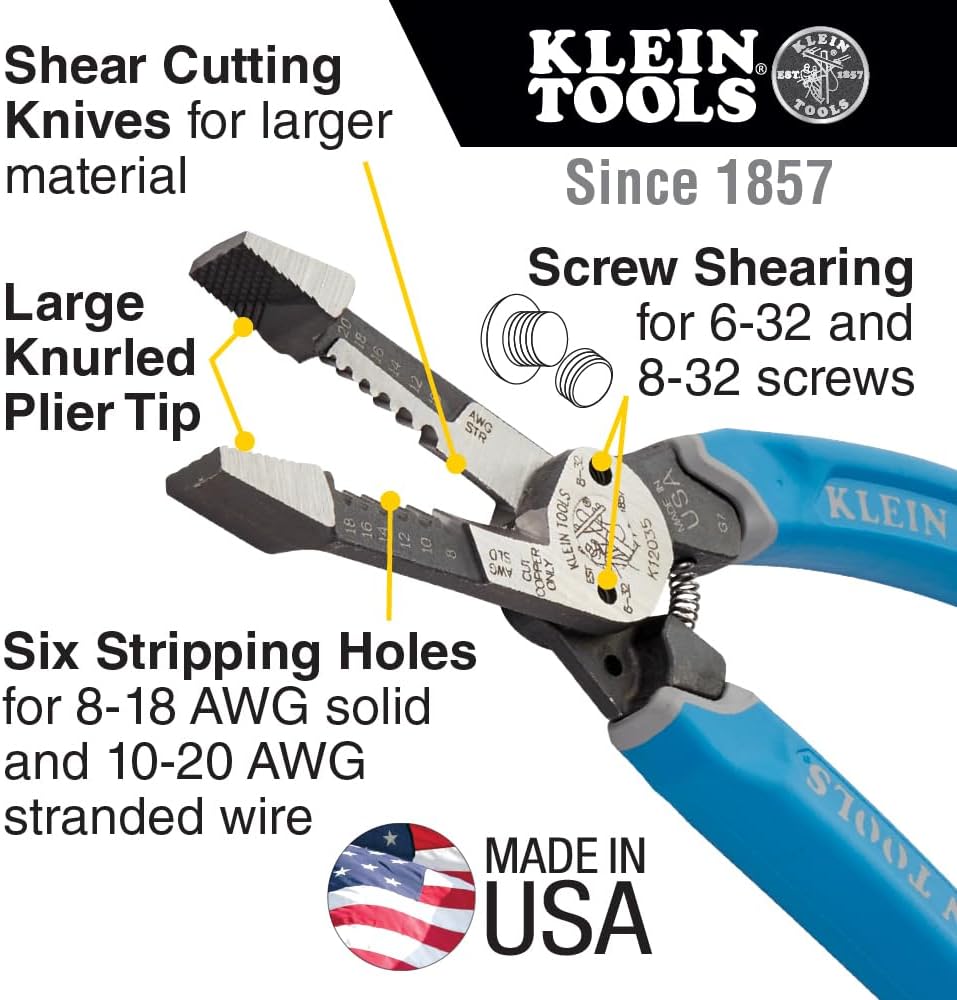
Check price on AmazonThe Stripmaster is the benchmark self-adjusting stripper for professional use. Ideal Industries offers it in multiple range configurations; the 45-165 covers 10–22 AWG in a single tool, making it the most practical single-tool option for electricians moving between power wire and control wire in the same panel. Ideal Industries Stripmaster and T-B Series Technical Data (2025) details the self-adjusting mechanism as a spring-actuated jaw system with a dedicated conductor backstop — the design element that prevents over-insertion and the resulting nick at the cut line. The Wirecutter (New York Times), in their 2025 wire stripper review, identifies self-adjusting tools in this class as the recommended choice for panel trim-out and mixed-gauge work precisely because the mechanism removes the gauge-matching step that causes most nicking errors.
It is heavier than a fixed-notch tool — a real consideration if you’re wearing it on a belt for eight hours — but for panel trim-out work where it sits in a pouch between uses, the weight is operationally irrelevant. Operators in long-run trade reviews consistently cite mechanism durability as the reason to pay the premium over generic self-adjusting tools sourced from unverified vendors.
Best for: Panel trim-out, mixed-gauge commercial panels, control wiring, VFD installs, any job where gauge varies frequently. Limitation: Slower than fixed-notch on high-repetition single-gauge rough-in. Higher per-unit cost.
Klein
$34.97
In stock on Amazon
Check price on AmazonErgonomics and Durability: What the Data Shows
Electrical Construction & Maintenance (EC&M), in their reporting on hand tool ergonomics and repetitive strain on commercial job sites, makes a point worth repeating: repetitive strain from hand tools is a real occupational hazard for electricians doing high-volume stripping work. The force required to close a fixed-notch stripper on 10 AWG THHN is meaningfully higher than on 14 AWG, and over a full commercial rough-in day, grip fatigue accumulates.
Handle design — specifically, spring-return handles and cushion-grip overmold — matters more on a commercial job than on a weekend project. Both Klein and Ideal offer spring-return options across their commercial lines. If you’re pricing out tools for a crew, the minor per-unit cost difference between a spring-return handle and a squeeze-only handle is worth it on high-volume rough-in work.
Jaw quality is the durability variable that determines longevity. Drop-forged or induction-hardened cutting edges outlast stamped steel notches significantly in multi-year commercial use. Klein Tools and Ideal Industries both document their jaw hardening processes in their published specification sheets. Tools from unverified third-party marketplace vendors frequently omit this specification entirely — which is itself a reliable signal to avoid that listing. EC&M’s ergonomics coverage further notes that tools with inadequate jaw hardness show notch deformation within months of commercial use, leading to inconsistent strip depths and increased conductor damage rates over time.
The Decision Rule
Here’s the practical “if X, then Y” frame for this purchase:
-
If you’re roughing in residential or light commercial, running the same gauge repeatedly: Fixed-notch tool in the 10–14 AWG range. Klein 11055 or Ideal 45-120 series. Speed wins.
-
If you’re doing panel trim-out, mixed-gauge device work, or any control wiring: Self-adjusting tool. Ideal Stripmaster 45-165 for the range and durability track record.
-
If you’re working on feeders (8 AWG and larger) regularly: Add the Ideal 45-318 or equivalent 8 AWG-capable fixed stripper to the kit. Most mid-range strippers don’t reach 8 AWG and the spec sheet won’t announce that limitation clearly until you’re standing in front of the panel.
-
If you’re equipping a crew: Budget for two tools per person — one fixed for rough-in, one self-adjusting for panel work. The per-unit cost difference is trivial against the cost of a nicked conductor that fails inspection or generates a callback.
The right wire stripper isn’t glamorous, but it’s the tool you use on every single circuit you touch. It’s worth making a deliberate decision rather than grabbing whatever’s on the supply house peg without thinking about it.