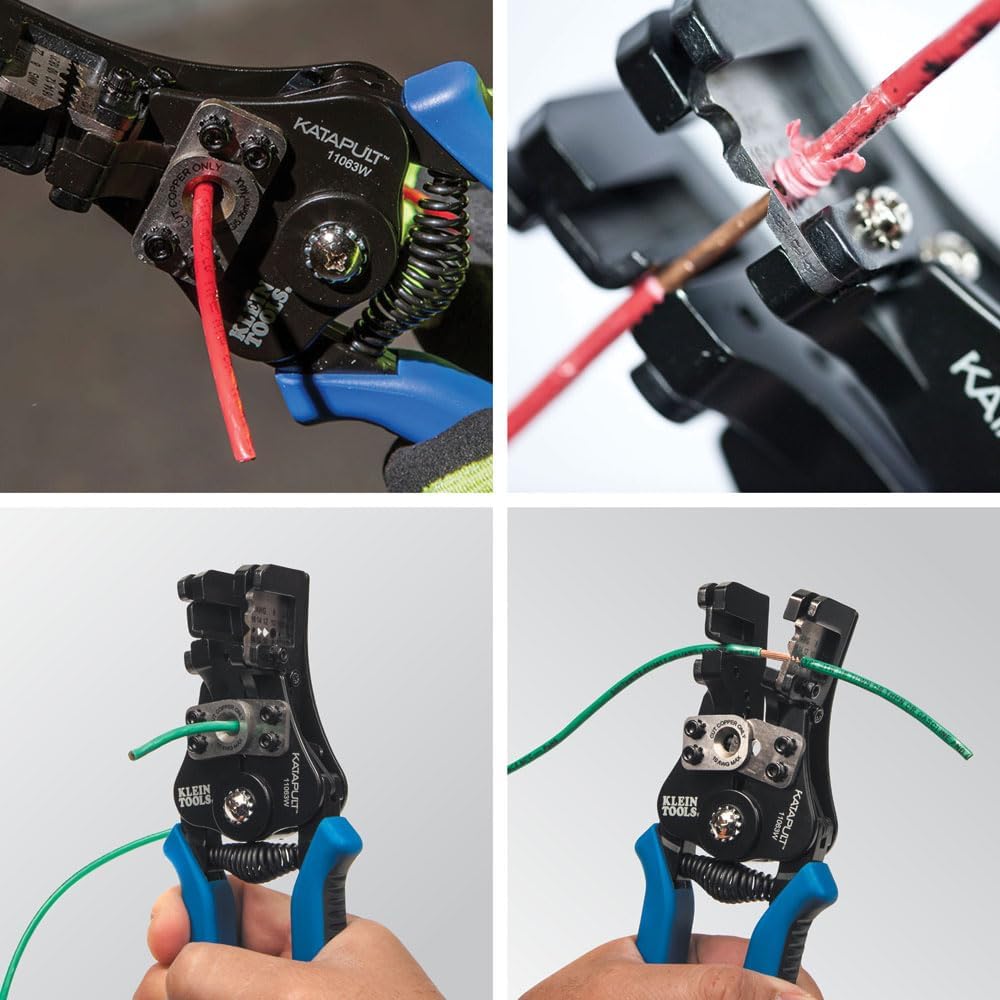
A wire stripper is exactly what it sounds like: a hand tool that removes the plastic insulation jacket from an electrical wire so you can make a safe, clean connection. Do it right and the bare copper conductor underneath is smooth and undamaged. Do it wrong — wrong gauge notch, dull blades, too much pressure — and you nick or score the copper, creating a stress riser that can crack over time or add resistance at the connection point. If you’re new to the trade, that’s the whole stakes of this tool choice. If you’ve got a year or two in and you’re still grabbing whichever stripper is closest, this guide is for you. We’re going to break down the two main design families — fixed-notch and self-adjusting — name the tradeoffs plainly, and give you clear decision rules so you can buy once and get it right.
Fixed-Notch Strippers: The Baseline You Already Know
A fixed-notch stripper (sometimes called a manual stripper) has a series of precisely sized holes or notches along the blade, each labeled with an AWG (American Wire Gauge) size. You match the wire gauge to the notch, squeeze, rotate slightly if needed, and pull. Simple. Durable. Cheap to replace if lost on-site.
Where fixed-notch wins:
- Consistent work on a single gauge. If you’re pulling 12 AWG Romex all day on a residential rough-in, a fixed-notch tool is fast and fatigue-free. You develop muscle memory for the exact notch, and reps go quickly.
- Precision on fine gauges. The Klein 11063W, which covers 10–20 AWG solid and stranded wire, earns strong praise from reviewers working outside residential electrical — an aviation mechanics student specifically calls out its handling of 18–22 AWG without nicking conductors, which matters enormously in avionics and electronics work where a scored strand can fail a continuity inspection. That kind of tight gauge accuracy is a fixed-notch strength.
- Hook-forming at the tip. The Klein K1412 dual-barrel fixed-notch stripper gets a specific callout from working electricians for a feature that non-electricians rarely think to look for: the hook-forming capability built into the tool tip. When you’re terminating to a screw terminal on a receptacle or switch, you need a clean J-hook on the conductor end. The K1412 lets you form that hook without reaching for a separate needle-nose. That’s a workflow detail that adds up over a full day of device work.
- Lower entry cost. A solid fixed-notch stripper lands in the $15–$35 range from reputable brands. For an apprentice building a first kit, that matters.
Where fixed-notch loses:
- Mixed-gauge work is slow. Every gauge change means finding a new notch. On a relay board or control panel wiring job where you’re moving through 14, 16, 18, and 22 AWG in the same hour, that mental overhead and finger repositioning adds up.
- Wrong-notch errors are common under fatigue. Grab the 10 AWG notch on a 12 AWG wire and you’ve left insulation on the conductor. Grab the 14 AWG notch on a 12 AWG wire and you’ve nicked the copper. Both are real mistakes that happen when you’re tired or rushing.
Self-Adjusting Strippers: Where the Design Logic Pays Off
A self-adjusting stripper (the mechanism is sometimes called “automatic” or “spring-loaded jaw”) senses the diameter of the wire you insert and calibrates the blade depth automatically. You insert the wire, squeeze the handles, and the tool figures out the gauge. No notch selection. No dial. The blades open, score, and strip in one motion.
The practical payoff is real. Reviews aggregated around the Klein 11061 self-adjusting stripper tell a consistent story: a professional vehicle upfitter — someone building out relay boards with mixed-gauge wiring harnesses all day — describes hand fatigue setting in badly during high-rep stripping sessions with a fixed-notch tool. After switching to the Klein 11061, that fatigue largely disappeared. The reason is biomechanical: with a fixed-notch tool, your fingers are doing two jobs — squeezing to cut, and modulating pressure to hit the right depth. With a self-adjusting tool, the jaw mechanism handles depth calibration. Your hand just squeezes. Over 200 strips in a shift, that difference in cognitive and physical load is measurable.
Where self-adjusting wins:
- Mixed-gauge wiring harnesses, control panels, relay boards. This is the primary use case. If your work routinely has you moving between gauges, self-adjusting is the right architecture.
- Reducing nick risk under fatigue. Because the blade depth is set mechanically rather than by the user’s feel, nick rate drops — particularly late in a shift when attention wavers.
- Faster throughput on unfamiliar gauges. If you’re doing a one-off EV charging installation that involves 14, 10, and 6 AWG in the same panel, you don’t have to stop and identify the right notch each time.
Where self-adjusting loses:
- Very fine gauges. Most self-adjusting strippers bottom out around 18–20 AWG reliably. Anything finer — 22 AWG thermostat wire, 24 AWG data wire — and the mechanism can slip or score the conductor. For that kind of fine work, a dedicated fine-gauge fixed-notch tool is still the right answer.
- Cost. The Klein 11061 sits in the $40–$55 range as of mid-2026. That’s real money compared to a $20 fixed-notch tool, though professionals generally recoup it in reduced rework.
- Mechanism maintenance. The spring and pivot mechanism can gum up with insulation debris over time. A fixed-notch tool has essentially no moving parts beyond the hinge.
The Multi-Function Plier-Stripper: Honest Tradeoffs
The multi-function plier-stripper category — tools like the Klein K12035 — tries to combine wire stripping, cutting, crimping, and sometimes bolt-cutting into a single handle. For a homeowner or light DIYer who wants one drawer tool, there’s logic here. The haisstronica 3-in-1 stripper is a good example of this category attracting buyers who are consolidating: one reviewer describes replacing three separate cheap strippers with a single multi-function tool, and being satisfied with the trade.
But there’s an honest limitation worth naming. A candid review of the K12035 describes a user who accidentally cut a live wire — and notes that the cutting edges chipped as a result. This is worth addressing directly: hardened cutting edges on plier-strippers are not rated for live-wire interruption. They’re designed to cut de-energized conductors cleanly. Hitting a live circuit with a standard cutter creates an arc that damages the blade geometry through localized heat and shock. That’s not a product defect — it’s physics. The right tool for interrupting a live circuit is a listed interrupting device, not a pair of combination pliers. The chipping is the tool telling you it was used outside its design envelope.
For journeymen and facilities techs evaluating tool kits: multi-function plier-strippers make sense as a supplemental second tool or a kit consolidator, not as your primary high-rep stripper.
By the Numbers: Quick AWG Reference for Common Residential Work
Per NFPA 70 (National Electrical Code, 2023 edition), Article 310, standard residential Romex wire sizing runs:
| Circuit | Wire Gauge | Typical Use |
|---|---|---|
| 15A branch circuit | 14 AWG | Lighting, outlets |
| 20A branch circuit | 12 AWG | Kitchen, bath, garage |
| 30A circuit | 10 AWG | Dryers, water heaters |
| 50A circuit | 6 AWG | Ranges, EV charging (Level 2) |
If your daily work is residential rough-in and trim-out, a fixed-notch tool covering 10–14 AWG handles 90% of your stripping needs. Self-adjusting earns its keep when your gauge range gets wider — control wiring, panel work, low-voltage.
The Made in USA vs. Imported Klein Question
Klein Tools manufactures some products domestically (Mansfield, Texas) and sources others internationally. The relevant question for tool buyers isn’t origin as a badge — it’s whether the quality control and materials spec are consistent.
Klein’s professional-grade USA-made line — which includes tools like the 11063W and K1412 — uses hardened, induction-tempered cutting edges and tighter tolerances on notch geometry. Reviewers of the imported lines note that stripping performance is generally adequate for light use but that edge durability under heavy daily use shows more variance. Klein Tools’ own product documentation distinguishes the lines clearly by part number prefix and country of origin labeling.
For apprentices: the imported Klein tools are a reasonable entry point. For journeymen doing 300+ strips a day in a commercial or industrial environment, the USA-manufactured tools earn their price premium in blade longevity.
Frequently Asked Questions
What is the difference between self-adjusting and fixed-notch wire strippers? A fixed-notch stripper has labeled holes for specific AWG wire sizes — you select the right notch manually. A self-adjusting stripper has a spring-loaded jaw mechanism that senses the wire diameter and sets blade depth automatically. Fixed-notch is faster when you’re working one gauge all day; self-adjusting reduces fatigue and nick risk when you’re moving through multiple gauges.
Can I strip stranded and solid wire with the same tool? Most quality strippers — fixed-notch and self-adjusting alike — handle both stranded and solid wire in their rated AWG range. The key is blade sharpness and correct gauge selection. Stranded wire is slightly more forgiving of minor blade misalignment because the individual strands can flex; solid wire will show a nick immediately. Klein Tools’ product specifications for both the 11061 and the 11063W explicitly rate both wire types.
Why do my wire stripper blades chip or nick the copper conductor? Three main causes: using the wrong gauge notch (too small scores the conductor; too large leaves insulation), using dull blades past their service life, or using a cutting tool to interrupt a live circuit (which causes localized arc damage to the blade). Nicking the copper conductor is a real problem — it creates a mechanical weak point and can increase contact resistance at terminations. If you’re seeing consistent nicking, check your notch selection first, then blade condition.
What AWG range do I need for standard residential Romex work? For the vast majority of residential NM-B (Romex) work, a stripper covering 10 AWG through 14 AWG handles nearly every circuit. If you’re also running low-voltage thermostat wire, doorbell wire, or data cable, extend that range down to 18–22 AWG with either a fine-gauge fixed-notch tool or a quality self-adjusting model rated for that range.
Is there a real quality difference between Made in USA Klein tools and their imported lineup? Yes, and Klein’s own documentation separates the lines. The USA-manufactured tools use tighter manufacturing tolerances and higher-grade steel for the cutting edges, which translates to longer blade life under heavy professional use. For occasional use or an apprentice’s starter kit, the imported lineup performs adequately. For journeyman-level daily carry on commercial work, the domestic-made tools are the better long-term value.
The Decision Rule
Here’s the clean if/then:
- If your daily work is single-gauge residential rough-in (10–14 AWG Romex): A fixed-notch stripper is faster, simpler, and costs less. The Klein K1412 earns a look for its hook-forming tip feature if you’re doing a lot of device terminations.
- If you’re doing mixed-gauge work — control wiring, relay boards, panel work, EV or solar installations with multiple wire sizes in the same job: A self-adjusting stripper like the Klein 11061 pays back its cost premium in fatigue reduction and fewer nicked conductors.
- If you work in avionics, electronics, or fine low-voltage wiring below 18 AWG: A dedicated fine-gauge fixed-notch tool like the Klein 11063W is the precision choice — self-adjusting mechanisms typically struggle at those diameters.
- If you want one consolidating tool for light DIY or occasional electrical work: A multi-function plier-stripper does the job, with the clear understanding that the cutting edges are not rated for live-circuit interruption.
The right stripper doesn’t save you minutes — it saves you rework, and rework on a termination you’ve already made is the most expensive kind.