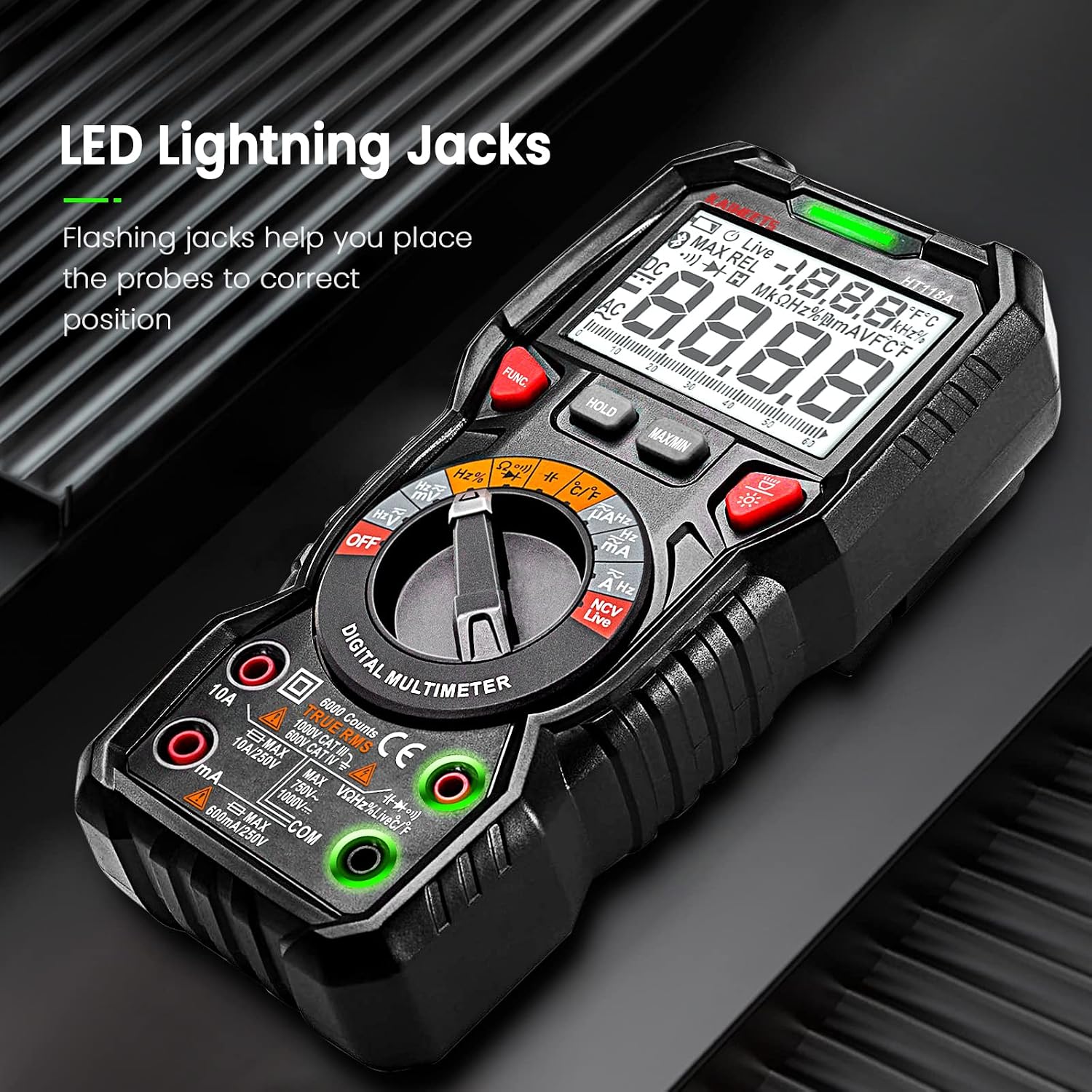
If you’ve ever grabbed a multimeter off the truck, checked a circuit, and walked away confident in the reading — only to have a motor fail or a breaker trip in ways that don’t add up — there’s a good chance your meter was lying to you. Not because it was broken. Because of how it measures AC (alternating current, the kind of electricity that flows through your outlets and panels, constantly reversing direction). Most inexpensive multimeters use a shortcut called average-responding measurement: they sample the incoming signal, assume it’s a clean, smooth sine wave (the ideal wave shape of utility power), and calculate a reading from that assumption. That works fine when the assumption is true. But on a modern commercial jobsite — where variable-speed drives, LED lighting ballasts, UPS systems, and computer loads are everywhere — the assumption breaks down fast. A true RMS meter (RMS stands for Root Mean Square, the mathematically correct way to calculate the effective value of any AC waveform) measures the actual shape of the signal, distorted or not, and gives you a number you can trust. This article breaks down when that difference matters, when it doesn’t, and which meters are worth the money for commercial work.
Why Waveform Shape Changes Everything on a Modern Jobsite
Back when a commercial building’s biggest electrical loads were fluorescent lights, motors, and resistive heaters, utility power arrived as a near-perfect sine wave and stayed that way. Average-responding meters were built for that world, and in that world, they were accurate to within a percent or two.
Today’s commercial buildings are a different animal. Variable frequency drives (VFDs) controlling HVAC compressors, LED drivers with switching power supplies, server rooms full of switching-mode power supplies, EV charging stations — all of these are nonlinear loads. They don’t draw current smoothly across the full sine wave. They pull current in sharp pulses, which distorts the waveform. Electricians and engineers quantify this distortion using a number called Total Harmonic Distortion, or THD: the percentage of the signal that consists of frequency components above the fundamental 60 Hz. A clean utility circuit might show 2–3% THD. A circuit feeding a bank of variable-speed drives or a large UPS system can easily reach 20–40% THD or higher.
When THD climbs, average-responding meters become unreliable. They’re calibrated against a pure sine wave, so they apply a fixed correction factor — 1.1107 — to scale their averaged reading up to what a sine wave’s RMS value would be. If the actual waveform isn’t a sine wave, that correction factor is wrong, and your reading is wrong with it.
According to a Fluke Corporation application note on true RMS measurement (Fluke Corporation, “True-RMS: What It Is and When You Need It,” available at fluke.com), average-responding meters can produce errors of 10–40% on highly distorted waveforms. On a circuit where you’re trying to confirm that load current is within conductor ampacity limits, a 40% error isn’t an inconvenience — it’s a safety issue.
True RMS meters don’t apply a correction factor. They compute the RMS value mathematically from the actual sampled waveform, distortion and all. The reading is accurate regardless of wave shape.
IEEE Standard 1459-2010, “IEEE Standard Definitions for the Measurement of Electric Power Quantities Under Sinusoidal, Nonsinusoidal, Balanced, or Unbalanced Conditions” (ieee.org), establishes the mathematical basis for RMS measurement in nonsinusoidal conditions and underscores why instruments that assume a pure sine wave are inadequate in systems with significant harmonic content. That standard is the engineering foundation behind the true RMS distinction.
When Average-Responding Is Actually Fine
Before you conclude that every average-responding meter belongs in the trash, let’s be honest about scope. There are still plenty of situations where average-responding measurement is good enough, and a journeyman who understands the tradeoff can use that knowledge well.
Residential service work — replacing panels, running circuits for standard outlets and lighting in a home with conventional loads — typically involves linear loads on clean utility power. THD is low. An average-responding meter gives you accurate voltage and current readings. If you’re doing residential service calls five days a week and the occasional commercial job, you don’t need to retire a basic meter for that work.
Continuity checking, resistance measurement, and DC voltage are completely unaffected by the true RMS vs. average-responding distinction. Both meter types handle these identically. If your work is primarily low-voltage DC systems — solar battery banks, fire alarm panels, access control wiring — the AC measurement method is almost irrelevant to your daily workflow.
Basic voltage presence checks — confirming that a circuit is live or dead before you work on it — don’t require precision. Either meter type will tell you reliably whether 120V is present.
The honest decision frame: if more than a quarter of your billable hours involve commercial or industrial facilities with VFDs, switching power supplies, LED ballast systems, or UPS equipment, a true RMS meter isn’t optional. It’s the cost of doing the job correctly.
The Meters Worth Naming: A Direct Comparison
The market for multimeters segments cleanly into tiers for commercial electricians. Here’s how four representative instruments stack up, followed by a detailed look at each.
| Meter | Approx. Price (2026) | True RMS | CAT Rating | AC Voltage Accuracy |
|---|---|---|---|---|
| Klein Tools MM300 | ~$40 | No | CAT III 600V | ±1.5% + 5 digits |
| Fluke 117 | ~$160 | Yes | CAT III 600V | ±1.0% + 3 digits |
| Fluke 87V | ~$400 | Yes | CAT III 1000V / CAT IV 600V | ±0.7% + 2 digits |
| Hioki DT4282 | ~$500 | Yes | CAT IV 600V | ±0.05% + 5 digits |
Prices based on distributor list pricing as of mid-2026. Accuracy specifications from published manufacturer data sheets.
Klein Tools MM300 — The Honest Starter Instrument
The MM300 is a solid average-responding meter for apprentices, homeowners, and technicians doing basic residential work. CAT III 600V rated, which means it’s appropriately safe at the distribution level in a home or small commercial panel. On a clean residential circuit, the readings are reliable and repeatable.
On a commercial circuit with nonlinear loads, the accuracy degrades in ways that aren’t visible to the user — the meter shows a confident number that may be off by 20% or more. That’s the core limitation of average-responding design, not a defect specific to Klein. The MM300 is a dependable starter instrument. It is not a commercial troubleshooting tool.

Klein
$20.97
In stock on Amazon
Check price on AmazonFluke 117 — The Entry Point for Commercial Work
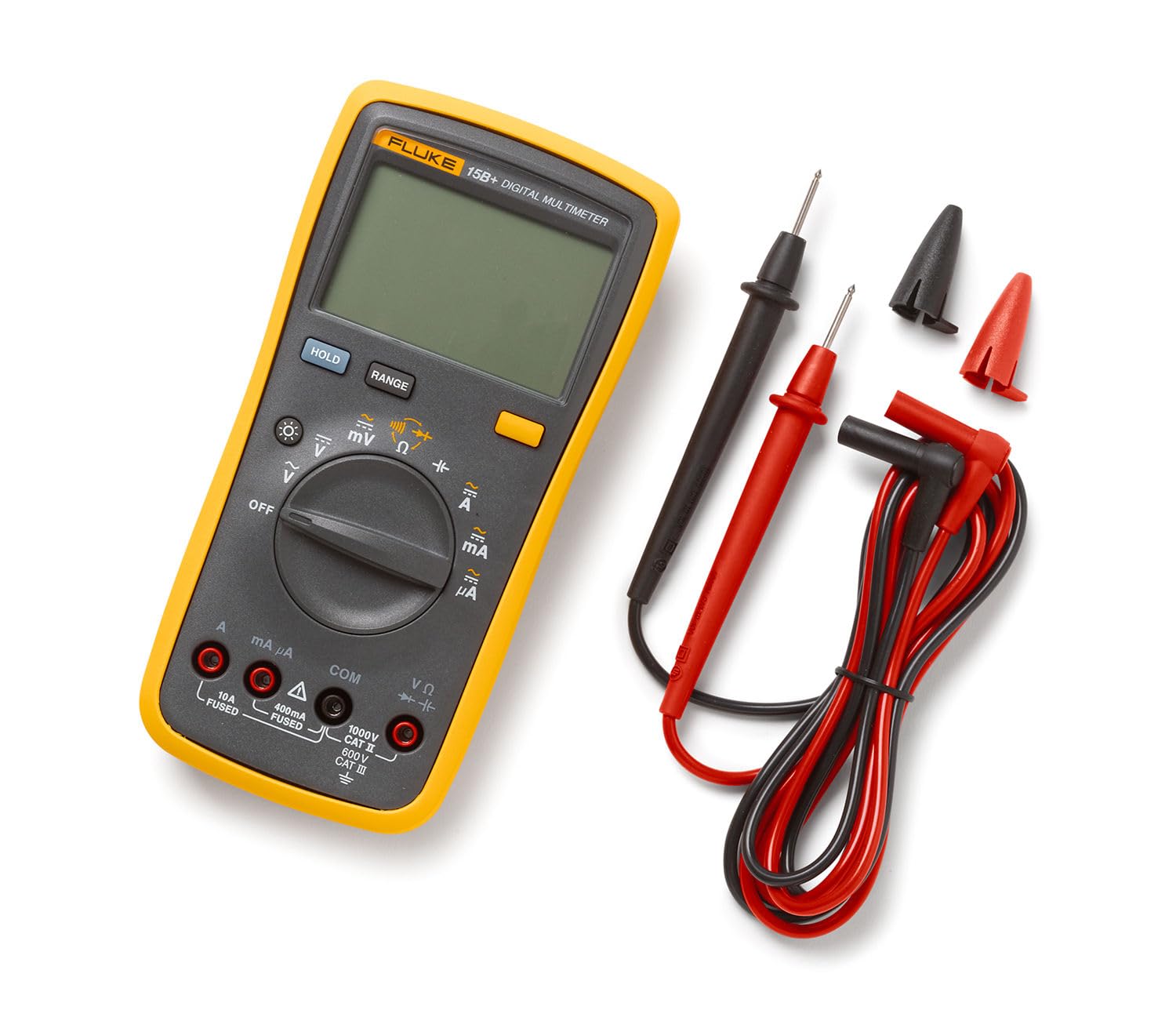
This is where the calculus shifts. The Fluke 117 is a true RMS meter built for commercial electricians doing residential and light commercial work. It includes a built-in non-contact voltage detector and a low-impedance mode (LoZ) that actively bleeds off phantom voltage on lightly loaded circuits — a real-world problem in buildings with long cable runs and sensitive electronics nearby.
Published specifications show ±1.0% basic accuracy on AC voltage, with true RMS measurement accurate through waveforms with THD up to approximately 30%. EC&M (Electrical Construction & Maintenance), in its multimeter selection guidance published at ecmweb.com, has identified the Fluke 117 as the entry point for commercial-grade measurement, citing its combination of true RMS capability and the LoZ mode as particularly relevant for commercial troubleshooting.
If you’re a journeyman doing primarily light commercial work — retail buildouts, small office suites, light industrial tenant spaces — the Fluke 117 is likely your instrument.
Fluke
$116.14
In stock on Amazon
Check price on AmazonFluke 87V — The Field Standard for Commercial and Industrial Work
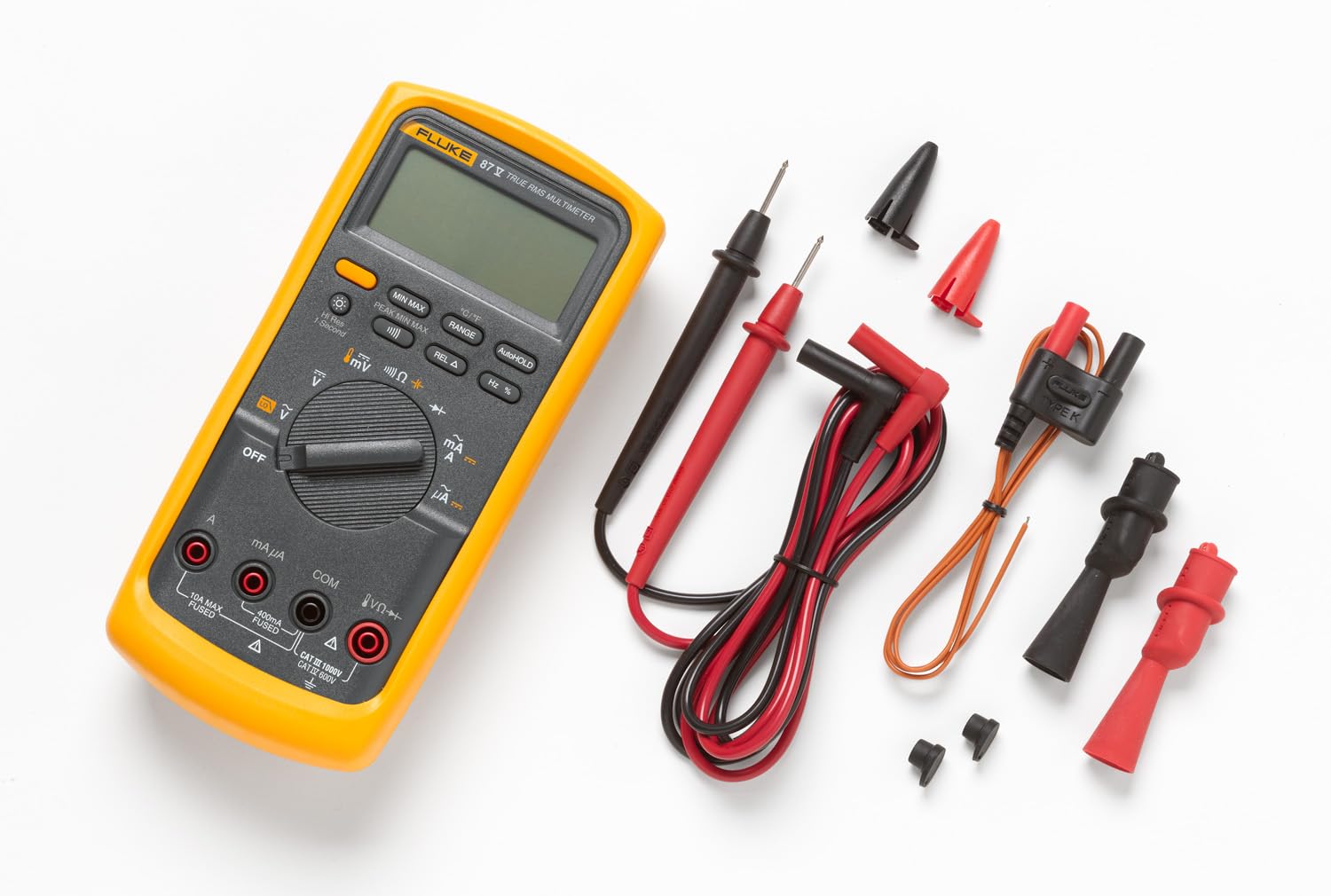
The Fluke 87V is the instrument that licensed master electricians and facilities managers have been specifying for decades, and the reasons are straightforward. It’s a true RMS meter with a 1 mHz frequency measurement range, a 4.5-digit display, and dual CAT ratings — CAT III 1000V and CAT IV 600V — that cover you from the utility service entrance down to the branch circuit.
The 87V’s low-pass filter mode is worth calling out specifically. When measuring on circuits driven by VFDs, the drive’s switching frequency creates high-frequency noise that can push a meter’s displayed reading off the true fundamental-frequency value. The 87V’s filter mode removes that noise so you get a clean reading at the fundamental. Test Equipment Depot’s multimeter buying guide (testequipmentdepot.com) identifies the low-pass filter as one of the key differentiators for industrial maintenance applications, and that assessment holds in practice.
If your work includes industrial facilities, large HVAC systems, or any VFD-heavy environment, the Fluke 87V earns its price point. Owners in long-run reviews consistently describe it as a buy-once instrument that holds calibration and survives jobsite abuse.
Fluke
$401.53
In stock on Amazon
Check price on AmazonHioki DT4282 — The Precision Instrument for Power Quality Work
The Hioki DT4282 operates in a different accuracy class. Published specifications show ±0.05% basic accuracy on AC voltage — roughly 14 times more accurate by that metric than the Fluke 87V’s ±0.7%. CAT IV 600V rated throughout. The DT4282 is particularly well-regarded among electrical engineers and facilities managers doing harmonic analysis and power quality work, where measurement accuracy at the third and fifth harmonic frequencies matters for diagnosis and reporting.
IEEE Standard 1459-2010 (ieee.org) establishes that accurate harmonic measurement requires instruments with sufficient bandwidth to capture signals well above the fundamental frequency. The Hioki DT4282’s bandwidth and accuracy specifications make it appropriate for that task in a way that general-purpose field meters are not.
The tradeoff is straightforward: the DT4282 is a precision instrument at a precision price, and its advantages over the Fluke 87V are most meaningful in power quality troubleshooting, system commissioning, and facilities engineering — not in everyday panel work. For electricians whose scope regularly includes harmonic analysis or formal power quality reporting, it’s the right tool.
Fluke
$401.53
In stock on Amazon
Check price on AmazonSafety Ratings: The Constraint You Cannot Negotiate
A technical discussion of measurement accuracy is incomplete without a direct statement about CAT ratings, because this is where under-spec meters don’t just give wrong readings — they create life-safety hazards.
CAT ratings (Category I through IV, defined under IEC 61010) describe the transient overvoltage an instrument can survive without arc flash or explosion. CAT IV covers the utility service entrance and outdoor conductors. CAT III covers distribution panels, feeders, and fixed equipment inside a building. CAT II covers receptacle-level circuits.
NFPA 70E-2024, “Standard for Electrical Safety in the Workplace” (National Fire Protection Association, nfpa.org), requires that test instruments used on energized electrical systems be rated for the category of the circuit being tested. This is not a guideline. It is a safety standard with legal and liability implications. Using a CAT II meter at a distribution panel is not just a measurement problem — it is an instrument that can fail catastrophically under a transient spike, with consequences for the person holding it.
The counterfeit and under-spec meter problem is documented and ongoing. Instruments sold through unverified marketplace listings frequently carry fraudulent CAT ratings — the markings on the case do not match the actual internal components. Fluke Corporation has published guidance on identifying counterfeit instruments (fluke.com), including internal photographs showing the difference between genuine CAT III instruments and impostors. EC&M (ecmweb.com) has also reported on this issue in the context of jobsite safety. The practical guidance is simple: buy from authorized distributors and verify the instrument through the manufacturer’s serial number lookup if there is any doubt about provenance.
The Decision Rule
Here’s the plain version:
- Residential-only work, clean loads, budget under $100: An average-responding meter like the Klein MM300 is adequate. Know its limits on distorted waveforms.
- Light commercial, mixed residential and commercial, budget ~$150–$200: The Fluke 117 is your instrument. True RMS, LoZ mode, correct CAT ratings for panel work.
- Commercial and industrial facilities, VFDs, HVAC systems, panel troubleshooting: The Fluke 87V at ~$400 is the field standard for a reason. The low-pass filter alone justifies the price step from the 117 on industrial sites.
- Power quality analysis, harmonic troubleshooting, commissioning, facilities engineering: The Hioki DT4282 at ~$500 is the appropriate instrument. The accuracy specification difference is real and meaningful in that context.
The single most expensive mistake a commercial electrician makes with test equipment isn’t buying a $400 meter. It’s trusting a $40 average-responding meter on a circuit where THD is 35%, then making a wire sizing or load calculation decision based on a reading that’s off by a third. The meter that lies to you confidently is the dangerous one.
If you’re standing at a distribution panel in a commercial building with VFD-controlled equipment on the circuit, you already know which meter belongs in your hand. The math is clear, the safety case is clear, and the decision rule is simple: match the instrument to the work, not to the budget.