A wire stripper is exactly what it sounds like: a tool that removes the plastic insulation from electrical wire so you can make a clean, bare-copper connection. Manual strippers require you to match a wire gauge — the thickness of the wire, measured in AWG (American Wire Gauge) — to a specific notch on the tool. Get the wrong notch and you either nick the copper conductors inside (weakening the wire) or leave a stub of insulation behind. Self-adjusting wire strippers solve that problem automatically: a spring-loaded jaw senses the wire diameter and stops the blade at exactly the right depth. If you’re pulling wire on a big panel job, building out relay boards for a vehicle upfit, or running dozens of home-run circuits on a commercial rough-in, that automatic adjustment translates directly into speed, consistency, and less hand fatigue by the end of the day.
This article compares three self-adjusting options — the Klein 11061, the Haisstronica self-adjusting stripper/crimper, and the KNIPEX 13 72 8 — across the dimensions that matter most to professional buyers: AWG range, stripping accuracy on both solid and stranded wire, ergonomics under sustained use, and price-to-value ratio. We also contrast them briefly against the Klein K12035 Klein-Kurve (a fixed-notch tool) to make clear why the self-adjusting mechanism earns its place in a professional kit. All performance observations are drawn from aggregated owner reviews and published specifications.
| EDITOR'S PICKKNIPEX Tools 13 72 8 Forged Wir… | Mid-tierKlein Tools 11048 Dual Wire Str… | Budget pickhaisstronica Self-Adjusting Wir… | |
|---|---|---|---|
| Self-adjusting | ✗ | ✗ | ✓ |
| Jaw capacity | — | — | 10-24 AWG |
| Functions | Stripper | Cutter | Stripper/Cutter/Crimper |
| Length | 8 in | — | — |
| Grip type | Comfort grip | — | — |
| Made in USA | — | ✓ | — |
| Price | $59.51 | $20.97 | $13.99 |
| See on Amazon → | See on Amazon → | See on Amazon → |
Why Self-Adjusting Beats Fixed-Notch on Gauge-Switching Work
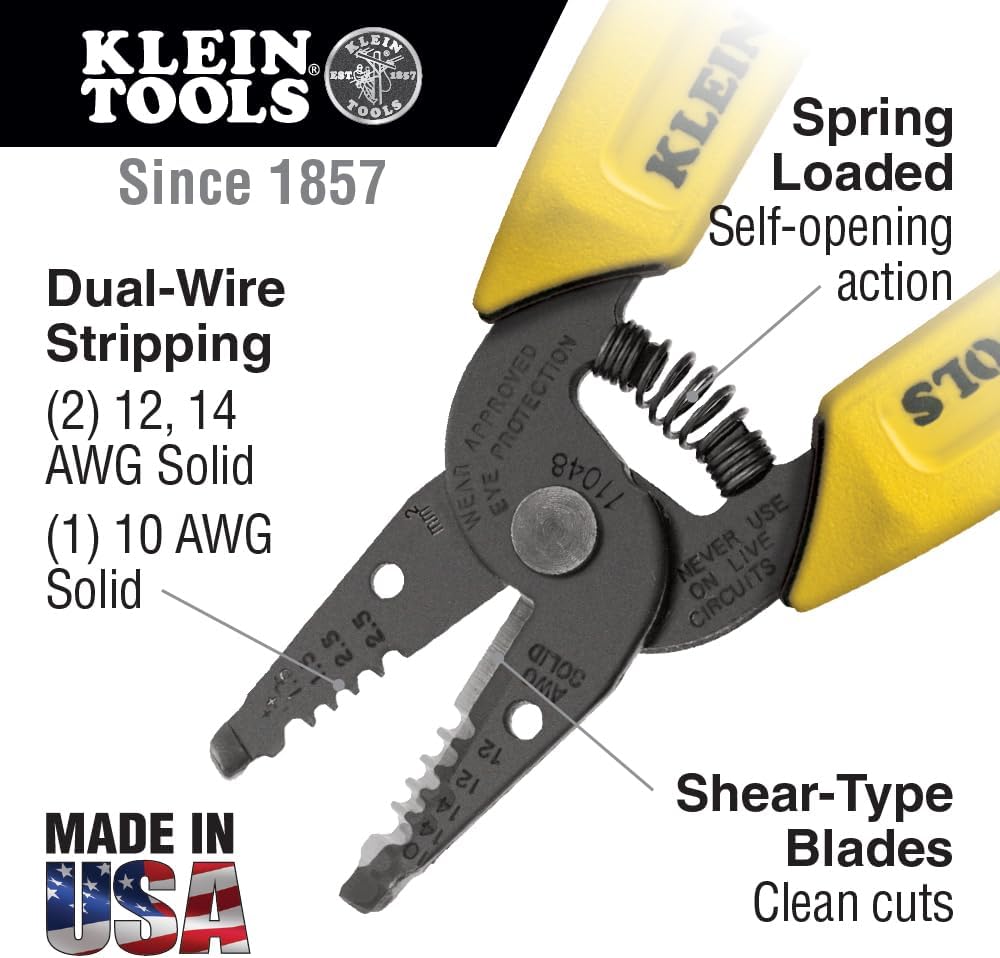
The Klein K12035 Klein-Kurve is a capable, well-built fixed-notch stripper that Klein Tools’ product documentation rates for 10–20 AWG solid and 12–22 AWG stranded. On a job where you’re stripping the same gauge all day — say, nothing but 12 AWG on a residential rough-in — a fixed-notch tool is perfectly adequate. The problem shows up the moment you start switching between gauges.
On a vehicle upfit relay board, for example, you might run 14 AWG for relay coils, 10 AWG for load feeds, and 18 AWG for signal wires in the same afternoon. With a fixed-notch tool, every gauge change means consciously hunting for the right notch, and when you’re moving fast, you make mistakes. Owners of self-adjusting strippers consistently describe the gauge-switching workflow as simply disappearing — you grab the wire, squeeze, pull, done. That cognitive offload matters across a long day.
Electrical Construction & Maintenance (EC&M), published at ecmweb.com, has covered repetitive motion injury prevention in trade hand tools, noting that any mechanism reducing the rotational or searching force required per cut compounds meaningfully across a full workday. Self-adjusting strippers eliminate the notch-matching step entirely, which reduces both decision fatigue and the fine-motor grip adjustments that accumulate into hand strain.
The Klein K12035 is still worth owning for dedicated single-gauge runs where its lower price makes sense. But for anyone whose work involves mixed gauges — commercial panels, vehicle electrical, solar string wire plus home-run conductors — self-adjusting is the right tool class, and the three-way comparison below is where the real decision lives.
The Three Contenders at a Glance
| Tool | AWG Range (stranded) | Approx. Street Price (May 2026) | Notable Differentiator | Tier |
|---|---|---|---|---|
| Haisstronica self-adjusting stripper/crimper | 8–28 AWG | ~$18–$25 | Widest AWG range; integrated crimper | haisstronica — $13.99 |
| Klein 11061 | 10–20 AWG | ~$40–$50 | Depth-of-strip adjustment dial | Klein — $20.97 |
| KNIPEX 13 72 8 | 0.08–16 mm² (~28–6 AWG) | ~$80–$110 | German tool-steel blades; precision-first design | KNIPEX — $59.51 |
Comparing the Three Tools in Depth
Haisstronica: The Budget Entry with a Surprisingly Wide Range
haisstronica
$13.99
In stock on Amazon
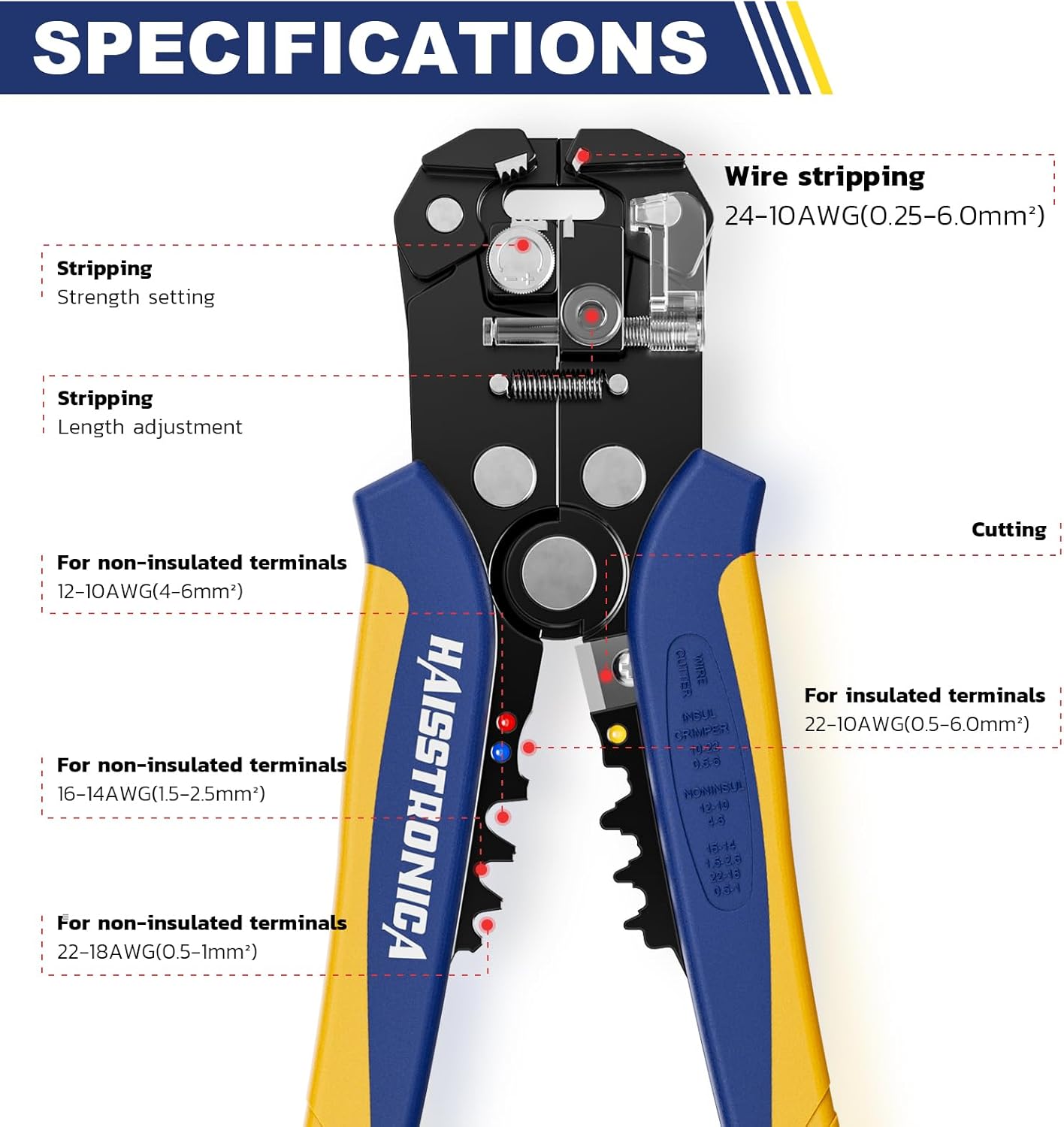
Check price on AmazonThe Haisstronica self-adjusting stripper earns its place in this comparison on two grounds: the widest advertised AWG range in the group (8–28 AWG per Haisstronica’s product listing documentation) and the lowest price point by a wide margin. The first-use surprise factor is well-documented in owner reviews — buyers who expected budget performance consistently report that the self-adjusting mechanism works as advertised out of the box.
The integrated crimper function, designed for insulated terminals, expands the tool’s utility on mixed tasks. That kind of multi-function consolidation makes real sense in a service van where you want fewer tools pulling out of the bag per job. That said, owners who have tried to use the crimper in confined spaces — specifically, under a vehicle or inside a crowded panel — flag the ergonomics as awkward. The tool’s geometry and crimper jaw placement make it difficult to develop proper leverage in tight quarters. If underdash or under-vehicle crimping is part of your regular workflow, that limitation is worth taking seriously before purchase.
The wider AWG range is the Haisstronica’s most compelling differentiator, particularly for anyone working with both large-gauge power feeds (8–10 AWG) and signal-level wire (22–26 AWG) on the same job. No other tool in this comparison covers that full span in a single tool. At 28 AWG, reviewers note that very fine wire benefits from slower, controlled jaw closure rather than a fast full squeeze.
The honest tradeoff: Aggregate owner reviews suggest reliable performance through normal use, but the build quality and blade precision do not match the Klein or KNIPEX. For occasional or secondary use, that is an acceptable trade at the price. For primary-tool daily use on commercial-volume work, most professional reviewers eventually move up.
haisstronica
$13.99
In stock on Amazon
Check price on AmazonKlein 11061: The Professional Workhorse with a Depth Dial
Klein
$20.97
In stock on Amazon
Check price on AmazonThe Klein 11061 is the tool that professional buyers most frequently describe in regret-purchase language — meaning they bought it eventually and immediately wished they had bought it years earlier. That pattern in owner reviews is worth paying attention to, because it suggests the tool delivers on something that was not obvious from the spec sheet alone.
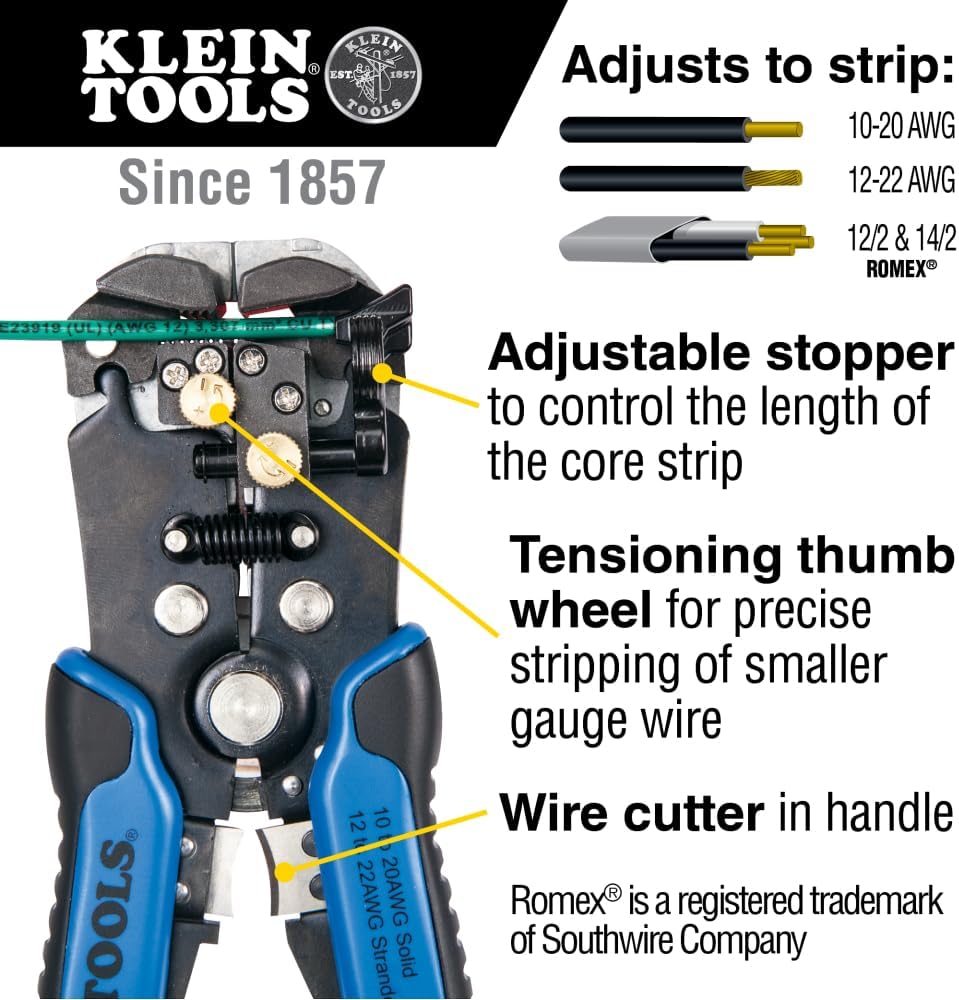
The standout feature is the depth-of-strip adjustment dial, a small knob that controls how far the insulation pulls back from the end of the conductor. Klein Tools’ product documentation for the 11061 describes this as allowing strip lengths from approximately 1/4 inch to 3/4 inch. That matters because different termination types require different strip depths. A push-in wire connector (such as a Wago or traditional push-in type) wants a short, precise strip. A screw terminal lug wants more bare copper. A wire-to-wire crimp splice has its own specified length. Without a depth dial, you strip longer than needed and then cut the excess — an added step that slows output and can leave a frayed conductor end if the cutter is not sharp. The depth dial eliminates that step entirely, which compounds into meaningful time savings across a high-volume stripping day.
Klein’s spec sheet rates the 11061 for 10–20 AWG on both solid and stranded wire. Owners consistently report clean strips on stranded wire across that full range. At the fine end (18–20 AWG), several experienced reviewers recommend adjusting the blade tension screw slightly looser than the factory setting to reduce nick risk on very fine, tightly-wound strands. The mechanism is specifically designed to be adjustable for this purpose.
EC&M’s coverage of hand tool ergonomics at ecmweb.com supports what owner accounts describe: the reduction in grip force required when a self-adjusting mechanism handles gauge-matching (rather than the user applying rotational force to hit a specific notch) is real and accumulates meaningfully across a full shift. On a vehicle upfit relay board with dozens of wire terminations at mixed gauges, that difference is felt by end of day.
The honest tradeoff: The 11061’s AWG range tops out at 10 AWG stranded. If you are pulling 8 AWG THHN on commercial work, you will need a dedicated large-gauge stripper alongside it.
Klein
$20.97
In stock on Amazon
Check price on AmazonKNIPEX 13 72 8: When the Premium Is Actually Justified
KNIPEX
$59.51
In stock on Amazon
Check price on AmazonThe KNIPEX 13 72 8 occupies a different category in the market, and the owner review language around it reflects that distinction. Superlatives and comparisons to precision instruments appear with unusual frequency in long-form professional reviews. That level of sustained enthusiasm across a large review population signals something real about the tool’s performance.
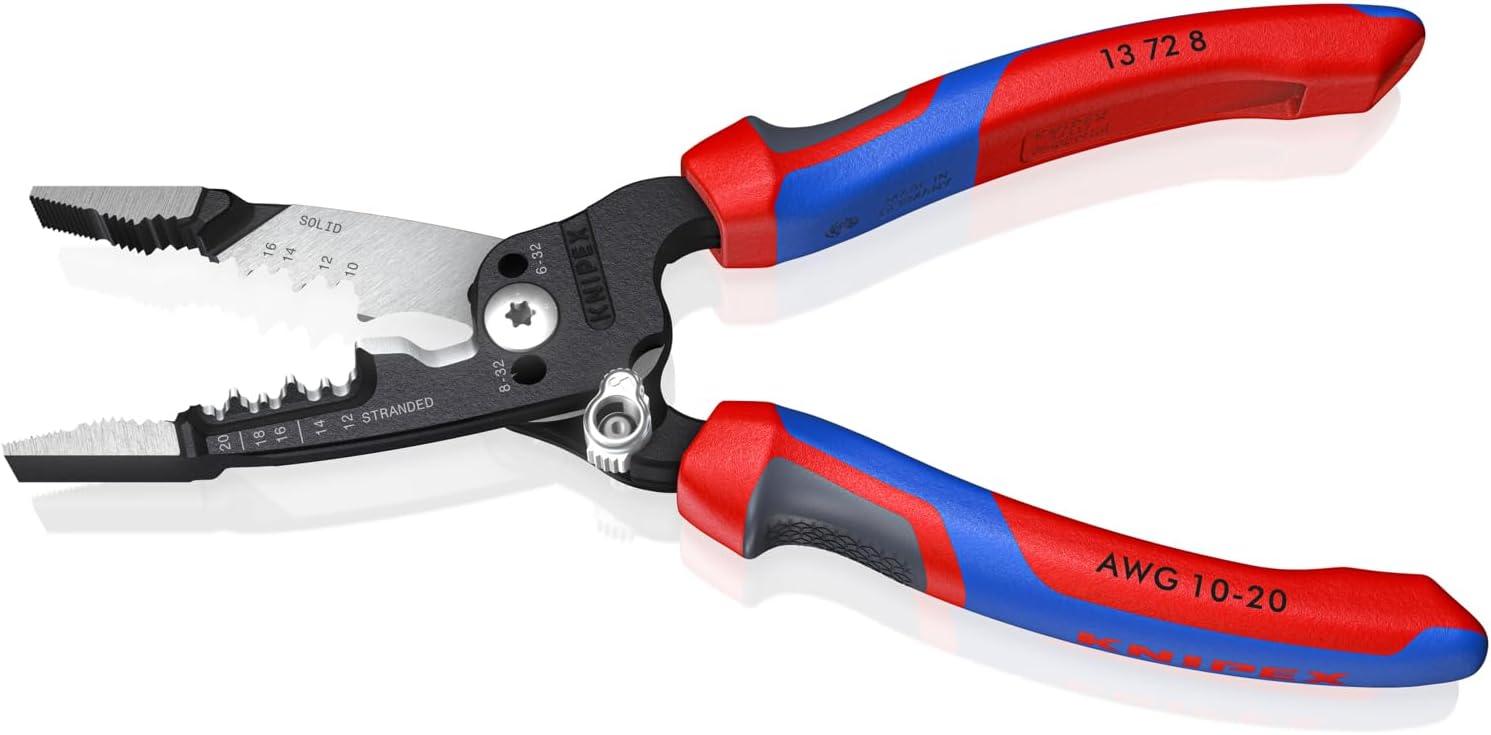
KNIPEX’s product documentation for the 13 72 8 describes the tool as handling conductors from 0.08 mm² to 16 mm² cross-section — spanning roughly 28 AWG to 6 AWG in American wire gauge terms. That covers ground that neither the Klein 11061 nor the Haisstronica can match at the large end with comparable precision. The tool is manufactured in Germany to KNIPEX’s tool-steel specifications, and the blade geometry is engineered to strip insulation without the blade contacting the copper strands underneath — meaning the insulation is cut and peeled without any conductor nick risk when the tool is used within its rated range.
For fine stranded wire — instrumentation cable, automotive primary wire in the 20–22 AWG range, low-voltage control wiring — owners report a level of strip cleanliness that removes concern about nicked conductors entirely. That matters in any application where a nicked strand in a 7-strand conductor represents a meaningful reduction in ampacity or a point of failure under vibration loading.
One documented owner note worth flagging: a user with reduced grip strength reports that the KNIPEX 13 72 8 requires more squeeze force on 10–12 AWG wire than the Klein 11061, and recommends two-handed use on thicker gauges for anyone for whom repetitive strain is already a consideration. For most able-bodied professionals this is not a daily concern, but it is worth knowing before purchase.
The honest tradeoff: At roughly double the price of the Klein 11061, the KNIPEX earns its premium specifically on precision stripping of fine or exotic wire types and on the long-run durability that comes with German tool-steel manufacturing. For a journeyman doing primarily residential electrical work on standard THHN and Romex, the price premium is harder to justify. For anyone in automotive, instrumentation, or commercial controls work where fine stranded wire is a daily constant, the cost calculates favorably over the tool’s service life.
KNIPEX
$59.51
In stock on Amazon
Check price on AmazonFrequently Asked Questions
1. Will the Klein 11061 strip fine stranded wire without nicking the conductors? Owners consistently report clean strips on stranded wire within the tool’s rated 10–20 AWG range. At the fine end of that range (18–20 AWG), several experienced reviewers recommend adjusting the blade tension screw slightly looser than the factory setting to reduce nick risk on very fine, tightly-wound strands. The tension adjustment is specifically included for this purpose.
2. What AWG range does the Haisstronica self-adjusting stripper handle reliably? Haisstronica’s product listing documentation rates the tool for 8–28 AWG. Owner reviews confirm reliable performance across most of that range in routine use. At 28 AWG, reviewers note that very fine wire benefits from a slower, controlled jaw closure rather than a fast full squeeze.
3. Is the KNIPEX 13 72 8 worth the price premium over the Klein 11061 for daily professional use? It depends on your primary wire type. For standard residential and commercial work — THHN, NM-B individual conductors, and similar — owners who have used both tools report that the Klein 11061 delivers professional results without the premium spend. For fine stranded wire, instrumentation cable, or any application where a nicked conductor is a serious quality or safety concern, the KNIPEX consistently earns its cost in long-form owner reviews. If your work is primarily commercial controls, automotive, or low-voltage instrumentation, the upgrade math favors KNIPEX. If you are primarily a residential or light commercial electrician, the Klein 11061 is the rational choice.
4. Can self-adjusting strippers handle Romex / NM cable sheathing, or do I need a dedicated cable stripper? None of the three tools in this comparison are designed to strip NM-B (Romex) cable sheathing — the outer jacket that wraps multiple conductors together. Self-adjusting strippers handle individual conductor insulation after the cable has already been opened. For NM-B sheathing, you need a dedicated cable ripper such as the Klein 44217 Cable Stripper. Once the cable is opened and individual conductors are separated, a self-adjusting stripper handles the individual wire insulation normally.
5. How does the depth-of-strip adjustment on the Klein 11061 work, and why does it matter? The 11061 has a small dial near the jaw that limits how far the tool pulls back along the wire after cutting the insulation. Turning the dial controls strip length — the length of bare copper exposed at the wire end. Klein Tools’ product documentation describes the adjustment range as approximately 1/4 inch to 3/4 inch. Different termination types have specific strip-length requirements: push-in connectors want a short, clean strip; lug terminals want more bare copper; crimp splices have their own spec. Without depth control, you strip longer than needed and must cut the excess — an extra step that slows output and can leave a frayed conductor end. The depth dial eliminates that step, which compounds into meaningful time savings across a high-volume day.
The Decision Rule
If you strip mixed gauges of standard electrical wire — THHN, NM-B individual conductors, typical residential and commercial runs — and you want one professional-grade self-adjusting stripper, the Klein 11061 is the buy. The depth-of-strip dial is a genuinely useful feature at this price point, and professional owners consistently describe it as the tool they should have bought sooner.
Klein
$20.97
In stock on Amazon
Check price on AmazonIf your work involves fine stranded wire, instrumentation cable, or automotive primary wire on a daily basis, and conductor integrity is non-negotiable, the KNIPEX 13 72 8 justifies the premium. Treat it as a precision tool that also handles everyday stripping — the blade geometry and tool-steel construction deliver a different category of performance on fine conductors.
KNIPEX
$59.51
In stock on Amazon
Check price on AmazonIf you need the widest possible AWG range on a limited budget — particularly for occasional large-gauge work combined with signal-level wire — the Haisstronica earns its place as a secondary tool or entry point, with the understanding that it represents a different tier of build quality than the Klein or KNIPEX.
haisstronica
$13.99
In stock on Amazon
Check price on AmazonFixed-notch strippers like the Klein K12035 Klein-Kurve remain worth having for dedicated single-gauge runs where simplicity beats flexibility. But for anyone whose gauge mix changes across the day, the self-adjusting mechanism pays for itself in the first week.