If you’ve ever tried to peel the plastic jacket off a wire with a basic fixed stripper — the kind where you squeeze it around the wire and hope for the best — you know the frustration. Nick the copper strands inside and you’ve weakened the connection. Cut too shallow and the insulation won’t come off cleanly. A self-adjusting wire stripper solves that problem by automatically sensing the wire’s diameter and applying just the right amount of bite, every single time. You set it once, squeeze the handles, and the tool does the calibration for you. For anyone wiring up a vehicle relay board, adding a backup camera, running low-voltage wire through a wall, or just wanting to stop ruining connectors on weekend projects, this category of tool is a genuine upgrade over the fixed-blade strippers most people start with.
This guide compares three options that come up consistently in automotive and home DIY conversations: the Klein Tools 11061, the Haisstronica wire stripper and crimper combo, and the KNIPEX 13 72 8. Each one occupies a different price tier and appeals to a different kind of buyer. We’ll name the tradeoffs plainly, show the relevant specs, and give you a clear decision framework so you don’t have to guess.
| EDITOR'S PICKKNIPEX Tools 13 72 8 Forged Wir… | Mid-tierKlein Tools 11061 Self-Adjustin… | Budget pickhaisstronica Self-Adjusting Wir… | |
|---|---|---|---|
| Wire gauge range | — | 10-20 AWG solid | 10-24 AWG |
| Stranded range | — | 12-22 AWG | — |
| Overall length | 8 in | — | — |
| Handle grip | Comfort Grip | — | — |
| Crimps | — | — | ✓ |
| Cuts wire | — | ✓ | ✓ |
| Price | $59.51 | $22.96 | $13.99 |
| See on Amazon → | See on Amazon → | See on Amazon → |
Why Self-Adjusting Strippers Matter More in Automotive Work Than You Might Expect
Residential electrical work — think 12 AWG and 14 AWG solid Romex for outlets and switches — is forgiving. The wires are stiff, the gauge is consistent, and a decent fixed stripper handles the job fine. Automotive wiring is a different animal. Vehicle harnesses typically run stranded wire from 22 AWG all the way up to 10 AWG or heavier for relay boards, trailer hitches, and auxiliary lighting. Stranded wire (wire made of many thin twisted copper strands rather than one solid conductor) nicks far more easily than solid because each individual strand is thin. Nick even a few strands and you’ve reduced the wire’s current-carrying capacity and created a potential hot spot under vibration.
The Wirecutter’s buyers guide on wire strippers makes the same observation: automatic-adjusting tools earn their price premium primarily in applications where wire gauges vary frequently or where stranded wire is the norm — exactly the conditions in vehicle upfit work and low-voltage home runs.
Beyond wire integrity, there’s the fatigue question. Anyone who has spent four hours under a truck dashboard stripping 40 or 50 individual wires for a relay board knows that repetitive squeezing with a fixed stripper is genuinely tiring. Automotive installers who work high volumes — tint shops doing vehicle upfit packages, 12-volt accessory installers, trailer hitch technicians — consistently name hand fatigue elimination as the practical reason they switched to an auto-adjusting tool. That’s not marketing language; it’s a recurring theme in long-run owner reviews across this category.
Klein 11061: The Vehicle Upfit Installer’s Go-To
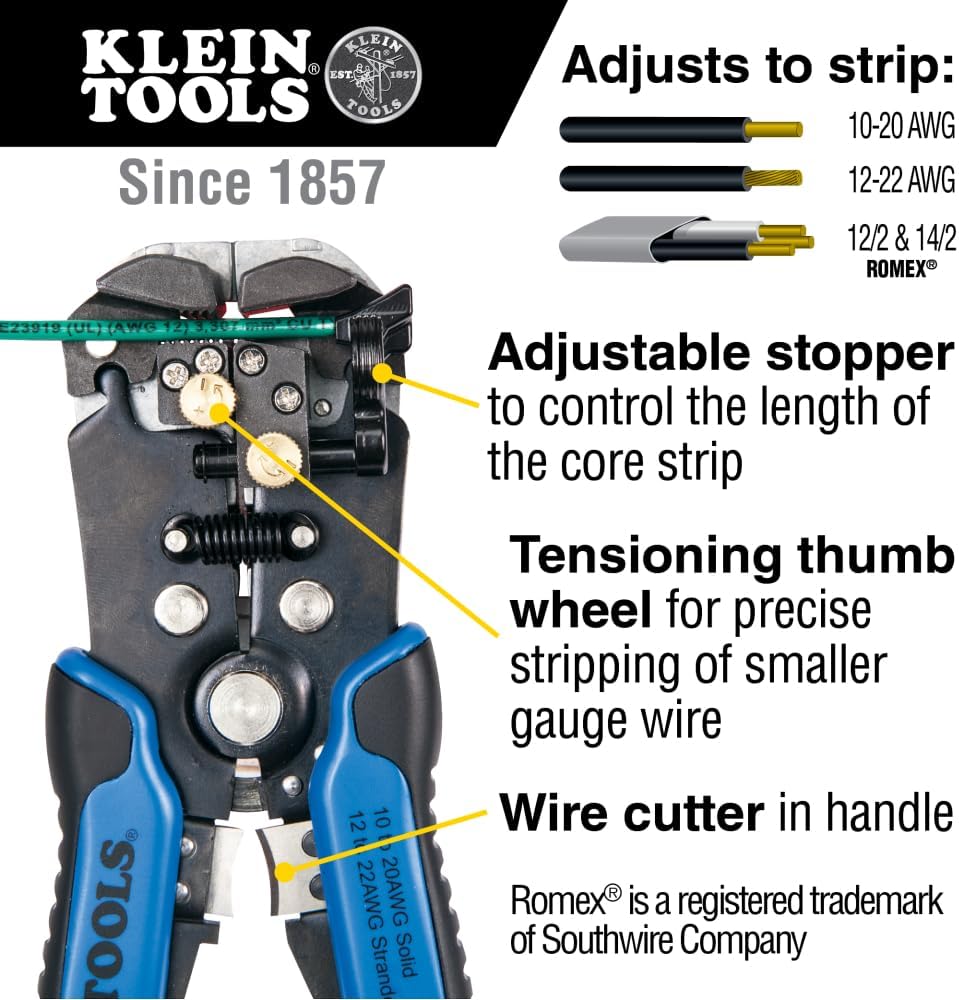
The Klein Tools 11061 is spec’d to handle 10–26 AWG stranded and solid wire, which covers nearly the entire range of automotive primary wire. Klein’s published specifications list the tool’s wire capacity at that range with a self-adjusting pivot mechanism that indexes to the wire diameter before the blade contacts the conductor.
What owners consistently report: The most enthusiastic reviews for the Klein 11061 don’t come from residential electricians — they come from people doing relay board installs, aftermarket lighting harnesses, and trailer wiring. The pattern in aggregated reviews is clear: buyers describe stripping 30–40 wires in a session and feeling none of the hand strain they expected. Several reviewers specifically mention working in cramped engine bays and noting that the tool’s ergonomic grip let them maintain a consistent squeeze even in awkward positions.
On wire quality, owners report that stranded automotive wire — the type where nicking strands is the main failure mode — comes out of the Klein 11061 cleanly, with the copper braid intact. This is consistent with the tool’s design: the self-adjusting jaw is intended to stop cutting at the insulation boundary, not push through to the conductor.
Honest tradeoff: The Klein 11061 is a stripper, not a crimper. If your job also involves installing butt connectors, ring terminals, or heat-shrink connectors, you’ll need a separate crimping tool. That’s not a flaw in the tool’s design — it’s a deliberate choice to do one thing well — but it matters for how you spec your kit.
By the numbers:
| Spec | Klein 11061 | Haisstronica Combo | KNIPEX 13 72 8 |
|---|---|---|---|
| Wire range | 10–26 AWG | 10–22 AWG | 0.2–6 mm² (≈ 24–10 AWG) |
| Crimper included | No | Yes | No |
| Approximate price tier | Mid-range | Budget-mid | Premium |
| Primary audience (per reviews) | Auto installers, relay board work | Beginners, light home/auto | Grip-limited or precision-focused pros |
Haisstronica: The Beginner Conversion Tool
The Haisstronica combo — wire stripper, crimper, and cutter in one unit — is the tool that generates the most “I used to ruin wires; now I don’t” testimonials. Buyers describe previously nicking wire with fixed strippers and being genuinely surprised at how much easier the self-adjusting mechanism is to learn. If someone is buying their first purpose-built stripping tool and wants to cover automotive butt connectors and basic home low-voltage work in one purchase, the Haisstronica is frequently the entry point.
The real limitation — and it’s worth naming explicitly: The Haisstronica’s crimper gets consistent praise on a workbench. In open air, aligned flat on a table, it handles standard insulated butt connectors and ring terminals without complaint. The honest complaint that surfaces repeatedly in owner reviews is different: working underneath a vehicle, in tight quarters, or at an angle, the crimper is hard to position correctly. One reviewer described it plainly — easy to use on a bench, awkward underneath a truck. That’s not a dealbreaker for someone doing home projects or bench wiring, but if your primary use case is vehicle underdash or underbody work, it’s a real friction point.
Haisstronica’s published spec covers 10–22 AWG for the stripping function, which handles most automotive primary wire but tops out before heavier gauge runs (8 AWG trailer wiring, for example, falls outside the range). The crimping function covers standard insulated connectors in red, blue, and yellow ranges — which maps to 22–10 AWG wire, aligning with the stripping range.
For marine and automotive butt connectors specifically: Owners report acceptable results with standard insulated butt connectors on the bench. For heat-shrink marine-grade connectors — which are thicker-walled and require more precise jaw alignment — the consensus is that the Haisstronica works but demands more patience with positioning than a dedicated crimper would.
KNIPEX 13 72 8: When “Good Enough” Isn’t
The KNIPEX 13 72 8 occupies a different tier entirely. Published KNIPEX specifications rate it across a wire cross-section range of 0.2 to 6 mm², which translates roughly to 24 AWG on the fine end up through 10 AWG — and critically, that 0.2 mm² floor means it handles wire gauges that smaller-jawed auto-adjusting tools struggle with. KNIPEX’s German manufacturing reputation in the tool industry is well-established; the product documentation emphasizes the tool’s compound-action mechanism designed to deliver consistent stripping force regardless of operator grip pressure variation.
Who actually buys this: The most interesting pattern in KNIPEX 13 72 8 owner reviews is who’s talking about it. Reviewers use unusually enthusiastic language — “without exaggeration the finest” stripping tool they’ve owned, descriptions of it combining “craftsman strength with surgical precision.” But the purchase driver that appears in multiple reviews isn’t pure performance-chasing. A meaningful number of buyers specifically mention grip strength limitations — arthritis, repetitive strain history, recovery from hand or wrist injury — as the reason they moved to this tool. The KNIPEX’s compound-action mechanism reduces the force needed to complete a strip cycle, which matters for anyone working long sessions or managing a physical limitation. This is an older or injury-aware professional audience that other tools in this category simply aren’t serving.
Tradeoff at the premium tier: The KNIPEX 13 72 8 is a precision stripping tool, not a combo unit. Like the Klein 11061, crimping is not in scope. At its price point, the value case rests on longevity, reduced operator fatigue, and precision — not feature count.
Decision Framework: If X, Then Y
The clearest way to think about this three-way split is by use case and session volume:
If you’re doing vehicle relay board installs, trailer wiring, or accessory harness work — and you strip 20+ wires per session: The Klein 11061 is the choice most consistently validated by people doing exactly that work. The fatigue reduction is real, the stranded wire performance is clean, and the single-function design keeps the tool light and maneuverable in tight dash spaces.
If you’re a beginner or occasional user who wants one tool to strip and crimp for home and light automotive projects: The Haisstronica’s combo format is the right entry point. Accept that the crimper works better on a bench than under a vehicle, and manage your expectations for marine-grade connectors accordingly. For weekend projects and home low-voltage runs, it’s more than adequate.
If you work long sessions, have grip strength limitations, or are wiring very fine-gauge applications (below 20 AWG regularly): The KNIPEX 13 72 8 is worth the premium. The compound-action mechanism and the extended fine-gauge range address real problems that the other two tools don’t fully solve. If you’re describing your previous tool as “it worked but my hand hurt afterward,” that’s the audience this tool was built for.
Frequently Asked Questions
Will the Klein 11061 strip automotive stranded wire without nicking it? Based on published specifications and the consistent pattern in long-run owner reviews, yes — this is the use case the tool is most praised for. Owners doing relay board and harness work specifically cite clean strips on stranded automotive primary wire as the reason they kept the tool. No self-adjusting stripper is immune to user error on the first few uses, but the learning curve is short.
Does the Haisstronica crimper work well for marine and automotive butt connectors? For standard insulated butt connectors on a flat work surface, owners report acceptable results. For marine-grade heat-shrink connectors — which have thicker walls and need precise jaw alignment — the consensus is that it works but requires more care with positioning. In tight vehicle spaces, the crimper is consistently described as awkward to maneuver. A dedicated crimping tool is a better choice if marine wiring is a regular part of your work.
How difficult is it to learn to use a self-adjusting wire stripper? The learning curve is genuinely short. Most buyers describe being comfortable within the first five to ten strips. The main adjustment is trusting the tool to index itself — new users sometimes over-squeeze, which the self-adjusting mechanism compensates for anyway. Beginners who describe previously nicking wire with fixed strippers consistently report that auto-adjusting tools felt intuitive within minutes.
Does the KNIPEX 13 72 8 strip fine gauge wire under 18 AWG? Per KNIPEX’s published specifications, the tool handles down to 0.2 mm² — approximately 24 AWG — which covers fine-gauge wire that many competing self-adjusting strippers bottom out before reaching. If you’re regularly working with 20–24 AWG wire (common in automotive sensor leads, trailer signal wires, and low-voltage home automation runs), the KNIPEX’s extended range is a meaningful spec advantage.
Is the Klein 11061 worth the price over the Haisstronica for occasional home use? For occasional home use — a few projects a year, light gauge variety, no heavy crimp work — the honest answer is probably not. The Haisstronica’s combo format covers more ground at a lower entry price, and occasional users won’t accumulate enough stripping sessions to feel the fatigue advantage that the Klein delivers for high-volume installers. The Klein earns its premium through session volume and automotive-specific performance, not through features. If you’re wiring two or three home projects a year, the Haisstronica is the sensible choice.