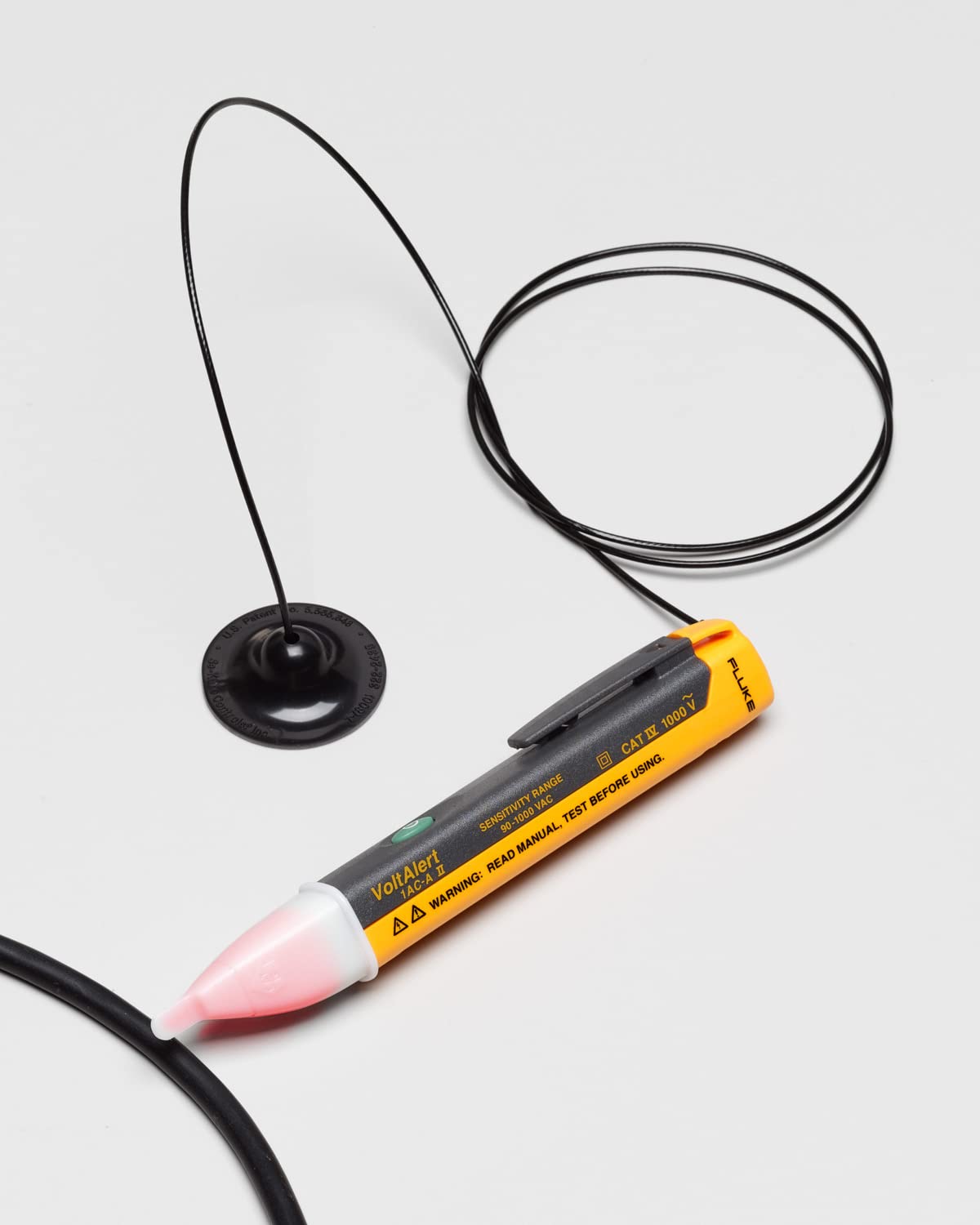
A non-contact voltage tester — sometimes called an NCV tester or a “tick tracer” on the job — is one of the simplest tools in an electrician’s bag. You hold it near a wire or outlet, and it beeps or lights up if voltage is present. No probes, no terminals, no direct contact with the circuit. For a quick “is this circuit live?” check before you touch anything, they’re invaluable. But here’s what a lot of people buying their first or second one don’t realize: the safety rating stamped on that little pen-shaped tool is not a marketing number. It tells you exactly how much transient energy the tool is designed to survive — and in the wrong environment, a tester that’s rated too low can fail catastrophically, sending energy back toward the person holding it. This article breaks down the two specs that matter most — CAT rating and sensitivity adjustment — so you can make a smart buying decision before a bad one costs you.
| EDITOR'S PICKKlein Tools HVNCVT-1 Dual-Range… | Mid-tierFluke 1AC II VoltAlert Non-Cont… | Budget pickKlein Tools NCVT1P Voltage Test… | |
|---|---|---|---|
| Voltage Range | Dual-Range | 90-1000V | 50V to 1000V |
| CAT Rating | — | CAT IV | — |
| Water Resistant | ✓ | — | — |
| Case Included | ✓ | — | — |
| Price | $185.04 | $34.98 | $16.94 |
| See on Amazon → | See on Amazon → | See on Amazon → |
What CAT Ratings Actually Mean (and Why CAT IV Is Not Just Marketing)
The “CAT” designation you see on test equipment — CAT I, CAT II, CAT III, CAT IV — comes from IEC 61010-1, the international safety standard for electrical measuring equipment. UL 61010-1 is the American adoption of the same standard. These categories describe the overvoltage installation category: essentially, where in the electrical distribution system you’re working, and how large a transient voltage spike the equipment must safely withstand and dissipate without failing toward the operator.
Here’s the simplified breakdown:
| Category | Typical Environment | Example |
|---|---|---|
| CAT I | Low-energy, protected circuits | Electronics benches, secondary-side low-voltage |
| CAT II | Single-phase receptacle loads | Household outlets, portable appliances |
| CAT III | Fixed building wiring | Panel boards, distribution boards, 3-phase at the load |
| CAT IV | Origin of the electrical installation | Utility service entrance, meter bases, overhead lines, outdoor conductors |
CAT IV is the highest rating. Per IEC 61010-1, a CAT IV–rated tool at 600V must be proven to withstand transient impulse voltages of 8,000 volts during testing — twice the 4,000V impulse requirement for a CAT III tool at the same voltage rating. That’s not a rounding error. That’s the difference between a tool that absorbs a voltage spike from a utility fault and one that turns it back into a flash event.
The EC&M reference article “Understanding CAT Ratings” puts it plainly: the CAT number is not a maximum working voltage ceiling — it’s a measure of transient energy let-through and arc-clearing capacity. Two tools can both say “600V” on the label but be separated by thousands of volts of impulse protection if one is CAT II and one is CAT IV.
For working electricians, the practical rule is this: if you’re anywhere near the service entrance — meter bases, utility CT cabinets, weatherheads, pad-mounted transformers, anything that touches the utility side — you need CAT IV rated tools, full stop. NFPA 70E (2024 edition) reinforces this by tying PPE and tool requirements to arc flash boundary assessments and the installation category. Using an under-rated tester in a high-energy environment isn’t a technicality. It’s a known failure mode.
Sensitivity Adjustment: The Feature That Prevents False Positives (and Missed Hots)
Once you’ve confirmed a tool is properly rated for your environment, sensitivity adjustment becomes the most important practical differentiator. Here’s the problem it solves.
Non-contact voltage testers work by detecting the electric field radiating from an energized conductor. That field bleeds through insulation, through conduit walls (to a lesser degree), and definitely through the air. A highly sensitive tester — set to detect very low field strengths — will pick up voltage. It will also pick up:
- Ghost voltage from adjacent energized conductors running parallel in a conduit
- Induced voltage on a de-energized wire lying next to a live one
- EMI from nearby equipment — motor drives, fluorescent ballasts, switching power supplies
In a residential panel or a simple branch circuit, high sensitivity is exactly what you want. A tester that can detect 12V–24V AC is useful for low-voltage lighting, doorbell circuits, and HVAC control wiring. But take that same tool into an industrial environment with a VFD (variable frequency drive) panel or a motor control center, and it will beep at almost everything — including conductors you’ve already isolated. That’s not just annoying. It’s dangerous, because false positives train you to ignore the tester’s signal.
Sensitivity adjustment — sometimes a physical slide switch, sometimes a mode button — lets you dial the detection threshold up or down. Low sensitivity (sometimes labeled “high voltage” mode) filters out induced and ghost voltages, giving you a clean signal only on actively energized conductors carrying meaningful load. High sensitivity mode is appropriate for low-voltage and residential work.
The tradeoff to name explicitly: high sensitivity can cause false “hot” readings on de-energized wire; low sensitivity can miss genuine low-voltage hazards. Neither setting is universally correct. The right tool matches the right sensitivity setting to the environment.
Comparing Real Tools: What the Spec Sheets Show
Let’s look at how this plays out across a few representative tools that electricians and technicians are actually buying in 2026.
Fluke 2AC (approximately $20–$25): This is the basic single-sensitivity NCV pen Fluke includes in combo kits. It’s CAT IV rated at 1000V — legitimately impressive for the price point. It detects 90–1000V AC. No sensitivity adjustment. It works exactly as intended for quick branch-circuit verification in residential and light commercial environments. Fluke’s product documentation confirms the CAT IV / 1000V rating, which means it meets the safety floor for service-entrance work, even if its feature set doesn’t extend beyond that.
Fluke LVD2 (approximately $50–$60): Adds dual sensitivity — a low setting (200V–1000V) and a high setting (12V–1000V) — making it genuinely useful across HVAC low-voltage control circuits and standard line voltage in the same tool. Still CAT IV / 1000V rated. For an apprentice or journeyman doing residential and light commercial service calls that include thermostat and control work, the dual sensitivity is a meaningful upgrade over the 2AC for a modest price increase.
Klein Tools NCVT-3 (approximately $35–$40): CAT IV rated at 1000V, with dual-range sensitivity (12–1000V and 70–1000V). Owners across aggregated reviews consistently highlight the audible and visual indicators as clear and reliable for field conditions. Klein’s spec sheet confirms the same essential architecture as the Fluke LVD2 at a lower price point, making it a strong value for apprentices building their first kit.
Fluke 2100 / 2200 series (approximately $80–$130): These are the step up for industrial environments. The 2200 adds GFCI outlet testing capability alongside NCV. Both are CAT IV / 1000V. For facilities maintenance technicians running circuits in commercial buildings with VFD-driven equipment, the improved interference rejection in these tools — noted in Fluke’s application notes for the series — is the practical differentiator over the entry-level pens.
By the numbers — CAT rating impulse requirements per IEC 61010-1:
- CAT II / 600V: 2,500V impulse withstand
- CAT III / 600V: 4,000V impulse withstand
- CAT IV / 600V: 8,000V impulse withstand
- CAT IV / 1000V: 12,000V impulse withstand
That last line is the one that matters near service entrances and utility connections.
The Counterfeit and Underspec Problem You Actually Need to Know About
Here’s where the buying guidance gets direct: third-party marketplace listings for non-contact voltage testers are riskier than almost any other test equipment category. The tool is physically simple, inexpensive to manufacture, and easy to relabel. A CAT II tool wearing a CAT IV label costs almost nothing extra to produce and commands a higher price.
UL’s certification verification system — accessible through UL’s official product database — allows you to confirm whether a specific model number holds a valid UL 61010-1 listing. If a seller on a third-party marketplace can’t provide that model number or the listing doesn’t resolve in UL’s database, treat that tool as unrated regardless of what the packaging says.
Fluke’s product security documentation explicitly warns about counterfeit instruments circulating under Fluke branding with incorrect or fabricated safety markings. The same pattern appears with Klein Tools and other recognized brands. The guidance from Fluke is consistent: buy from authorized distributors — that means direct from the manufacturer’s site, from established electrical supply houses like Grainger or Graybar, or from distributors explicitly listed as authorized on the manufacturer’s site.
This is not theoretical. EC&M has covered failure modes in counterfeit test instruments where the internal MOV (metal oxide varistor) protection components were either undersized or absent entirely — meaning the tool would arc or explode under a high-energy transient rather than safely dissipating it.
Decision Rules: If X, Then Y
Here’s how to apply all of this when you’re standing in front of a buying decision:
If you’re doing residential service calls — branch circuits, outlets, light switches, panel work at the load side: → A CAT IV / 1000V dual-sensitivity NCV pen (Klein NCVT-3, Fluke LVD2) is the right tool. You don’t need to spend more than $60. Buy from an authorized distributor.
If you work near service entrances, utility metering, or pad-mounted transformer secondary connections: → CAT IV / 1000V is non-negotiable. Confirm the UL or IEC listing, not just the label. The Fluke 2AC covers you on the safety rating even at its price point — but confirm you’re buying genuine product from an authorized source.
If your environment includes VFDs, motor control centers, or heavy switching loads: → Pay for the interference rejection. Low-sensitivity mode on a mid-tier tool (Fluke 2200-series range) prevents the false-positive problem that makes cheaper testers unreliable in those environments. Budget $80–$130 and don’t compromise.
If someone hands you an NCV tester of unknown provenance: → Verify the model number against UL’s certification database before trusting it on a live circuit. A tester that can’t be verified is a tester you don’t use.
The CAT rating isn’t a spec to skim past. It’s the margin of safety between you and a high-energy transient. Know what environment you’re in, confirm the rating is legitimate, and buy accordingly.