A non-contact voltage tester — often called an NCV tester or “tick tracer” on the job — is the simplest safety instrument in an electrician’s pocket. You hold it near a wire, outlet, or breaker, and it beeps or lights up if electrical voltage is present, without you ever touching a bare conductor. No probes, no leads, no direct contact with the circuit. For someone just building their first tool kit, that sounds like a solved problem. Buy one, stick it in your pouch, done.
Except it isn’t that simple. Once you’ve carried one for a few months, you start noticing the cracks: beeps where nothing should be live, silence near wires you’d swear are energized, and a nagging uncertainty about whether the tool is confirming reality or just confusing you. That uncertainty is the whole problem this article addresses. We’re going to frame the NCV market the way it actually works — as a three-way compromise between sensitivity, false-positive resistance, and adjustability — and walk through which tools land where on that triangle, so you can make a deliberate choice rather than just grabbing whatever’s on the shelf.
| EDITOR'S PICKFluke 2AC Alert Voltage Tester | Mid-tierFluke 1AC II VoltAlert Non-Cont… | Budget pickKlein Tools NCVT1P Voltage Test… | |
|---|---|---|---|
| Voltage range | — | 90-1000V | 50-1000V |
| Alert type | — | Audible beeper | Audible and flashing LED |
| CAT rating | — | CAT IV | — |
| Pocket clip | — | — | Pocket clip |
| Size | — | Pocket-sized | — |
| Price | $37.49 | $34.98 | $16.94 |
| See on Amazon → | See on Amazon → | See on Amazon → |
The Three-Way Compromise Nobody Explains at the Counter
Every NCV tester has to make a fundamental design tradeoff, and manufacturers rarely spell it out plainly.
Sensitivity is how weak a field the tester can detect. A high-sensitivity instrument can pick up a signal through two inches of drywall. That sounds great until you realize it also picks up induced voltage — stray electrical energy that leaks into nearby conductors from adjacent live wires, even when those conductors are themselves de-energized — radiating off a bundle of cables where only one is live.
False-positive resistance is the flip side. A tester tuned to ignore induced voltage and stray fields will stop crying wolf — but it may also miss a legitimately live wire that’s shielded, deeply embedded, or running at a lower voltage.
Adjustability is the rare feature that lets you dial the tester toward one end of that spectrum based on what the job actually demands: high sensitivity when you’re tracing wires in an open wall, low sensitivity when you’re sorting a crowded conduit.
Understanding where a given tester sits on that triangle is more useful than any single spec number. The sections below profile each major tool against those three criteria.
The Named Tools: Where Each One Actually Lands
Fluke 1AC II — The Contractor Standard
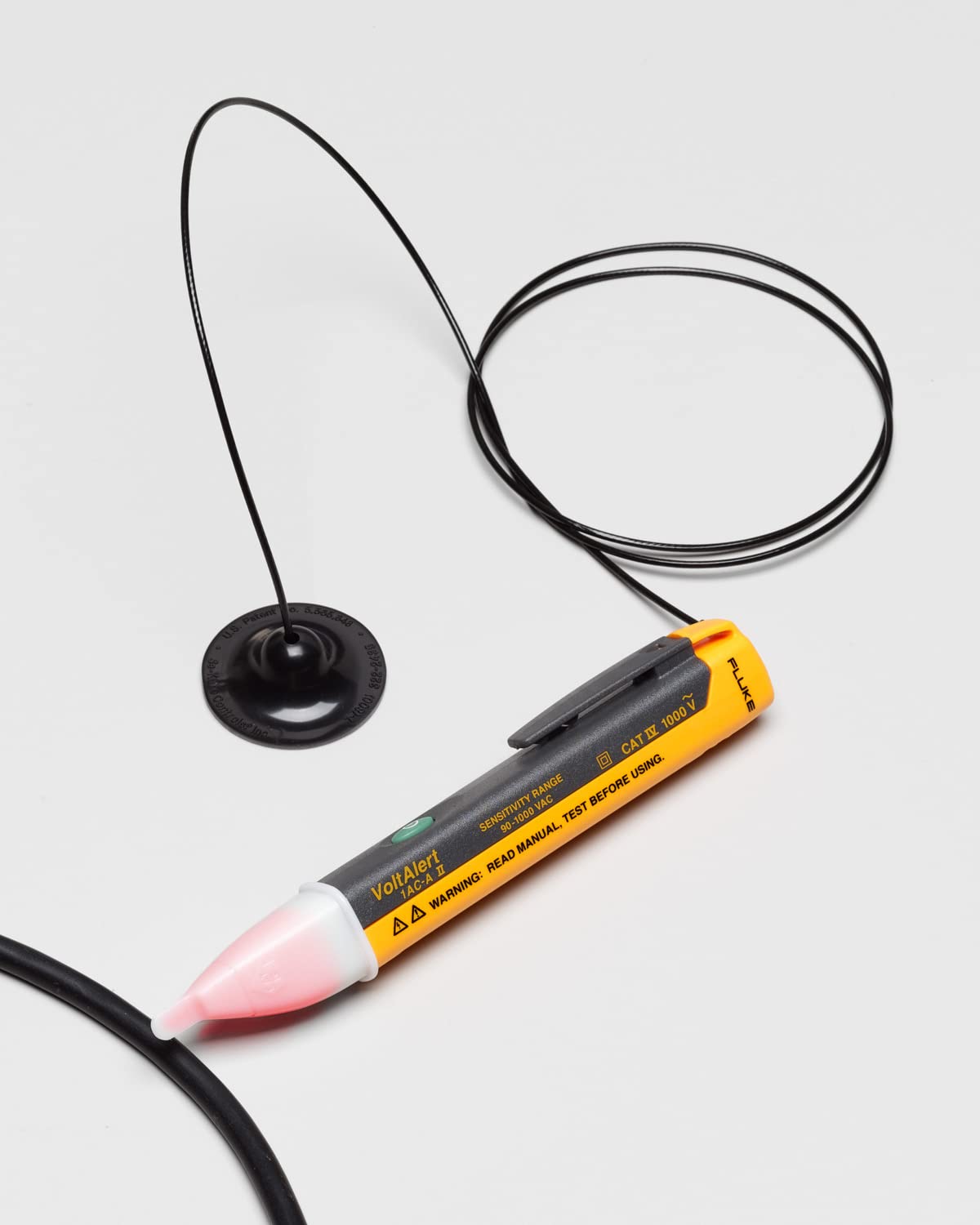
The Fluke 1AC II is the workhorse of the contractor market and has held that position for years. Fluke Corporation’s published product documentation rates it for 90–1000V AC, which covers the full residential and light commercial range. Performance is calibrated for jobsite reality: sensitive enough to confirm live circuits through standard residential wire insulation, but not so hair-trigger that it lights up every time you walk past a loaded panel.
The tradeoff is that the 1AC II is a binary instrument — it beeps or it doesn’t, with no signal-strength indication and no sensitivity adjustment. That works for most outlet and panel work. It becomes a limitation when you’re doing detective work in a crowded junction box where induced voltage on adjacent conductors will set it off indiscriminately.
This is the right tool if you want a predictable, industry-tested go/no-go screener with nothing extra to manage.
Fluke
$34.98
In stock on Amazon
Check price on AmazonFluke 2AC — Same Engine, Silent Operation
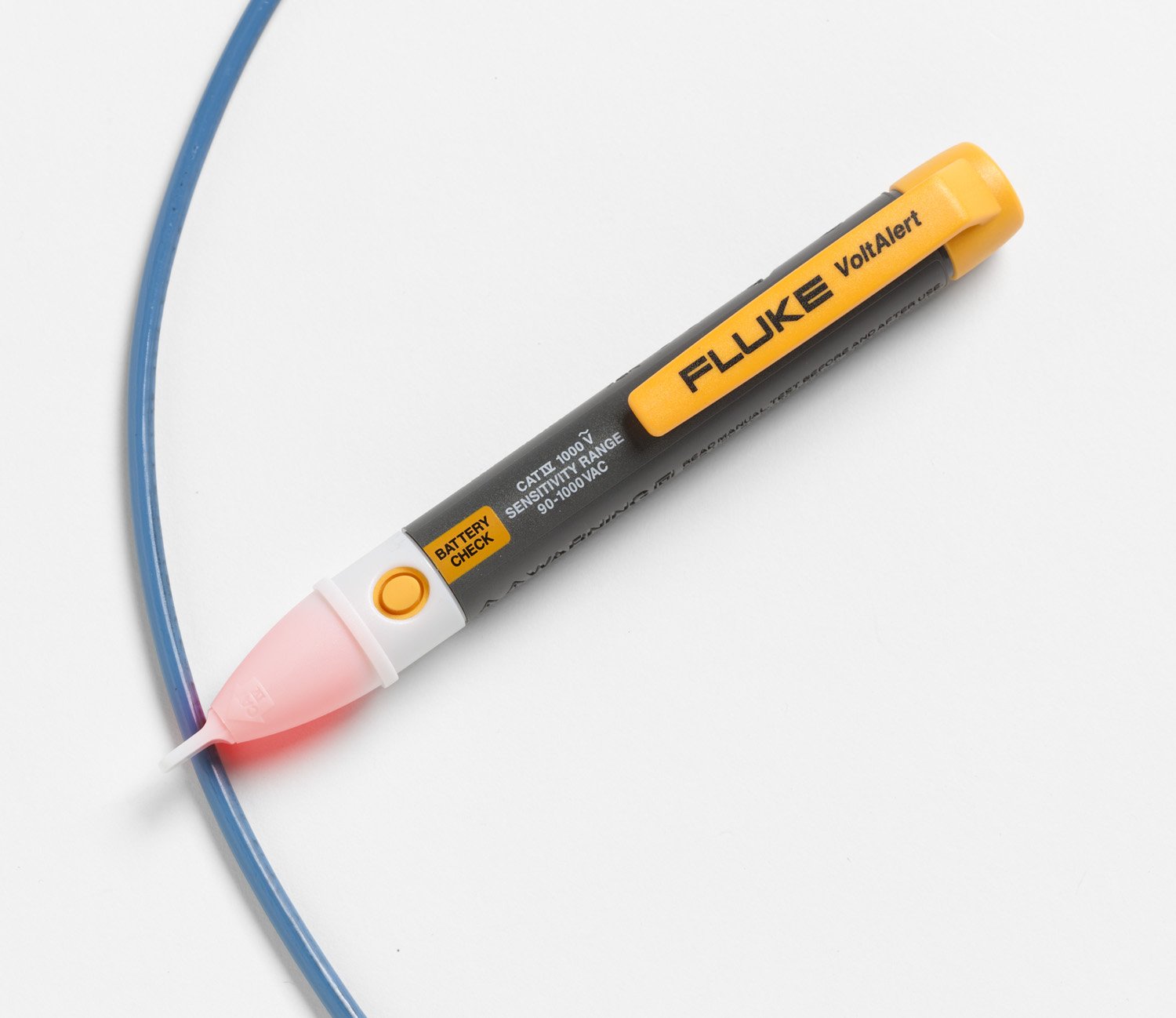
The Fluke 2AC shares the same core detection circuit and 90–1000V AC range as the 1AC II, with one meaningful difference: it produces no audible beep. The alert is visual only, through a series of LEDs. That is not an oversight. It is a deliberate design choice for environments where an audible alert is impractical or inappropriate — hospitals, recording studios, occupied residential spaces during evening hours, or any situation where the person holding the tester cannot afford to disturb the room.
The absence of a beep becomes a genuine safety concern if you’re working in a confined space where you cannot always see the tip of the tester. In that case, the 2AC is the wrong tool. In noise-sensitive contexts, it’s the right one. Some electricians carry both a 1AC II and a 2AC and reach for whichever matches the environment. Fluke Corporation’s product documentation for both instruments confirms the identical detection range, making the audible/silent choice purely situational rather than a performance tradeoff.
Fluke
$34.98
In stock on Amazon
Check price on AmazonKlein Tools NCVT-1P — The Value-Tier Competitor
Klein’s NCVT-1P enters at approximately the same price point as the Fluke 1AC II with comparable published specifications: 50–1000V AC detection and a CAT IV 1000V safety rating, per Klein Tools’ published specification sheets. The lower floor of 50V versus Fluke’s 90V is worth noting for low-voltage applications, though for standard residential circuits it makes no practical difference.
Where the conversation gets interesting is with false positives. When a live wire runs parallel to a neutral or ground conductor over any significant distance inside the same cable jacket, the electromagnetic field from the live wire induces a small voltage onto those adjacent conductors. The NCVT-1P cannot distinguish that induced voltage from a genuinely live wire, so it alerts. This is not a malfunction; it is the sensitivity-false-positive tradeoff playing out in the real world. ECM Web’s overview of non-contact voltage tester fundamentals notes that induced voltage false alerts are the most common source of user confusion with fixed-sensitivity NCV instruments, and that the correct response is to confirm circuit status with a contact measurement rather than to interpret the tester as broken.
The NCVT-1P is a sound choice for straightforward residential work when budget matters. For crowded panel or conduit work, its fixed single sensitivity range will generate more noise than the dual-range Klein model below.

Klein
$16.94
In stock on Amazon
Check price on AmazonKlein NCVT-4IR — Dual Range and Real Signal Feedback
The Klein NCVT-4IR is where Klein steps up the capability set. It adds an infrared thermometer to the NCV function — a genuinely useful combination for HVAC troubleshooting and panel thermal inspection — but the feature that matters most to this comparison is dual-range sensitivity. Per Klein Tools’ published specification sheets, the low-sensitivity range covers 200–1000V AC; the high-sensitivity range drops the floor to 12V AC. Switching between them lets you tune the instrument on the fly.
In low-sensitivity mode, the tester ignores the weak induced fields that cause false positives in crowded conduit or multi-wire cable. In high-sensitivity mode, it picks up 24V transformer circuits — doorbell wiring, HVAC control wiring, landscape lighting — that a standard NCV would miss entirely. The NCVT-4IR also includes a bar-graph signal-strength indicator, which provides a rough proximity cue that a binary beeper cannot. That visual feedback is what turns this instrument from a screener into a diagnostic tool: you can watch signal strength climb as you approach the live conductor in a bundle.
Professional users in panel and HVAC work tend to cite the predictability of a clearly labeled sensitivity switch and a consistent bar-graph response as the features that build trust in a tester over time. Predictability — the tester doing the same thing in the same situation every time — is what lets you build a reliable mental model of its behavior.
Fluke
$37.49
In stock on Amazon
Check price on AmazonKAIWEETS NCV with Signal-Percentage Display — Proximity Intelligence for Wire Tracing
The KAIWEETS NCV instrument takes the signal-feedback concept the furthest of any tool in this comparison by displaying a numerical percentage of detected field strength on a small screen rather than a bar graph or binary alert. That percentage readout is most useful when you’re trying to identify which wire in a bundle of five is live: sweep the tester across each wire and watch the number climb toward the source. A binary beeper goes off for all five conductors in a tight bundle; the percentage display lets you differentiate.
Two caveats are worth stating plainly. First, signal percentage is a proxy for electromagnetic field strength, not a direct voltage reading. It tells you “closer to the source” — it does not identify a specific wire with certainty. Second, the KAIWEETS NCV carries a CAT III 1000V safety rating, versus CAT IV 1000V on the Fluke and Klein instruments reviewed here. That distinction is addressed in the FAQ below. For wall-tracing and bundled-wire differentiation in CAT III environments, the percentage display is a meaningful capability upgrade. For work at the service entrance or utility side of the main panel, the CAT IV instruments are the appropriate choice.
Fluke
$34.98
In stock on Amazon
Check price on AmazonComparison at a Glance
| Tester | Voltage Range | Sensitivity Modes | Visual Indicator | CAT Rating |
|---|---|---|---|---|
| Fluke 1AC II | 90–1000V AC | Fixed (one range) | LED + audible | CAT IV 1000V |
| Fluke 2AC | 90–1000V AC | Fixed (one range) | LED only, no beep | CAT IV 1000V |
| Klein NCVT-1P | 50–1000V AC | Fixed (one range) | LED + audible | CAT IV 1000V |
| Klein NCVT-4IR | 12–1000V / 200–1000V | Dual-range switchable | Bar graph + audible | CAT IV 1000V |
| KAIWEETS NCV | 12–1000V AC | Variable (signal %) | Percentage display + audible | CAT III 1000V |
Sources: Fluke Corporation product documentation; Klein Tools specification sheets; KAIWEETS published product specifications.
Frequently Asked Questions
What causes a non-contact tester to beep when no wire is live?
Almost always: induced voltage. When a live conductor runs parallel to an un-energized conductor — even inside the same cable jacket — the electromagnetic field from the live wire induces a small voltage onto its neighbor. The NCV tester detects that induced voltage and alerts. It is doing exactly what it is designed to do; the signal it detects is real. What it cannot do is distinguish a genuinely dangerous live wire from harmless induction. This is precisely why NCV testers are a screening tool, not a definitive safety verification. The NFPA 70E Standard for Electrical Safety in the Workplace specifies that a no-voltage confirmation must be backed up by a contact measurement with a properly rated multimeter before a worker treats a circuit as de-energized. ECM Web’s coverage of test equipment fundamentals echoes this: the NCV alert tells you to look closer, not that the work is safe to begin.
Is CAT IV rating necessary for a homeowner, or only for professionals?
CAT ratings describe the electrical environment where a tool is safe to use — not the skill level or license status of the person holding it. CAT IV covers the origin of installation: utility service entry points, outdoor conductors, and the service panel on the utility side of the main breaker. CAT III covers fixed building wiring: outlets, junction boxes, load-side distribution panels. The IEC 61010-1 standard — published by the International Electrotechnical Commission and titled “Safety Requirements for Electrical Equipment for Measurement, Control, and Laboratory Use” — defines these categories based on the energy available at each point in the distribution system and the severity of transient overvoltages that can appear there. A homeowner changing an outlet works in a CAT III environment. A homeowner working at the main service panel is in a CAT IV environment. The standard does not check credentials before a transient surge arcs through an under-rated instrument. For anything upstream of the first breaker, CAT IV is the appropriate rating regardless of who is holding the tester.
What does dual-range sensitivity actually change in practice?
It shifts the threshold voltage at which the instrument triggers an alert. In high-sensitivity mode — the Klein NCVT-4IR’s 12V floor, for example — the tester alerts on low-voltage signals, which is useful for tracing 24V doorbell wiring, HVAC control circuits, or landscape lighting. In low-sensitivity mode, with a 200V floor, the tester ignores those weak fields entirely and alerts only on full-voltage circuits. That dramatically reduces false positives when working in crowded panels or conduit where multiple conductors are running in close proximity. Switching between modes is how you manage the sensitivity-false-positive tradeoff in real time rather than accepting whatever the factory set for a single fixed range.
Can I use an NCV tester to find wires inside a wall?
Yes, with meaningful caveats. High-sensitivity NCV testers can detect electromagnetic fields through standard drywall when the wire is within a few inches of the surface. Signal attenuates quickly with distance and is blocked or distorted by metal framing, foil-faced insulation, and metal conduit. ECM Web’s test equipment overview notes that NCV wall-tracing is most reliable for confirming a wire’s approximate location once you already have a rough idea of its path — it supplements a proper wire tracer rather than replacing one. The signal-percentage display on instruments like the KAIWEETS NCV makes wall tracing more informative than a binary beep, because you can watch field strength change as you sweep across the surface and identify the region of highest signal.
Why does the Fluke 2AC have no audible beep, and is that a limitation?
The 2AC is deliberately designed for silent operation, using LED indicators only. Whether that is a limitation depends entirely on the work environment. In noisy mechanical rooms or job sites with heavy equipment running, an audible beep may be inaudible anyway. In confined spaces — inside a panel cabinet, behind a junction box cover — where the tester tip is not always visible, silent-only operation is a genuine workflow concern because you lose the audio confirmation. The right answer is situational: the 2AC is the correct choice when silence is the requirement, and the wrong choice when you need an alert you can hear without looking. Fluke Corporation’s documentation for both the 1AC II and the 2AC confirms identical voltage detection performance, so the choice between them is entirely about the output modality, not measurement capability.
The Decision Rule
- Standard residential work, lowest complexity: Fluke 1AC II. Predictable, durable, industry-standard for a reason.
- Occupied or noise-sensitive spaces: Fluke 2AC. Identical detection performance, no audible disturbance.
- Value-tier residential, budget-constrained: Klein NCVT-1P. Comparable performance to Fluke 1AC II with a slightly lower voltage detection floor.
- HVAC, panel work, or sorting energized bundles: Klein NCVT-4IR. The dual-range sensitivity switch and bar-graph indicator convert a binary screener into a diagnostic instrument.
- Wall-tracing or pinpointing one live wire in a multi-wire bundle: KAIWEETS NCV with signal-percentage display. The numerical readout solves the proximity-guessing problem that binary beepers cannot address. Confirm you are working in a CAT III environment before relying on this instrument’s rating.
- Regardless of which tester you choose: confirm any “circuit is dead” conclusion with a contact measurement on a properly rated multimeter before you work on the circuit. Per NFPA 70E, the NCV tester is the first word on voltage presence — never the last.