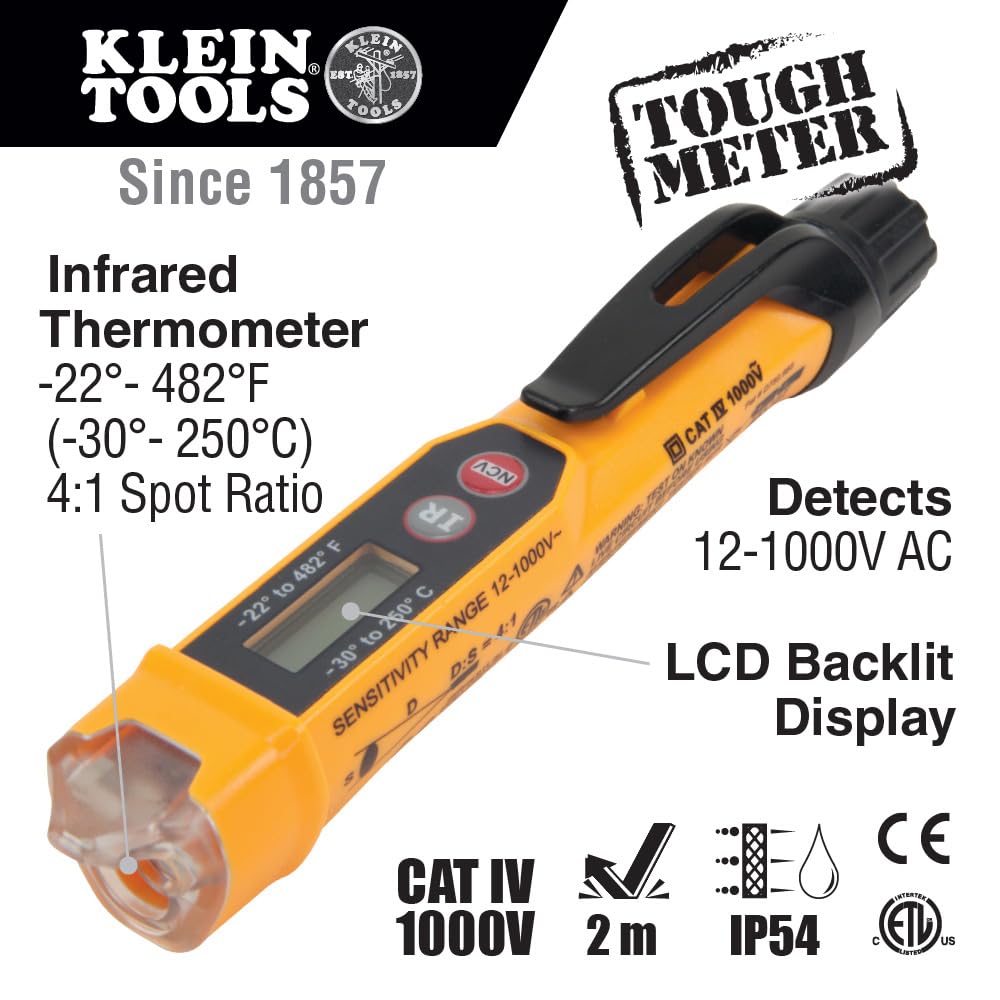
A non-contact voltage tester — often called an NCV tester or “tick tracer” — is a pen-shaped tool that beeps and lights up when it senses an energized wire, without you ever touching a bare conductor. Think of it as an early-warning system: you wave it near an outlet, breaker, or cable, and it tells you whether the circuit is live before you commit your hands to it. The Klein NCVT-4IR adds a second trick — a built-in IR thermometer (infrared thermometer, which measures surface temperature from a distance using heat radiation) at the tip. The pitch is obvious: one pocket tool instead of two. But combo tools have a long history of doing two things adequately instead of one thing well. If you’re an apprentice about to buy your first pen tester, or a journeyman looking to consolidate your pouch, this breakdown will tell you exactly what the NCVT-4IR gets right, where it stumbles, and which alternatives make more sense for specific job profiles.
| EDITOR'S PICKKlein Tools NCVT-4IR Non-Contac… | Mid-tierFluke 1AC II VoltAlert Non-Cont… | Budget pickKAIWEETS Voltage Tester/Non-Con… | |
|---|---|---|---|
| Voltage range | 12–1000V | 90–1000V | 12V/70–1000V |
| Display | — | — | LCD |
| Signal strength | — | — | ✓ |
| IR thermometer | ✓ | — | — |
| Temperature range | -22–482°F | — | — |
| Price | $39.99 | $34.98 | $12.99 |
| See on Amazon → | See on Amazon → | See on Amazon → |
What the Klein NCVT-4IR Actually Does — and What It Doesn’t
Let’s separate the two functions before we judge them together.
NCV side: The NCVT-4IR is rated for 12–1000V AC. It uses the industry-standard feedback loop — a red LED tip flash and audible beep when voltage is detected. Klein’s spec sheet lists CAT IV 1000V / CAT III 1000V safety ratings, which is important: CAT IV covers utility service entrances and outdoor conductors, the most dangerous measurement environment in residential and light commercial work. Most cheap NCV pens on third-party marketplaces show no CAT rating at all, which per IEC 61010-1 standards means you cannot rely on their input protection under transient surge conditions — a real risk near panel boards.
IR thermometer side: This is where expectations need managing. The NCVT-4IR’s IR sensor reports surface temperature in a basic point-and-read format. Across aggregated owner reviews, the consistent framing is “nice bonus” rather than “the reason I bought it.” One long-term user — a tech who described a decade of daily use and then bought an identical replacement — specifically noted it’s ideal for “rough measurement of surface components” in low-voltage and IT environments: checking whether a patch panel runs warm, whether a UPS cabinet feels right, whether a motor housing is running hotter than usual. That’s genuinely useful. What it is not: a precision instrument. No owner account found in research independently verified its IR readings against a calibrated reference thermometer. Attribute all temperature accuracy impressions to owner experience rather than verified specification.
By the numbers — NCVT-4IR key specs:
| Spec | Rating |
|---|---|
| Voltage detection range | 12–1000V AC |
| Safety category | CAT IV 1000V / CAT III 1000V |
| IR temperature range | -10°C to 250°C (14°F to 482°F) |
| Battery | 2 × AAA |
| Flashlight | Yes (integrated) |
The 250°C ceiling on the IR side is worth noting. For HVAC work involving high-temperature surfaces — motor windings, exhaust flues, compressor heads — that upper limit can be restrictive. A dedicated IR thermometer for HVAC typically starts at 500°C or higher. For electrical panel work and IT closets, 250°C is more than enough.
The Real-World Use Case: Who This Tool Actually Serves
Here’s the honest job-site picture.
Where the NCVT-4IR earns its keep:
- Low-voltage and IT cabling work. You’re tracing Cat6 runs, verifying PoE switch ports, and checking whether a rack’s patch panel feels warmer than it should. The NCV function confirms whether you accidentally punched down a circuit with line voltage (it happens). The IR tells you if that switch is running at 45°C or 80°C. One tool covers both tasks without a bag dig.
- Residential electrical work with occasional thermal checks. Checking outlets before pulling wire, verifying breakers are dead before working the panel, and doing a rough scan of an older panel for hot breakers — the combo serves all three without reaching for a second tool.
- Apprentice first kit. The value-per-dollar case is strongest when budget is tight and pouch space is at a premium. Owning one functional NCV with a thermal bonus beats owning one NCV and zero IR capability.
Where the combo starts to crack:
- Precision thermal diagnostics. If you’re doing a formal thermal survey of a commercial panel for an insurance company or a preventive maintenance report, you need a dedicated IR imager or at minimum a calibrated spot thermometer with a documented accuracy spec. The NCVT-4IR’s thermal readings are useful as a field flag, not as a logged, defensible measurement.
- High-voltage industrial environments. At CAT IV 1000V, the Klein’s rating covers most commercial work. But if you’re routinely working distribution switchgear above that threshold, you’re already reaching for purpose-built HV detection equipment.
How the Competition Stacks Up
The NCV pen market splits into three clear tiers, and the NCVT-4IR competes in the middle.
Fluke 1AC II — the narrow-detection benchmark. The Fluke 1AC II is repeatedly called out by experienced electricians and reviewers for its precise, narrow detection cone — meaning it’s less likely to trip on an adjacent energized conductor and give you a false “hot” reading when the circuit you’re testing is actually dead. In dense panel work or tightly bundled conduit, false positives aren’t just annoying — they erode your trust in the tool and can slow a troubleshooting job significantly. The 1AC II doesn’t have an IR thermometer, and it doesn’t pretend to. Per Fluke’s official documentation, it’s a single-function instrument optimized for one job. If your primary concern is precision voltage detection and you already carry a separate IR thermometer or can live without one, the 1AC II is the cleaner buy.
Klein NCVT3P — a same-brand caveat. Before you assume Klein’s own lineup is interchangeable, there’s a notable usability gap in the NCVT3P worth flagging. Across owner feedback aggregated in research, one recurring complaint about the NCVT3P is probe tip length: it’s too short to reliably reach the voltage contacts inside 250V receptacles (dryer and range outlets). That’s not a minor quibble — if your work involves appliance circuits or older construction with deep-set outlets, a tester that can’t physically reach the conductor is a real problem. The NCVT-4IR’s tip geometry is different; check the physical specs against your most common receptacle types before buying.
KAIWEETS dual-range NCV — the signal-percentage feature. One differentiator in the KAIWEETS tester that owners specifically call out is its signal-percentage bar — a visual indicator that shows how strong the detected voltage field is, not just whether it’s present. Owners report using this to trace cables inside walls: as you move the tester along the drywall surface, the percentage reading rises as you approach the hidden conductor and falls as you move away. It’s a cable-routing tool built into a voltage tester. Neither the Klein NCVT-4IR nor the Fluke 1AC II offers this feature. If wall-tracing is a regular part of your workflow — finish work, renovation electrical, low-voltage roughs — the KAIWEETS feature addresses a genuine need the Klein doesn’t.
The CAT Rating Question: Does the Combo Format Change Your Safety Profile?
This is worth a clear answer: no, a combo NCV/IR tool is not inherently less safe than a dedicated NCV pen, provided the CAT rating is the same and legitimately certified. The IR thermometer circuit in the NCVT-4IR is a separate, passive optical sensor — it doesn’t interact with the voltage detection circuitry, and it doesn’t reduce the input protection of the NCV side.
What does matter is whether that CAT rating has been third-party verified. Per NFPA 70E guidance on selecting test instruments for energized electrical work, instruments should carry ratings from recognized testing laboratories. Klein’s NCVT-4IR is UL Listed, which satisfies that requirement. The counterfeit and under-spec problem is more acute in the budget pen tester segment — tools sold under generic brand names on third-party marketplaces with printed CAT ratings that haven’t been validated. If the CAT rating on a $9 pen tester isn’t backed by a listed certification mark, treat it as decorative, not protective.
Frequently Asked Questions
How accurate is the IR thermometer on the NCVT-4IR compared to a dedicated IR thermometer?
Based on owner accounts aggregated across reviews, most users treat the NCVT-4IR’s IR readings as directionally accurate for surface checks — useful for flagging a “this feels warm” situation rather than logging a precise temperature. No owner account found in research verified readings against a calibrated reference. Klein’s spec sheet lists the IR temperature range (−10°C to 250°C) but does not publish a granular accuracy tolerance in the same class as a dedicated instrument. If you need temperature readings for a maintenance log or formal report, use a dedicated, calibrated spot thermometer.
Can the NCVT-4IR detect voltage on 240V dryer or range outlets?
Yes. The NCVT-4IR’s detection range extends to 1000V AC, so 240V circuits are well within its operating window. The caveat — noted above for the Klein NCVT3P, not the NCVT-4IR specifically — is physical probe tip geometry. On deep-set 250V receptacles, some NCV pens can’t physically reach close enough to the contacts to reliably detect the field. Confirm the tip geometry fits your most common outlet types before relying on any NCV pen for dryer/range circuit verification.
What does the signal-percentage bar on the KAIWEETS NCV tester actually tell you?
It’s a relative field-strength indicator. The stronger the AC voltage field at the probe tip, the higher the percentage reading. Owners use it as a cable tracer: because the field strength falls off with distance, moving the tester along a wall while watching the percentage climb and fall lets you roughly locate where a hidden cable runs. It doesn’t tell you wire gauge, circuit identity, or exact depth — but for roughing in where not to cut, it’s a practical field trick.
Is a combo NCV/IR tool CAT-rated the same as a dedicated NCV pen?
Yes, if the CAT rating is the same and legitimately certified. The IR sensor in the NCVT-4IR is optically isolated from the voltage detection circuit — adding it doesn’t degrade the NCV pen’s input protection. Verify that any NCV tool, combo or not, carries a CAT rating backed by a recognized certification mark (UL, CSA, TÜV) rather than a self-declared printed label.
How long do the batteries typically last on pen-style NCV testers with a built-in flashlight?
Owner reports vary widely depending on flashlight usage. NCV detection alone is extremely low-draw — many users report a year or more of regular use without changing batteries if the flashlight is used sparingly. Heavy flashlight use drains AAA batteries significantly faster. The NCVT-4IR runs on two AAA batteries. Keeping a spare pair in your bag is the standard practice; at the price of AAA batteries, there’s no reason to run it close to empty on a job.
The Decision Rule
If X, then Y — here’s the clear fork:
- If your work is primarily electrical verification (panels, outlets, circuits) and you already carry a separate IR thermometer, buy the Fluke 1AC II for its narrow-detection precision and single-function reliability.
- If you want one pocket tool that covers voltage detection and rough surface temperature and you work in low-voltage, IT, or light residential, the Klein NCVT-4IR is a legitimate two-for-one — not a gimmick. The decade-of-use replacement story from a long-term owner is a durability signal worth weighting.
- If wall-tracing hidden cables is a regular part of your workflow, the KAIWEETS dual-range tester’s signal-percentage bar addresses a need the Klein doesn’t, and it’s worth evaluating on that feature alone.
- If the NCVT3P tip-length problem resonates with your work environment (deep-set 250V receptacles), shop the NCVT-4IR’s tip geometry directly against those outlets before committing.
The combo format only becomes a gimmick if you expected a primary IR thermometer and got a bonus one instead. Walk in with the right expectation — a solid NCV pen with a useful-but-rough thermal sensor — and the NCVT-4IR is a genuinely practical addition to a working electrician’s pouch.