Ghost Voltage, False Positives, and the NCV Tester Features That Actually Keep You Safe
You reach for your non-contact voltage tester — a pen-shaped tool that detects live electricity without touching a wire — and it lights up and beeps next to a switch you just de-energized. Your stomach drops. Did you not kill the right breaker? Is the circuit still hot? Or is your tester giving you a false signal?
That confusion is called ghost voltage (also called phantom voltage), and it is one of the most common sources of self-doubt for electricians in their first few years on the job. A non-contact voltage tester, or NCV tester, works by sensing the electric field that surrounds any energized conductor. That is tremendously useful — you can check a wire’s status before touching it, screen an outlet in seconds, or sweep a panel without probing every terminal. But the same sensitivity that makes these tools valuable also makes them capable of flagging signals that are not truly dangerous. Understanding the difference is not a technical curiosity — it is the thing standing between a safe workday and a serious incident.
This article explains what actually causes false readings, which tester features separate reliable instruments from frustrating ones, and how to match the right tool to your specific work environment.
| EDITOR'S PICKFluke 2AC Alert Voltage Tester | Mid-tierFluke 1AC II VoltAlert Non-Cont… | Budget pickKlein Tools NCVT1P Voltage Test… | |
|---|---|---|---|
| Voltage Range | — | 90-1000V | 50-1000V |
| Audible Alarm | ✗ | ✓ | ✓ |
| CAT Rating | — | CAT IV | — |
| Pocket Clip | — | — | ✓ |
| LED Indicator | — | — | ✓ |
| Price | $37.49 | $34.98 | $16.94 |
| See on Amazon → | See on Amazon → | See on Amazon → |
What Ghost Voltage Actually Is — and Why Every NCV Tester Experiences It
Ghost voltage is not a defect. It is physics.
When a live conductor runs through a wall, conduit, or cable assembly, it radiates a capacitively-coupled electric field outward — even through insulation, through PVC, even through drywall to some extent. An NCV tester is essentially a very sensitive antenna tuned to pick up that field at 50 or 60 Hz (the frequency of your AC power grid). The problem is that this field can induce a small voltage onto adjacent, de-energized conductors through capacitive coupling — think of it as the live wire “charging” a nearby dead wire through the air between them, the same way two capacitor plates interact without touching.
NFPA 70E: Standard for Electrical Safety in the Workplace, 2024 Edition, Article 130 (Shock Risk Assessment), emphasizes that no single detection method should be treated as the sole verification of a de-energized state. That is not because NCV testers are bad tools — it is because understanding their physics makes you a more effective user of them.
The result: a truly dead wire can still register a small induced voltage, anywhere from a few volts to tens of volts depending on cable proximity and run length. Your NCV tester does not know the difference between 120 V of real circuit voltage and 8 V of ghost voltage coupling. It is responding honestly to what it detects; the tool is not wrong, it is simply not omniscient.
By the numbers:
- Real residential line voltage: 120 V or 240 V AC
- Typical ghost voltage on a de-energized conductor near a live run: 2–30 V AC (occasionally higher in long parallel runs)
- Most basic NCV testers trigger above roughly 50–70 V; high-sensitivity mode can trigger at 12 V or lower
- IEC 61010-1 (Safety Requirements for Electrical Equipment for Measurement, published by the International Electrotechnical Commission) defines CAT IV as covering voltages originating from the utility service entrance — the highest-energy, most hazardous measurement category
The practical takeaway: if your tester chirps at a wire you are confident is dead, do not dismiss the reading and do not panic. Investigate. Use a second verification method — a true-RMS multimeter with proper probing. A reading of 4 V that collapses when you load the circuit confirms ghost voltage. A reading that holds at 120 V means you missed a circuit. The NCV alert got you looking in the right place.
The Sensitivity Spectrum: Why “More Sensitive” Is Not Always Better
There is a central tension every NCV tester buyer eventually confronts: all NCV testers are a compromise between sensitivity and false readings. That is not cynicism — it is the real engineering tradeoff you need to internalize before choosing a tool.
High sensitivity means the tester triggers at low field strengths. Useful for detecting voltage through conduit walls, inside panels where crowded conductors make precise positioning impossible, or for any situation where you need to locate a live conductor you have not yet found. The cost: higher false-positive rate from ghost voltage.
Low sensitivity (or a dual-range selector) means the tester only responds to stronger fields, filtering out weak induced signals. Useful for confirming a specific wire is dead rather than merely near-live. The cost: you can miss a real hazard if you are not close enough to the conductor.
Understanding this tradeoff is the foundation for evaluating the three distinct tools below.
Comparing the Top NCV Tester Approaches
The Single-Range Field Standard: Fluke 1AC-II VoltAlert
The Fluke 1AC-II is built around a single, conservatively calibrated sensitivity — enough to catch real voltage reliably without triggering on every stray coupling event. Per Fluke Corporation’s published product documentation and safety specifications for the 1AC-II VoltAlert, the tester carries a CAT IV / 1000 V rating. That headline specification is what field electricians consistently cite as the reason they reach for it at the service panel rather than a cheaper pen.
The tradeoff is straightforward: it will not detect voltage through thick metallic conduit at arm’s length — you need to be close to the conductor. Long-term users describe it as the tool that eliminated second-guessing on service entrance work precisely because its sensitivity floor filters out most ghost coupling events that plague high-sensitivity pens.
Per Electrical Construction and Maintenance (EC&M), “Instrument Safety Ratings: Understanding CAT Categories,” CAT IV covers measurements made at the service entrance, utility connections, and outdoor runs before the first overcurrent protection device — the highest-energy fault exposure a tester can encounter. For electricians working upstream of the main breaker, a verified CAT IV rating is not a marketing upgrade.
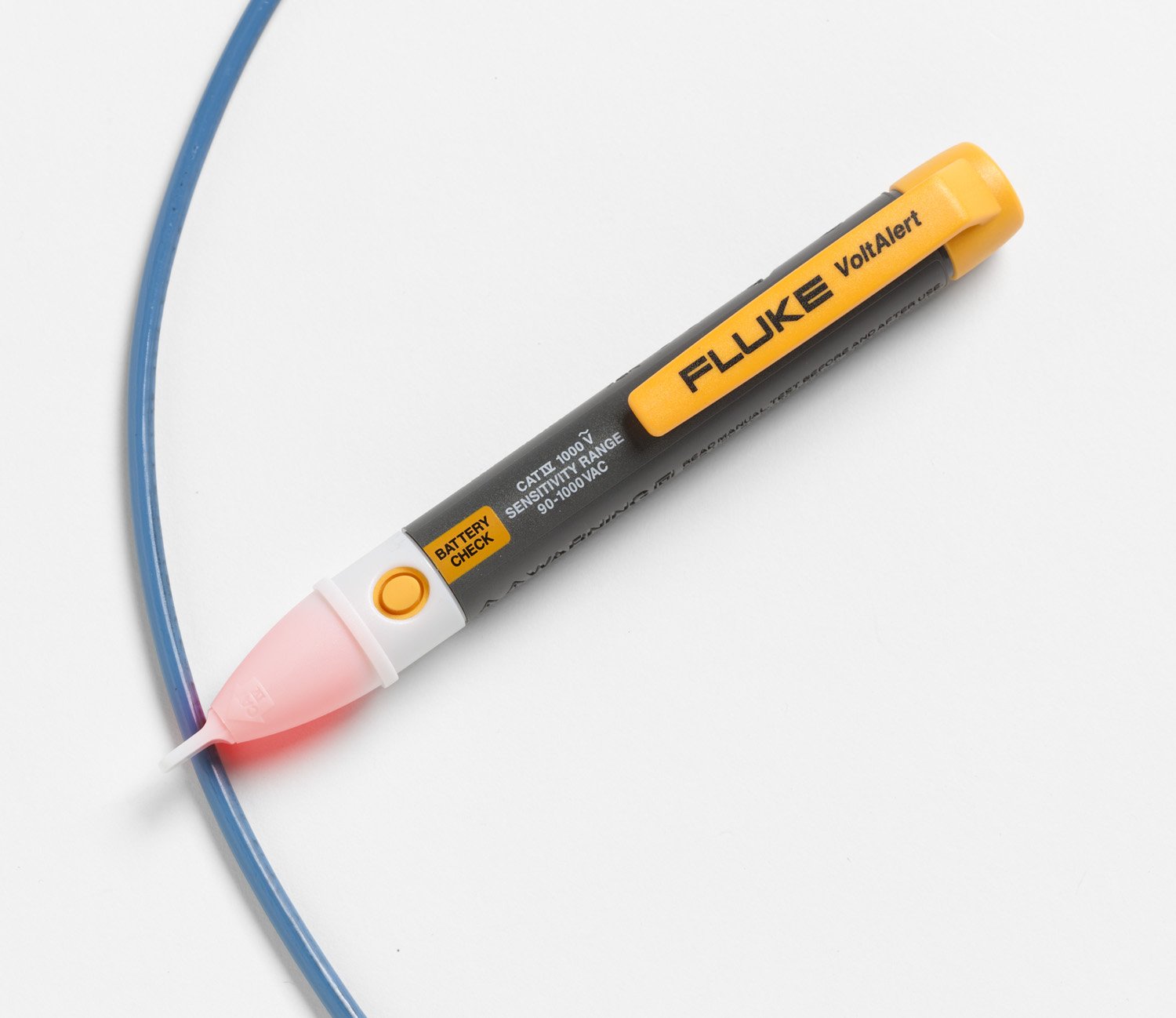
Fluke
$37.49
In stock on Amazon
Check price on AmazonThe Dual-Range Workhorse: Klein Tools NCVT-4IR
The Klein NCVT-4IR addresses the sensitivity tradeoff differently: it gives you both modes in a single tool. Per Klein Tools’ published product specifications for the NCVT-4IR Non-Contact Voltage Tester with IR Thermometer, the low-range mode detects 12–1000 V AC and the high-range mode detects 48–1000 V AC.
In practice, that lets you sweep a wall on low sensitivity to locate a cable run, then switch to high sensitivity to confirm dead before cutting. The field technique of toggling between modes is the single most reliable non-multimeter method for distinguishing ghost voltage from real voltage with one instrument in hand.
The integrated IR thermometer is a genuine functional addition for motor and panel work — identifying a hot breaker or an overloaded neutral before you open a connection is the kind of contextual information that prevents surprises. Aggregated owner feedback consistently describes the NCVT-4IR as the first NCV tester users fully trusted after going through frustrating runs of cheaper single-range pens.
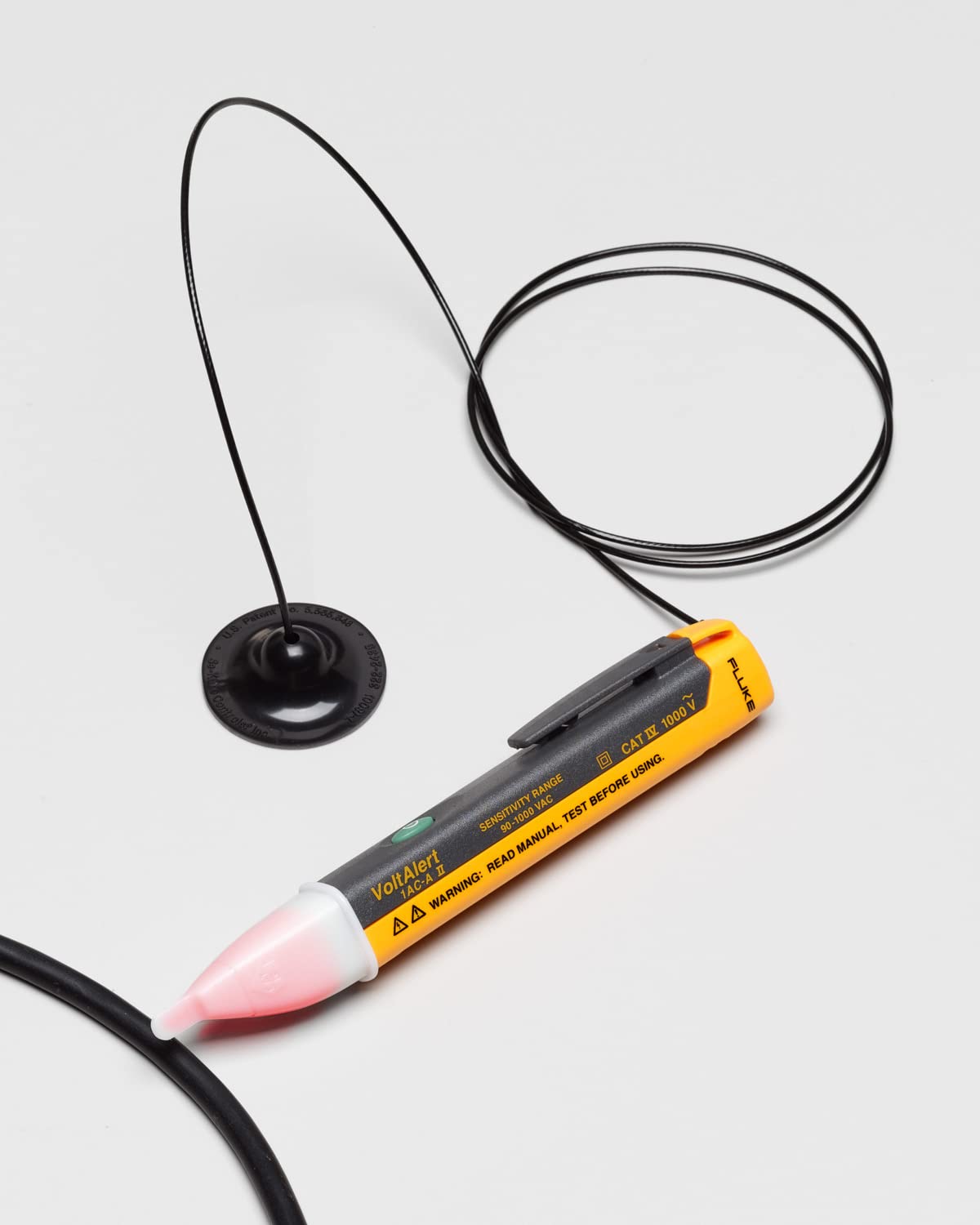
Fluke
$34.98
In stock on Amazon
Check price on AmazonThe Signal-Strength Display: KAIWEETS HT100
The KAIWEETS HT100 takes a third approach: an LCD that displays a signal-strength percentage rather than a simple on/off flash. Where a basic pen gives you a binary alert, a percentage readout lets you distinguish a 90% strong reading (almost certainly real voltage) from a 15% reading (almost certainly capacitive coupling from a nearby live run).
That interpretive layer is exactly what a practitioner building field intuition needs during the learning curve. Rather than choosing between “trust it” and “ignore it,” you develop a calibrated sense of what signal strength corresponds to what real-world condition. Users who find binary testers frustrating in environments with dense parallel wiring runs report that the percentage display resolves most of their ghost voltage confusion without requiring a second instrument for every check.
The tradeoff is that interpreting a percentage still requires experience — a new user seeing “22%” still needs to understand why that number does not mean danger. Pairing the HT100 with the NFPA 70E 2024 guidance to always verify with a multimeter before touching ensures the display aids interpretation rather than replacing verification discipline.

Klein
$16.94
In stock on Amazon
Check price on AmazonAudible vs. Silent Alerts: An Underrated Purchase Decision
Audible alert preference is a real differentiator for different work contexts, and it deserves deliberate consideration rather than defaulting to whatever the shelf stock offers.
When audible is better: Most rough-in and service work. Your hands are occupied, your eyes are on the connection, and an audible chirp lets you process the alert without looking at the tester. In noisy environments — loud HVAC rooms, active construction — a louder alert is safer than an indicator light you might miss in peripheral vision.
When silent or low-alert is better: Residential service calls with clients present, where a continuous beeping tester can create anxiety before you have had a chance to explain what you are doing. Sensitive environments such as hospitals or data centers where noise matters operationally. And workspaces with animals or people sensitive to repetitive high-frequency tones.
Per Fluke Corporation’s published specifications and use guidance for the 2AC VoltAlert, the vibration-only alert model meets the same voltage detection specifications as audible variants. The safety performance is not diminished — the workflow requirement changes. Used alone, without an audible backup, you need to maintain consistent visual contact with the tip indicator, which changes how you hold and move the tool. Used in a two-tester workflow alongside an audible model, it is a deliberate and sensible pairing.
CAT Ratings: What They Mean and When They Matter
CAT ratings under IEC 61010-1 define how much transient energy a meter or tester can safely withstand from a fault event — not just the steady-state voltage it can measure. As Electrical Construction and Maintenance (EC&M) explains in its published overview of instrument safety ratings, CAT III covers distribution panels, branch circuits, and permanently installed equipment. CAT IV covers the service entrance, utility connections, and outdoor runs before the first overcurrent protection device.
For a homeowner doing one outlet swap per year, CAT II or CAT III is technically sufficient. The fault energy available at a standard receptacle circuit is limited enough that a lower-rated instrument does not meaningfully increase risk in that context.
For an electrician working service entrances, utility handoffs, or anything upstream of the main breaker, CAT IV is the difference between an instrument that can absorb a transient spike and one that can fail catastrophically and direct that energy back through the user. The Fluke 1AC-II’s CAT IV / 1000 V rating — confirmed in Fluke Corporation’s published product documentation — is why experienced journeymen reach for it over cheaper pens at the service panel.
The honest answer to “does CAT rating matter for a homeowner?” is: at typical outlet and fixture work, probably not. But given that CAT IV testers at the NCV price point cost only marginally more, there is no reason to accept a lower rating if the product otherwise meets your needs.
Why Cheap NCV Testers Feel Unreliable Even When They Technically Work
The specification printed on a low-cost NCV pen from an unverified marketplace seller often reads identically to a tested Klein or Fluke. So why do electricians who have gone through a supply of cheap pens describe them as unreliable even when they are “technically detecting voltage”?
Inconsistent trigger thresholds. Manufacturers of specification-grade testers calibrate sensitivity within tight tolerances. Instruments without verified third-party certification may trigger at widely different voltages unit-to-unit — or drift over time. You cannot build field intuition around a tool that gives you different results in the same conditions on different days.
Poor mechanical durability. The Klein NCVT-4IR is frequently described by long-term users as surviving serious physical abuse — the language of a tool that has earned trust through physical resilience. Housings that crack, tips that fail, and battery contacts that oxidize turn a tester into a tool you hesitate to trust electrically.
Unverified CAT ratings. Electrical Construction and Maintenance (EC&M) and Electronic Design have both noted in published coverage that instruments sold without verifiable third-party certification — from organizations such as UL, CSA, or TÜV — may carry printed CAT ratings that were never independently tested. A rating printed on packaging is not the same thing as a rating that has been tested and certified. Fluke Corporation’s own published guidance warns against purchasing instruments from unverified third-party marketplace sellers. Stick to authorized distributors, established retailers, or direct manufacturer channels.
Frequently Asked Questions
What causes a non-contact voltage tester to beep when no wire is present? Capacitive coupling. A live conductor running nearby induces a small voltage onto adjacent surfaces — walls, de-energized cables, even metal conduit. Your tester is detecting that induced field. It is not malfunctioning; the signal it is reporting is real, just not directly hazardous. Verify with a multimeter and load test to confirm.
Is the silent Fluke 2AC safe to use alone? Yes — per Fluke Corporation’s published specifications, the 2AC meets the same detection ratings as audible models. The tradeoff is that you must maintain visual contact with the tip indicator rather than relying on sound. In high-distraction environments, pairing it with an audible tester or using it deliberately and methodically is sound practice.
What does dual-range sensitivity mean in practice? It means you have two trigger thresholds: a low-voltage mode that picks up fields as weak as 12 V AC, useful for finding hidden conductors, and a high-voltage mode that only triggers above roughly 48 V AC, useful for confirming dead before cutting. Switching modes is the field technique for distinguishing ghost voltage from real voltage with a single tool.
Does CAT IV vs. CAT III matter for a homeowner? For a homeowner working only at outlets and light fixtures, CAT III is technically sufficient. CAT IV matters when work approaches the service entrance or utility connections. Given that CAT IV testers at the NCV price point cost only marginally more, there is minimal reason to accept a lower rating.
Can an NCV tester detect voltage through conduit? Through thin-wall PVC or drywall, yes — especially in high-sensitivity mode. Through metallic conduit such as EMT or rigid steel, the metal shielding significantly attenuates the field, and most NCV testers will not reliably detect voltage through it. Physical access to the conductor or an open conduit end is required for reliable detection in metallic conduit installations.
The Decision Rule
If you are working residential service calls and want one tool that handles both finding live conductors and confirming dead wires before cutting: a dual-range tester like the Klein NCVT-4IR gives you the most interpretive flexibility, and the integrated IR thermometer earns its place on motor and panel inspections.
If you are primarily doing service entrance and utility-side work and want the simplest, most field-proven CAT IV instrument: the Fluke 1AC-II is what long-term users consistently point to as the tool that eliminated second-guessing on high-energy work.
If your work environment makes audible alerts impractical: the Fluke 2AC is purpose-built for that constraint without sacrificing detection reliability per Fluke Corporation’s published specifications.
If you want a signal-strength readout that helps you build intuition about ghost voltage versus real voltage during your learning curve: the KAIWEETS HT100’s percentage display gives you interpretive detail that binary pens simply do not offer.
The one rule that holds regardless of which tool you choose: never rely on a single NCV reading as final confirmation of a de-energized circuit. NFPA 70E: Standard for Electrical Safety in the Workplace, 2024 Edition, Article 130 is explicit that voltage detection is a screening step — verification with a properly rated, properly probed multimeter is the confirmation. Use your NCV tester to find the hazard. Use your multimeter to prove it is gone.