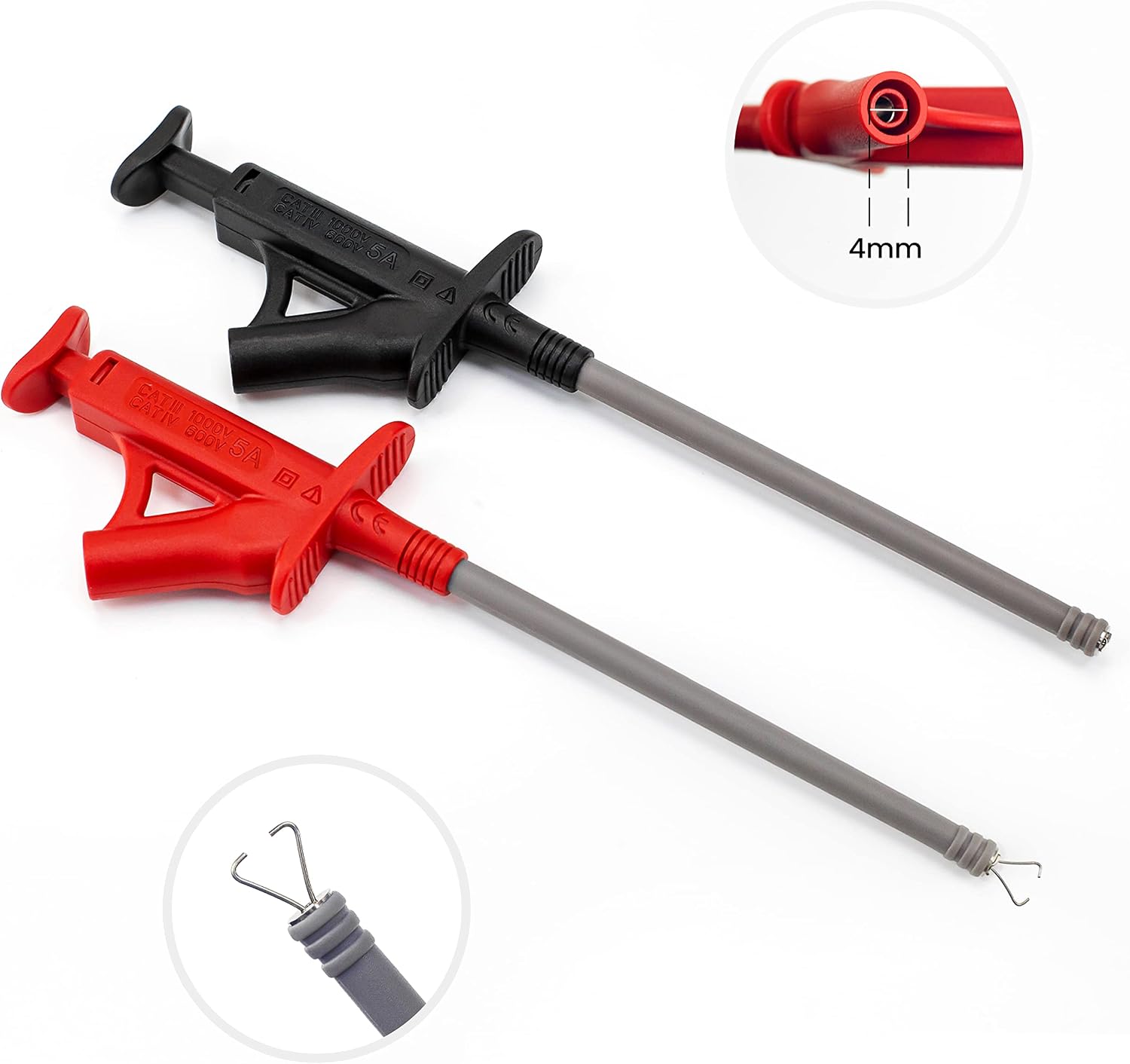
Your multimeter — the handheld device electricians use to measure voltage, current, and resistance in electrical circuits — is only as reliable as the two probes you stick into the circuit. Those probes are called test leads: they’re the wires with the pointy metal tips that carry the electrical signal from whatever you’re measuring back to the meter’s display. Every meter ships with a set, usually tucked in the box beside the manual. Here’s the uncomfortable truth: those included leads are almost always the cheapest part of the whole package. Manufacturers price the meter to win the sale and economize everywhere else. The leads are first in line for cost-cutting. For a student doing homework on a 9-volt battery, that’s fine. For a journeyman pulling troubleshooting duty on a 480-volt three-phase panel, it’s a genuine safety problem — and a daily frustration even on low-stakes residential work. This guide explains what separates a good set of leads from a bad one, which specs actually matter, and how to match your lead upgrade to the work you’re actually doing.
| EDITOR'S PICKES Electronic Specialties 149 U… | Mid-tierElectronic Specialties 146 Silv… | Budget pickKAIWEETS 23PCS Multimeter Test… | |
|---|---|---|---|
| Piece count | 54 | 54 | 23 |
| Probes | — | — | ✓ |
| Alligator clips | — | — | ✓ |
| Test hooks | — | — | ✓ |
| Price | $146.87 | $136.30 | $42.99 |
| See on Amazon → | See on Amazon → | See on Amazon → |
Why the Included Leads Are a Real Problem, Not Just a Minor Annoyance
The leads bundled with most meters — even respectable mid-range units — typically meet the minimum threshold to ship legally. That threshold is IEC 61010-031, the international standard governing hand-held probe assemblies for electrical measurement. IEC 61010-031:2015 (with the 2022 amendment) defines requirements for insulation thickness, contact current limits, probe tip shrouding, and the all-important CAT rating system.
CAT ratings — short for Category ratings — describe how much transient energy a lead (and meter) can survive without flashing over or failing dangerously. The categories run from CAT I (low-energy electronics) to CAT IV (utility service entrance, outdoor conductors). Here’s the practical breakdown:
| CAT Rating | Typical Environment | Example |
|---|---|---|
| CAT II | Single-phase receptacle loads | Household outlets, plug-in appliances |
| CAT III | Distribution-level wiring | Panel boards, branch circuits, 3-phase at the load |
| CAT IV | Origin of installation | Utility meters, service entrance, outdoor feeders |
The included leads on a Fluke 117 or Klein MM300 are frequently rated CAT III 600V or, in cheaper bundles, just CAT II 1000V. Those ratings aren’t equivalent. CAT III 600V is safer for panel work than CAT II 1000V — the voltage number tells you maximum continuous voltage; the CAT number tells you how much instantaneous spike energy the lead can handle without arc-flash failure. On a 480V industrial circuit, you want CAT III or CAT IV rated leads, period.
Beyond the safety ratings, the physical quality of included leads tends to fail fast. The insulation cracks at the strain relief point within a few months of daily use. The banana plug — the cylindrical metal connector that plugs into the meter’s input jacks — loses its spring tension and introduces intermittent resistance that throws off your readings. The wire itself is often thin-gauge stranded copper with minimal flex ratings, which means it work-hardens and fractures inside the insulation where you can’t see it. EC&M’s coverage of test equipment selection consistently highlights lead integrity as an underappreciated source of measurement error in the field.
What to Look for When You’re Shopping Replacements
CAT Rating Matched to Your Work
This is non-negotiable and the place to start. Your leads should be rated at least as high as the highest-CAT environment you work in — and ideally one step higher, since ratings assume ideal conditions. If you’re doing residential work exclusively (panels, outlets, fixtures), CAT III 600V is your floor. If you touch any commercial distribution equipment, transformer secondaries, or anything upstream of the main breaker, CAT III 1000V or CAT IV 600V becomes the right call. NFPA 70E:2024 emphasizes that personal protective equipment — and that includes your test leads — must be rated for the incident energy and voltage of the circuit being tested. Leads are PPE in that context.
Fluke’s published accessory documentation lists their TL175 TwistGuard leads at CAT III 1000V / CAT IV 600V — a meaningful upgrade over the TL75 leads that ship with many of their meters. The TwistGuard design lets you slide a plastic shroud over the probe tip to reduce the exposed metal surface when you’re working in tight panels, which directly lowers arc-flash risk.
Wire Gauge, Flexibility, and Length
Standard included leads are typically 19AWG or thereabouts, which limits current-carrying capacity and increases resistance over the lead length — relevant if you’re doing milliohm-level resistance measurements or just want accurate readings close to the meter’s stated accuracy. Aftermarket leads spec’d at 16AWG or 18AWG with fine-stranded silicone insulation stay flexible in cold weather, resist cracking at bend points, and last years instead of months. Silicone jacketing handles heat better than PVC — useful when you’re working near motors or switchgear that radiate significant warmth.
Length matters operationally. The standard 4-foot lead set is adequate for most bench or panel work. For working inside deep switchgear or reaching across large equipment, a 6-foot set pays for itself in reduced awkward posture. Some sets offer interchangeable lead lengths.
Probe Tip Design
A basic sharp-point probe is fine for most work. But if you’re regularly doing PCB-level diagnostics, meter out-of-reach test points in tight enclosures, or need to clip a lead onto a wire and free both hands, you want modular leads with interchangeable tips. The probe-to-alligator-clip conversion is one of the most useful accessories in an electrician’s bag — it lets you monitor a voltage or current reading continuously while you manipulate a circuit with both hands. Quality modular systems use a threaded or push-lock collar rather than friction alone, which prevents the tip from separating inside an energized panel.
By the Numbers: Lead Upgrade Cost vs. Replacement Frequency
| Lead Tier | Typical Price | Avg. Useful Life (Daily Use) | CAT Rating Available |
|---|---|---|---|
| Included (OEM) | $0 (bundled) | 6–18 months | CAT II–III, 600–1000V |
| Budget aftermarket | $10–$25 | 12–24 months | CAT III 600V typical |
| Mid-grade (e.g., Fluke TL175) | $30–$55 | 3–5 years | CAT III 1000V / CAT IV 600V |
| Premium modular sets | $60–$120 | 5+ years | CAT IV 1000V |
The cost-per-year math favors the mid-grade tier quickly. A $45 set lasting four years runs about $11/year. The included set replaced annually (or more often once the insulation starts cracking) costs nothing upfront but introduces measurement uncertainty and safety risk that has no dollar figure you want to discover the hard way.
Matching the Lead to the Meter and the Job
Residential Electrician (Service, Panels, Outlets)
If your daily work is residential service upgrades, panel troubleshooting, and outlet circuits — the kind of work where a Fluke 117 or similar CAT III 600V meter is your primary tool — a mid-grade CAT III 1000V set is the logical upgrade. The Fluke TL175 or comparable offerings from Pomona and Ideal Industries are well-documented in reviews aggregated at testequipmentdepot.com as solid performers in this tier. You get shrouded tips for panel safety, real silicone insulation, and banana plugs with appropriate spring tension for the meter’s input jacks.
Don’t overspec here if budget is tight. A CAT IV 1000V modular set is genuine overkill for a journeyman doing residential service calls. Spend the difference on a quality clamp meter accessory instead.
Industrial / Commercial Electrician (480V, 3-Phase, Switchgear)
This is where lead quality becomes a safety line item, not a preference. If you’re routinely inside motor control centers, transformer secondaries, or service entrance equipment, CAT IV 600V or CAT III 1000V rated leads with fully shrouded tips and finger guards are the standard. Published specs from Fluke’s accessory lineup and similar offerings from Pomona Electronics place these sets in the $50–$90 range. For a Fluke 87V or Hioki DT4282 owner — meters in the $400–$500 range — spending $60–$80 on leads that match the meter’s actual CAT IV rating is just completing the instrument. Owners in long-run reviews note that the OEM leads bundled even with premium meters often don’t fully match the meter body’s rated CAT IV capability.
Solar and EV Technicians
This audience has a specific wrinkle: PV array work involves DC voltages that can reach 600–1000VDC on string circuits, with limited overcurrent protection upstream. Standard AC-focused CAT ratings don’t fully address DC arc characteristics, but CAT III 1000V leads with robust insulation are the accepted practice standard for this environment. Modular leads with alligator clips are especially useful for monitoring DC bus voltages while making adjustments. If you’re doing EV charging infrastructure (Level 2 and DCFC installations), you’re back in standard AC distribution territory for the supply-side work — CAT III 1000V is appropriate.
The Accessories That Belong in the Same Kit
Test leads are the foundation, but a few accessories turn a basic measurement setup into a capable troubleshooting kit:
Alligator clips — Slip-on or screw-lock adapters that mate with standard probe tips. Essential for hands-free monitoring. Buy clips rated to match your lead set’s CAT rating; cheap clips at a lower rating become the system’s weak point.
Back-probe adapters — Small piercing or back-access tips designed to slip alongside a wire already seated in a connector, letting you measure voltage without disconnecting anything. Particularly useful for automotive and low-voltage control wiring work.
Magnetic hanging strap — Some probe sets include these; they hold the meter at eye level on a metal surface so you can read the display while your hands are in the panel. Minor quality-of-life upgrade, major reduction in neck strain over an eight-hour troubleshooting shift.
Replacement banana plugs — If the leads on an otherwise-good set are wearing out at the plugs while the wire is still fine, replacement plugs are available and solderable. This matters for low-volume users who want to extend a quality set’s life.
The Decision Framework
Here’s the if/then logic to take into your next purchasing decision:
If you’re a residential journeyman or advanced DIYer: Upgrade to a CAT III 1000V silicone-jacketed set in the $35–$55 range. Add a set of alligator clip adapters. Skip the modular system — you don’t need the complexity.
If you work commercial or industrial (480V+, 3-phase, switchgear): Invest in fully shrouded CAT IV 600V or CAT III 1000V leads from a named manufacturer — Fluke, Pomona, or Ideal Industries. Match the lead’s CAT rating to your meter’s CAT rating. If your meter is CAT IV rated and your leads are CAT III, the leads set the ceiling, not the meter.
If you do solar or EV work: CAT III 1000V with modular tips and quality alligator clips. Prioritize leads with robust strain relief at both ends — field work means more mechanical abuse than panel work.
If you’re still on apprentice wages building your first kit: A $20–$25 aftermarket CAT III 600V set is a better starting point than reusing the included leads once they start cracking. It’s not the last set you’ll buy, but it gets you off the OEM leads without a major outlay.
The leads are the physical interface between your meter and every circuit you’ve ever trusted your safety and your readings to. The meter gets the headline; the leads do the actual work. Spend accordingly.