A megohmmeter — often called a “megger,” after the brand that popularized the tool — is a specialized tester that pushes a known high voltage (typically 250 V to 1,000 V) through the insulation surrounding a wire or winding and measures how much current leaks through. If insulation is healthy, almost none leaks through, and your reading is in the millions of ohms (megohms, or MΩ). If insulation is cracked, moisture-soaked, or just old, current bleeds across it, your reading drops, and you now know — before you energize the circuit — that something needs to be fixed. Regular multimeters max out well below the test voltages these jobs require, which is why a dedicated megohmmeter is a separate tool entirely. This article is a direct comparison of two instruments that appear on a lot of shortlists right now: the Klein ET600 and the Fluke 1507. We will look at where each one excels, where it falls short, and — most importantly — which one makes sense for your specific work.
Why Test Voltage Selection Matters More Than the Meter Brand
Both the Klein ET600 and the Fluke 1507 share the same four-step voltage ladder: 125 V, 250 V, 500 V, and 1,000 V. That overlap is deliberate — it means the comparison is not about which voltages you can use, but about which tool helps you choose correctly and interpret results reliably.
Here is a practical voltage selection guide for the three application areas this article covers:
| Application | Recommended Test Voltage | Reason |
|---|---|---|
| Low-voltage motor windings (< 1 kV rated) | 500 V | Matches equipment voltage class per IEEE Standard 43-2013 |
| Medium-voltage motor windings (1–5 kV rated) | 1,000 V | Higher test stress reveals marginal insulation |
| Residential/commercial branch circuit cable | 250–500 V | Avoids over-stressing modern THHN insulation |
| Solar PV string and array wiring | 500–1,000 V | Matches actual system operating voltage |
| Inverter-driven compressor (HVAC, variable speed) | 500 V | Sensitive electronics upstream must be disconnected first |
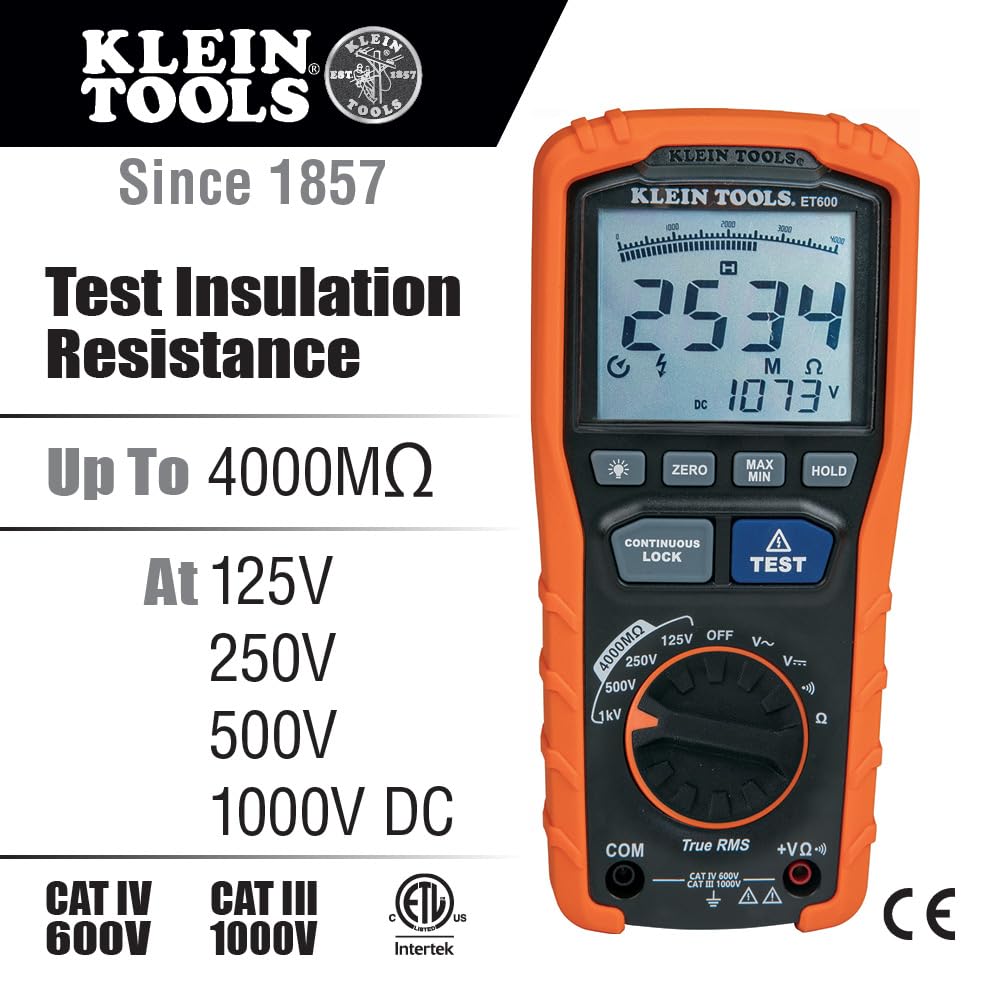
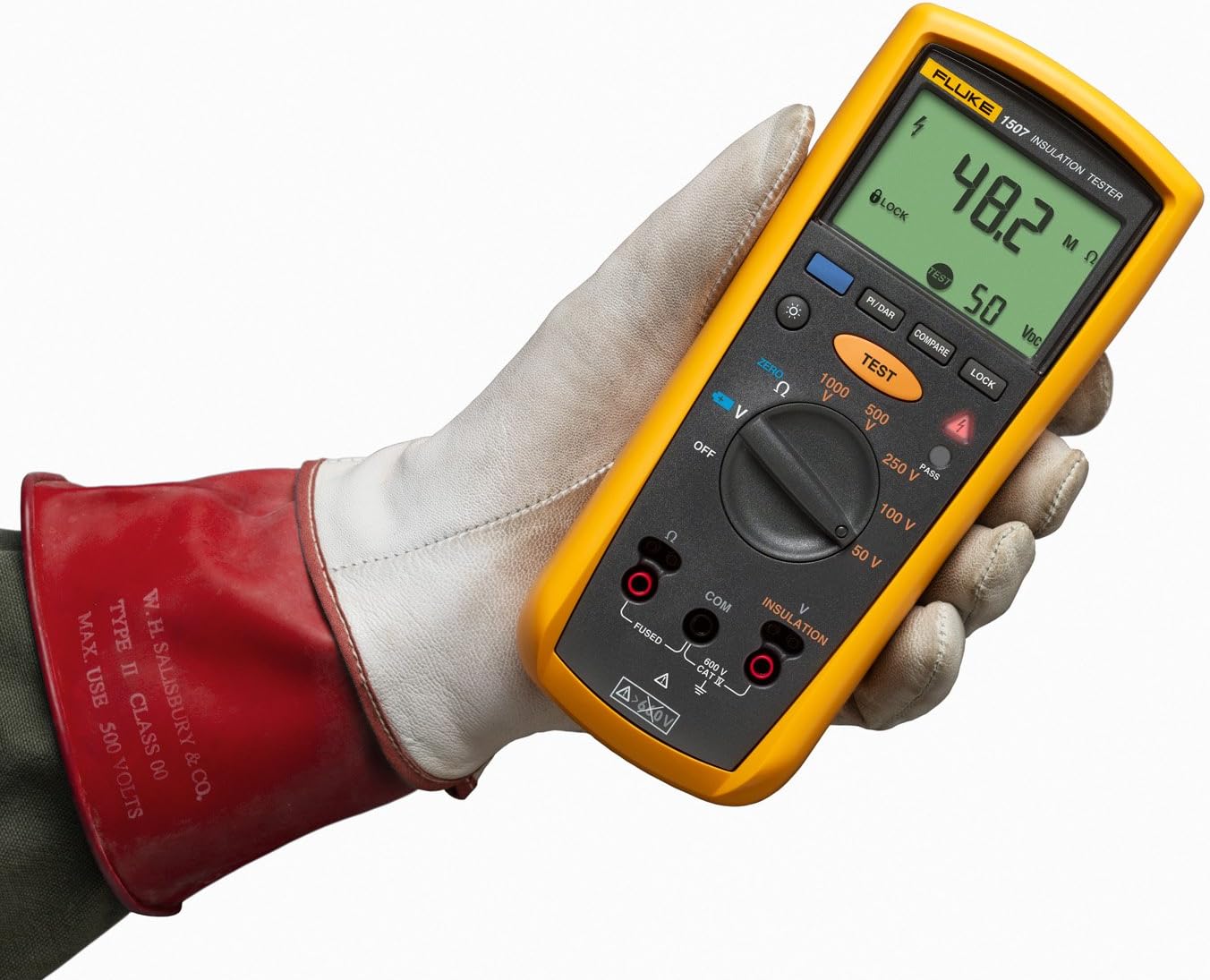
The reason this matters for your buying decision: the Klein ET600 uses a straightforward rotary-dial interface with no guard terminal. The Fluke 1507 adds a guard terminal — a three-terminal measurement setup that routes surface leakage current away from the measurement circuit, improving accuracy on contaminated or wet surfaces — and a more granular display that shows live resistance as it climbs during the test. That live-climb view is particularly useful when you are doing a time-resistance or polarization index test rather than just a spot reading. If your work is primarily spot readings on residential branch circuits and occasional motor checks, you may never need the guard terminal. If you are doing PI testing on large motor windings or commissioning solar arrays in humid climates, the guard terminal earns its keep.
Head-to-Head: Klein ET600, Fluke 1507, and Application Fit
The Klein ET600: Fleet-Buy Logic and Where It Delivers
Klein
$191.87
In stock on Amazon
Check price on AmazonThe ET600 has developed a notable reputation in HVAC fleet purchasing. Multiple facility and HVAC service managers have purchased these in quantities of five to ten units for inverter compressor testing programs. That is a fleet-purchase signal, not a one-off hobbyist buy, and it tells you something meaningful about how the tool performs in real dispatch environments.
According to Klein Tools ET600 product documentation, the meter carries a CAT III 600 V safety rating for the measurement circuit and is specified for insulation resistance testing up to 1,000 MΩ at 1,000 V test voltage.
What users consistently highlight about the ET600:
- Durability under daily use. The tool handles the drops and temperature swings of a service van without reported issues in aggregated field feedback.
- Uncomplicated operation. The rotary dial and minimal button layout mean a tech who has been briefly trained can run a 500 V spot test on a compressor winding without fumbling through menus.
- Price-to-capability ratio. For HVAC compressor winding checks and residential cable acceptance testing, the ET600 delivers a fully specified instrument at a price point that makes fleet purchasing feasible.
Where the ET600 hits its ceiling:
- No guard terminal. On a clean, dry motor lead or cable end, this does not matter. On a wet, contaminated, or outdoor surface where surface leakage is significant, you may read a falsely low resistance because the meter cannot separate bulk insulation leakage from surface leakage.
- No built-in PI test timer. A polarization index test requires you to divide the 10-minute reading by the 1-minute reading. The ET600 will give you both numbers if you track time manually, but there is no automated calculation.
- Display resolution at high resistance. The display can be less stable at readings above 2,000 MΩ — which matters more for cable work than for motors, where most decision thresholds fall below 1,000 MΩ anyway.
The straight read: For HVAC service companies dispatching techs to do compressor winding checks, or for electrical contractors who need a fleet of megohmmeters for cable acceptance testing on residential and light commercial work, the ET600 makes serious economic sense. It is a legitimate, properly specified tool with the safety ratings the job requires.
Klein
$191.87
In stock on Amazon
Check price on AmazonThe Fluke 1507: When the Premium Is a Labor-Cost Calculation
Fluke
$667.10
In stock on Amazon
Check price on AmazonThe Fluke 1507 costs roughly twice what the ET600 costs. Whether that premium is justified depends on your specific work. According to Fluke Corporation’s published specifications for the Fluke 1507 Insulation Resistance Tester, the instrument supports test voltages of 50 V, 100 V, 250 V, 500 V, and 1,000 V — a wider voltage ladder than the ET600 — along with built-in polarization index (PI) and dielectric absorption ratio (DAR) test modes with automatic timing and calculation.
Consider the labor math directly. If an industrial maintenance technician earns $45 per hour fully burdened and a proper PI test with manual timing and calculation adds 8 minutes per motor compared to a meter that automates it, that is $6 of labor per motor. On a 12-motor predictive maintenance round, that is $72 per inspection cycle. The Fluke 1507’s price premium over the ET600 can be recovered in under three inspection cycles if PI testing is a regular part of the workflow. That is not a luxury argument — it is a breakeven calculation.
What the Fluke 1507 adds over the ET600:
- Guard terminal. Critical for accurate readings on wet, contaminated, or long cable runs where surface leakage is a real variable.
- Built-in PI and DAR test modes. Per Fluke Corporation’s Fluke 1507 user documentation, the meter tracks 1-minute and 10-minute readings and displays the PI ratio automatically. The DAR mode computes the 60-second to 30-second ratio for a faster screening test.
- Live resistance display during test. You can watch the resistance climb in real time, which helps experienced operators identify a capacitive charge-up curve (normal, healthy insulation behavior) versus a flat or declining curve (a sign of trouble).
- Wider voltage ladder. The 50 V and 100 V settings are useful for testing sensitive solid-state equipment or low-voltage instrumentation wiring where 250 V would be excessive.
The Fluke 1507 review pool skews toward industrial maintenance, motor shop, and electrical inspection use cases. The note that this tool rewards operators who understand what they are doing is worth taking seriously: any instrument pushing 1,000 V into a circuit requires the operator to understand safe test conditions, isolation verification, and discharge procedures before touching conductors. That applies to every megohmmeter, not just the Fluke.
The straight read: For licensed electrical inspections, utility commissioning, motor shop use, solar string testing in humid or coastal environments, or any application where PI testing is routine — the Fluke 1507 is the correct tool, and the labor-cost math closes the price gap faster than it might initially appear.
Fluke
$667.10
In stock on Amazon
Check price on AmazonHigher-Tier Instruments: When to Look Beyond Both
Fluke
$667.10
In stock on Amazon
Check price on AmazonFor utility-grade medium-voltage commissioning, acceptance testing requiring full calibration traceability documentation, or automated multi-step dielectric testing programs, both the ET600 and the Fluke 1507 have ceiling limitations. Instruments in the Fluke 1550C or Megger MIT series tier add features such as automated step-voltage testing, memory storage with timestamp logging, USB data export, and traceable calibration certificates that some Authority Having Jurisdiction requirements and utility commissioning specifications mandate by name. If your work involves written test reports that must accompany a commissioning package — and that package specifies calibrated instrument traceability — verify requirements with the AHJ or specifying engineer before committing to either the ET600 or the 1507. Neither is the wrong tool for the work described in this article; both have limits if the specification goes beyond that scope.
Fluke
$667.10
In stock on Amazon
Check price on AmazonDischarge Procedures and the Safety Requirement Both Tools Share
This section applies to both meters equally. As documented in NFPA 70E-2024, Standard for Electrical Safety in the Workplace (National Fire Protection Association), establishing an electrically safe work condition requires verification that stored energy has been released before conductors are touched. EC&M (Electrical Construction and Maintenance) has covered insulation resistance testing discharge procedures in its best-practices editorial coverage, noting specifically the risk of residual charge on large capacitive loads such as motor windings and long cable runs.
After a megohmmeter test, the capacitance of the cable or winding being tested retains a charge proportional to the test voltage and the capacitive size of the specimen. A large motor winding tested at 1,000 V can hold enough charge to deliver a serious shock. Both the ET600 and the Fluke 1507 include built-in discharge circuits that bleed stored charge after the test — but you must wait for the discharge indicator to clear before disconnecting leads, and you should verify with a separate contact voltage tester before touching conductors. The meter handles the math; the operator handles isolation and discharge verification.
Frequently Asked Questions
Can I test motor insulation resistance with a regular multimeter set to megohms?
No — not meaningfully. A standard multimeter’s resistance function applies only a small internal test voltage, typically 9 V or less. Insulation defects that appear healthy at low voltage can break down under actual operating voltage. A megohmmeter applies voltage that approximates or slightly exceeds real-world stress, which is what makes the reading diagnostic. IEEE Standard 43-2013, Recommended Practice for Testing Insulation Resistance of Electric Machinery (Institute of Electrical and Electronics Engineers), is explicit: insulation resistance measurements for machinery must be made with a dedicated high-voltage test instrument.
What MΩ reading indicates a motor winding is safe to energize?
Per IEEE Standard 43-2013, the minimum acceptable insulation resistance for a motor rated above 1 kV is 100 MΩ (corrected to 40°C). For motors rated below 1 kV, the practical industry threshold is 1 MΩ minimum, with most motor shop technicians wanting to see at least 10 MΩ before returning a motor to service. A reading below 1 MΩ on a low-voltage motor is a red flag; below 0.5 MΩ is effectively a do-not-energize condition in most interpretive frameworks.
What is the difference between a spot reading and a polarization index (PI) test?
A spot reading is a single measurement taken at a fixed time — typically 1 minute — after test voltage is applied. A polarization index test takes readings at 1 minute and 10 minutes and divides the 10-minute value by the 1-minute value. Per IEEE Standard 43-2013, a PI of 2.0 or above generally indicates good insulation; 1.0 to 2.0 is questionable; below 1.0 indicates serious degradation. The PI is more reliable than a spot reading alone because it factors out the normal capacitive absorption effect, giving you a truer picture of insulation quality independent of the absolute resistance value.
How long do I need to wait after a megohmmeter test before touching the conductors?
Wait until the meter’s discharge indicator confirms the specimen is below a safe threshold — typically below 50 V — then verify independently with a contact voltage tester. For large motors or long cable runs tested at 1,000 V, built-in discharge can take 30 seconds to several minutes. EC&M’s insulation resistance testing best-practices coverage specifically calls out the risk of residual charge on large capacitive loads. Never assume discharge is complete simply because a timer started.
Why do HVAC technicians use a megohmmeter to test inverter-driven compressors specifically?
Inverter-driven (variable-speed) compressors are more sensitive to winding insulation degradation than single-speed compressors because the variable frequency drive produces voltage spikes that stress marginally degraded insulation more severely than 60 Hz line voltage does. A winding that passes a multimeter continuity check may show 0.5 MΩ insulation resistance on a megohmmeter, predicting premature failure under drive-induced electrical stress. Fleet purchasing of megohmmeters in HVAC service companies reflects this reality: inverter compressor testing has become a standard diagnostic step, not an exception.
The Decision Rule
If your work is residential and light commercial service, HVAC compressor testing, or fleet dispatch where per-unit tool cost matters — the Klein ET600 is a legitimate, properly rated instrument that delivers real diagnostic value at a price point that makes fleet deployment feasible. You will handle PI timing manually and work around the absence of a guard terminal, but for the jobs it is designed for, it performs as specified.
If you are doing industrial motor predictive maintenance, solar array commissioning in wet environments, electrical inspection work requiring documented calibration traceability, or any application where PI testing is routine — the Fluke 1507’s automated test modes, guard terminal, and wider voltage range make it the correct tool. The labor-cost math closes the price gap faster than it might appear on a spec sheet.
Both tools share the same core voltage structure. The decision comes down to workflow friction, documentation requirements, and how often you are in conditions where the guard terminal and PI automation actually change your diagnostic outcome. Know your job list before you buy the meter.