If you’ve ever stood in the electrical supply house staring at a wall of Klein Tools boxes wondering what the number on the label actually means — you’re not alone. A multimeter is the core diagnostic tool every electrician carries. It measures voltage (the electrical pressure pushing current through a circuit), amperage (the flow of that current), and resistance (how much a circuit or component pushes back). The model number on a Klein meter — MM325, MM400, MM600, MM700, MM720 — doesn’t directly tell you whether it will handle the panel work you’re bidding or the motor troubleshooting you’re doing on Tuesday. This guide breaks down the full Klein lineup from entry-level to professional-grade, maps each model to the work it’s actually designed for, and ends with a clear decision rule so you can stop second-guessing and get back on the job.
How the Klein Lineup Is Actually Organized
Klein doesn’t publish a formal tier chart, but the models sort cleanly into three performance bands once you look at what’s under the hood:
Entry band — MM300 series (MM325): Basic auto-ranging meters targeting apprentices, hobbyists, and light residential work. Auto-ranging means the meter picks the right measurement scale for you automatically — you don’t have to guess which voltage range to dial in.
Mid band — MM400 and MM600: Workhorse meters for journeymen doing residential and light commercial work. The MM600 adds True RMS measurement, which matters more than most users realize (more on that below).
Professional band — MM700 and MM720: Full-featured meters with True RMS, low-impedance LoZ mode, and the safety ratings required for industrial and commercial panel work.
Understanding where each model sits on that spectrum — and which spec actually matters for your license level — is what this article is about.
The Spec That Separates the Real Tool from the Training Wheel: True RMS
Before diving model by model, let’s nail one concept that the Klein lineup splits on cleanly: True RMS vs. average-responding measurement.
Most electrical loads in homes built before 2000 were resistive or lightly inductive — incandescent lights, simple motors, resistive heaters. These loads draw a smooth, predictable sine wave of current, and a cheap average-responding meter reads them accurately enough.
Modern loads are different. Variable-frequency drives (VFDs) on HVAC equipment, LED driver circuits, EV charger power electronics, and switched-mode power supplies all create non-sinusoidal waveforms — distorted, choppy current shapes. An average-responding meter can read those loads 10–40% low or high depending on the distortion level. A True RMS meter (RMS stands for Root Mean Square, the mathematically correct way to calculate the effective value of any waveform) reads them accurately regardless of shape.
Per Fluke Corporation’s published technical primer on True RMS vs. average-responding meters, average-responding meters are specifically calibrated to pure sine waves and should not be relied upon for loads with high harmonic distortion. The NFPA 70E Standard for Electrical Safety in the Workplace, 2024 Edition, underscores accurate voltage and current measurement as a core element of electrical hazard assessment — a measurement that’s off by 20% on a VFD circuit isn’t just imprecise, it can mask a real hazard.
The practical split in the Klein lineup: The MM325 is average-responding. The MM600, MM700, and MM720 are True RMS. If you’re doing any commercial work — motor circuits, lighting control panels, anything with a drive or inverter — True RMS isn’t optional.
Model-by-Model Breakdown
MM325 — The Apprentice’s First Meter (~$30–$40)
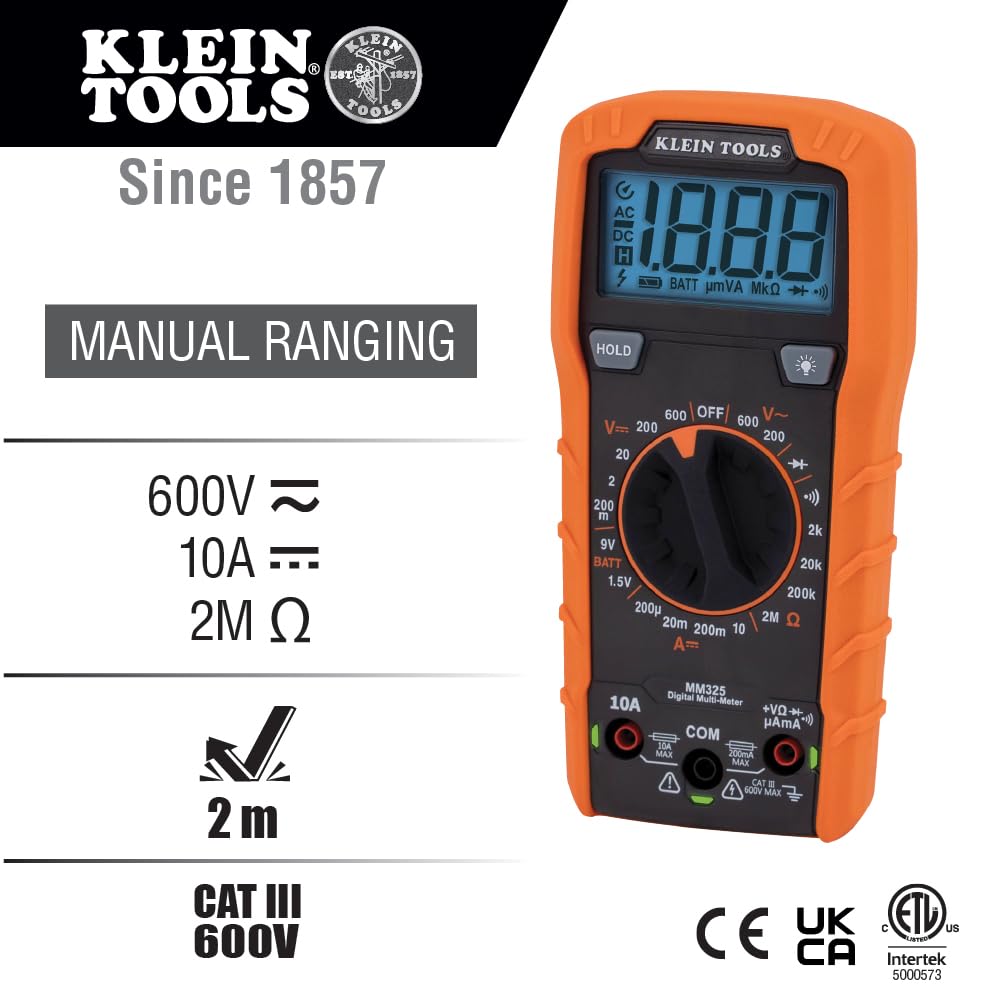
The MM325 is a CAT III 600V auto-ranging meter with a basic feature set: AC/DC voltage, resistance, continuity with audible beep, and diode test. No True RMS. No capacitance. No temperature.
CAT III 600V means it’s rated for distribution-level circuits inside a building — branch circuit panels, outlets, lighting circuits — but not for service entrance work or industrial switchgear at higher voltages. The IEC 61010-1 measurement category system (CAT I through CAT IV) rates meters for the energy let-through at a fault: CAT III handles higher transient energy than CAT II, and CAT IV handles utility service entrance work. Across aggregated reviews on tool forums and supply-house feedback channels, the MM325 is consistently described as a solid starter tool for trade school and apprentice-level residential work — not a meter you’d bring to a commercial job site.
If you’re an apprentice or first-year student: This is a reasonable first purchase. Just understand you’ll likely replace it within 18 months as your work diversifies.
MM400 — The Residential Journeyman’s Value Pick (~$55–$70)
The MM400 steps up with a built-in non-contact voltage tester (NCV) — that’s the tip that glows and beeps when AC voltage is present without requiring a probe contact. It also adds temperature measurement via Type K thermocouple input and capacitance testing, which helps when diagnosing motor run capacitors on HVAC units.
Still no True RMS. CAT III 600V / CAT IV 300V dual rating.
The CAT IV 300V rating is worth noting: it means this meter can be safely used at the utility service entrance side of a residential meter socket (240V single-phase service). That’s a meaningful upgrade over CAT III-only meters for electricians who work residential service upgrades.
Where it falls short: Any commercial circuit with VFDs or switching loads — the average-responding measurement engine limits its diagnostic value there.
MM600 — The Real Crossover Model (~$80–$100)
This is where the Klein lineup gets genuinely interesting. The MM600 adds True RMS, retains the NCV detector, adds a built-in flashlight, and maintains the CAT III 600V / CAT IV 300V dual rating.
For a residential-to-light-commercial journeyman, the MM600 is arguably the best value in the entire Klein lineup. You get accurate readings on LED-heavy circuits, small motor loads, and any panel that’s seen inverter-driven equipment — without paying for industrial-grade features you may not need daily.
Test Equipment Depot’s buyer’s guide to digital multimeters notes that True RMS meters have become the professional standard for residential journeymen precisely because modern LED dimmer circuits and HVAC inverters have made average-responding meters unreliable for troubleshooting.
By the numbers — MM600 vs. MM325 on a VFD-fed motor circuit:
- Average-responding reading (MM325-class): ±10–40% error on non-sinusoidal loads
- True RMS reading (MM600-class): ±(1.5% + 5 digits) per published spec
- Cost delta: approximately $45–$60 at typical supply-house pricing
That math favors the MM600 for anyone doing more than simple residential branch circuits.
MM700 — The Commercial-Ready Step-Up (~$100–$130)
The MM700 builds on the MM600’s True RMS foundation and adds two features that matter specifically in commercial and industrial work:
LoZ (Low Impedance) mode: In standard mode, a multimeter has high internal impedance — meaning it draws almost no current from the circuit being tested. That’s usually correct. But in commercial panels with long wire runs and floating conductors, high-impedance meters can read “phantom voltages” — induced voltages from adjacent energized conductors that make a dead circuit look live. LoZ mode drops the meter’s input impedance dramatically, collapsing phantom voltage readings and giving you a confident dead/live answer. Per Klein Tools’ published spec sheets, the MM700’s LoZ mode is rated to suppress ghost voltages below 30V.
Improved accuracy on resistance and continuity: The MM700 tightens resistance accuracy to ±(0.9% + 2 digits) from the MM600’s ±(1.5% + 3 digits) — meaningful when you’re doing precise motor winding checks or troubleshooting long conduit runs.
CAT III 1000V / CAT IV 600V rating — a notable jump that opens up medium-voltage distribution work for facilities maintenance technicians.
MM720 — The Professional-Grade Daily Driver (~$130–$160)
The MM720 is Klein’s current flagship handheld multimeter, and it’s designed for electricians who work across commercial, industrial, and large-facility environments daily.
Key additions over the MM700:
- TRMS AC+DC: Measures the combined AC and DC component of a waveform simultaneously. This matters in industrial environments where DC offset can appear in nominally AC circuits.
- MIN/MAX/AVG recording: Captures voltage sags, swells, and transients over time without you standing there holding the probes — critical for diagnosing intermittent faults on motor circuits.
- Backlit display with large digit count: Operators in long-run reviews consistently flag the MM720’s readability in low-light industrial environments as a genuine differentiator over the MM600 and MM700.
- CAT III 1000V / CAT IV 600V dual rating.
Across aggregated reviews from electricians in HVAC and industrial maintenance contexts, the pattern is consistent: the MM720 is the Klein meter that professionals reach for when they’re commissioning VFD panels, troubleshooting UPS systems, or doing preventive maintenance on large motor loads. It’s not competing with a Fluke 87V at $400 on raw specification depth, but it’s also not asking you to pay Fluke prices for work that Klein handles capably.
CAT Ratings: The Non-Negotiable Safety Filter
Every model comparison has to route through this checkpoint. The NFPA 70E 2024 Edition and IEC 61010-1 both make clear that using an under-rated meter in a high-energy environment isn’t just a calibration issue — it’s a personal safety issue. A transient voltage spike at a service entrance can arc-flash through a meter rated below the incident energy at that point.
| Model | CAT Rating | Appropriate Environment |
|---|---|---|
| MM325 | CAT III 600V | Residential branch circuits, apprentice training |
| MM400 | CAT III 600V / CAT IV 300V | Residential including service entrance |
| MM600 | CAT III 600V / CAT IV 300V | Residential + light commercial, True RMS loads |
| MM700 | CAT III 1000V / CAT IV 600V | Commercial panels, facilities maintenance |
| MM720 | CAT III 1000V / CAT IV 600V | Industrial, VFD-heavy, UPS, large motor circuits |
Don’t bring a CAT III 600V meter to a commercial switchgear room. The rating exists because the fault energy is different — not because manufacturers are being conservative.
The Decision Rule: If X, Then Y
Here’s where all the tradeoff framing cashes out:
If you’re an apprentice or in your first year of residential work → MM325 gets you calibrated on real circuits without a painful first purchase. Budget the upgrade before your second year.
If you’re a journeyman doing residential service upgrades, load calculations, and light HVAC work → MM600 is the minimum. True RMS at this price point is the decision. Skip the MM400 unless budget is truly the constraint.
If you’re a journeyman or early master doing commercial work — panels, motor circuits, tenant buildouts → MM700. The LoZ mode alone pays for the price delta over the MM600 the first time you call a circuit dead and it’s not.
If you’re a facilities maintenance tech, industrial maintenance electrician, or commercial contractor doing VFD commissioning and preventive maintenance as regular work → MM720. The MIN/MAX recording and TRMS AC+DC mode are the difference between a diagnostic tool and a guessing tool on intermittent faults.
If you’re already running a Fluke 87V or Hioki DT4282 as your primary meter → None of the Klein handheld meters replace those instruments on specification depth. Klein fits better as a second meter, a truck spare, or a tool you hand to a helper without anxiety about the replacement cost.
The Klein lineup is genuinely well-engineered at its price points. The mistake most electricians make isn’t buying the wrong brand — it’s buying too far down the spec ladder for the work they’re actually doing today, then finding out on a job that their meter can’t give them a trustworthy answer.