Romex and Residential Wiring Tools: The Klein Strippers and Cutters Built for House Wire
Walk into any residential rough-in job and you’ll see the same two materials everywhere: Romex (the trade name for NM-B cable — nonmetallic-sheathed cable with a plastic outer jacket surrounding two or three insulated conductors plus a bare ground wire) and 12 or 14 AWG solid copper wire (AWG stands for American Wire Gauge; lower numbers mean thicker wire). Strip the jacket wrong and you nick a conductor. Nick a conductor and you’ve got a potential hot spot that could fail inspection or, worse, start a fire years after the drywall goes up. Good stripping tools aren’t glamorous, but they’re the difference between a clean, fast rough-in day and one that comes back to bite you.
This article compares three Klein Tools designed specifically for this environment — the K1412 Romex cable stripper, the 11048 wire stripper, and the K11095 Klein-Kurve multi-tool — drawing on published specs and the aggregated experience of working electricians who’ve used them on real job sites. By the end, you’ll know exactly which one belongs in your apron pocket, and whether it’s worth buying more than one.
| EDITOR'S PICKFluke 87V Industrial Digital Mu… | Mid-tierFieldpiece Compact HVACR Clamp… | Budget pickKlein Tools 11048 Dual Wire Str… | |
|---|---|---|---|
| Voltage rating | 1000 V AC/DC | — | — |
| Current measure | — | ✓ | ✗ |
| True RMS | — | ✓ | — |
| Temp measure | ✓ | ✓ | ✗ |
| Test leads | ✓ | — | ✗ |
| Alligator clips | ✓ | — | ✗ |
| Price | $401.53 | $160.65 | $20.97 |
| See on Amazon → | See on Amazon → | See on Amazon → |
What Each Tool Is Actually For
Before diving into comparisons, it helps to understand that these three tools solve three different problems, even though they overlap on paper.
The K1412: The Sheathing Specialist
The K1412 is a cable ripper — its single purpose is slitting the outer plastic jacket of NM cable without touching the conductors inside. It handles 12 AWG and 14 AWG Romex, which covers the vast majority of residential branch circuits. Per NFPA 70 National Electrical Code, 2023 edition, Article 334, 15-amp circuits require 14 AWG conductors and 20-amp circuits require 12 AWG, making these two gauges the foundation of virtually every residential rough-in.
The task the K1412 makes genuinely easy — and that is awkward with other methods — is slitting Romex sheathing inside a finished electrical box. In a standard new-construction box you might have four to six inches of cable to work with. Using a utility knife in that space means dragging a blade toward your fingers with limited visibility. Electricians who report on the K1412 through aggregated purchasing platforms consistently describe the tool solving this problem cleanly: insert the cable, pull, and the jacket splits without contacting the inner insulation. Multiple long-run reviews from working electricians specifically call out inside-the-box slitting as the K1412’s defining advantage — the kind of detail that comes from actual job-site use, not spec-sheet reading.
Klein
$20.97
In stock on Amazon
Check price on AmazonThe 11048: The Rough-In Workhorse
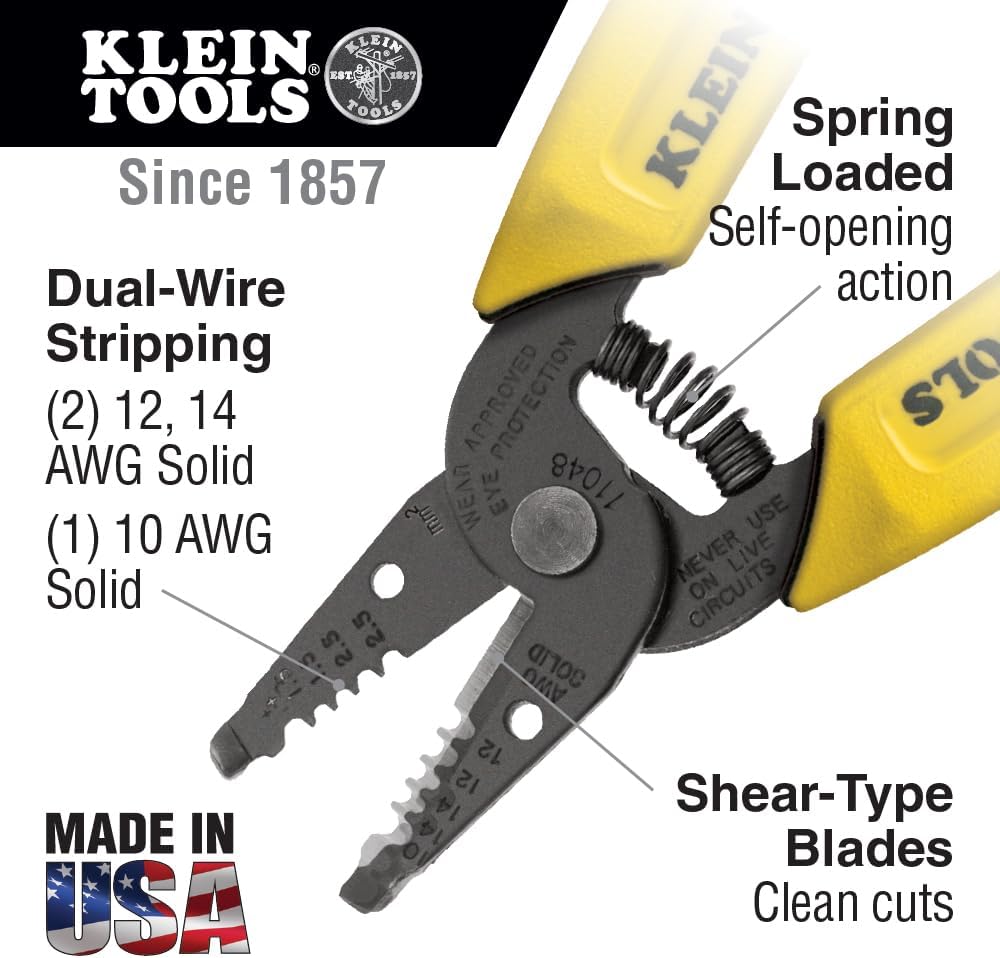
The 11048 is a dedicated wire stripper for 10–20 AWG solid and stranded wire, and working electricians are emphatic that it shines on solid house wire, particularly 12 AWG and 14 AWG. The design feature owners return to most often is the ability to strip two wires simultaneously, which compresses time on rough-in days when you’re terminating dozens of receptacles or switch legs in sequence.
Per Klein Tools product documentation, the 11048 handles 10 through 20 AWG with precisely sized stripping holes, giving solid conductor a clean, consistent strip length every time. Electrical Construction & Maintenance (EC&M, ecmweb.com) has consistently flagged strip consistency as an underrated productivity factor in its residential rough-in coverage — inconsistent strip lengths mean re-stripping or re-cutting at the device, which adds up over a full home.
One caveat that reviewers raise explicitly and consistently: the 11048 underperforms on stranded wire. Stranded wire — where the conductor is made of many thin twisted wires rather than a single solid wire — is common in automotive and marine applications, and the 11048’s geometry is not optimized for it. If your work is purely residential NM cable, this is irrelevant. If you’re doing car audio or marine wiring on the side, a different tool belongs in the bag for that.
Fieldpiece
$160.65
In stock on Amazon
Check price on AmazonThe K11095 Klein-Kurve: Wide Range, One Major Asterisk
The K11095 is Klein’s multi-function tool, offering stripping from 8–22 AWG, wire cutting, and a built-in crimper. Its wide AWG range makes it the most versatile of the three on paper, and owners report it handles cutting and stripping across a broad residential and light-commercial range very well.
The asterisk reviewers apply consistently and without exception: the crimper is not reliable for wire connectors. Across aggregated reviews, the pattern is clear — electricians describe the crimper as underpowered for insulated butt connectors and flag it as a feature that looks good on the packaging but doesn’t hold up in production use. The summary that recurs most often: use it for cutting and stripping, ignore the crimper. If you need to crimp terminals routinely, a dedicated crimping tool is the correct answer; the K11095 is not.
Like the 11048, the K11095 also receives explicit reviewer notes about stranded wire — it performs better than the 11048 on stranded due to its wider AWG range, but it remains primarily optimized for solid house wire. Reviewers doing automotive wiring consistently recommend against relying on it for that application.
Fluke
$401.53
In stock on Amazon
Check price on AmazonSide-by-Side: The Numbers That Matter
| Tool | Primary Function | AWG Range | Simultaneous Strip | Crimper |
|---|---|---|---|---|
| K1412 | NM cable jacket slitting | 12 & 14 AWG NM | N/A (cable ripper) | No |
| 11048 | Wire stripping, solid | 10–20 AWG | Yes (2 wires) | No |
| K11095 Klein-Kurve | Strip/cut/crimp combo | 8–22 AWG | No | Yes (reviewers: avoid) |
By the numbers: A typical 2,000 sq ft home rough-in involves roughly 40–60 receptacle and switch locations. At three conductors per location needing individual strips, that’s 120–180 strip operations per house. The 11048’s dual-strip capability cuts that operation count roughly in half on straight runs — a genuine time savings across a full rough-in day. Klein Tools product documentation confirms the dual-strip geometry is an intentional design feature of the 11048, not an incidental capability.
Build Quality and the Made-in-USA Question
Klein manufactures these tools in the United States, and this is a legitimate differentiator at the price points involved — not just a marketing talking point. Electricians in long-run reviews (meaning tools used over months and years of regular job-site work, not a single evaluation) report that all three Klein tools hold their calibration and edge significantly longer than imported strippers at comparable or lower price points.
The specific feedback pattern on quality is worth noting: no reviewer raises serious quality complaints about any of these three tools. The criticisms that appear in reviews are consistently about scope — “doesn’t work well on stranded,” “the crimper isn’t for serious use” — not about tools breaking, going out of calibration, or handles cracking. That’s a meaningful signal. Cheap imported strippers frequently generate complaints about blades that dull quickly, stripping holes that chew conductors, or handles that fail under cold-weather use. The Klein tools in this lineup simply don’t produce those complaints.
Electrical Contractor Magazine (electricalconstruction.com), in its coverage of residential hand tool selection, has noted that longevity calculations matter more for working electricians than for occasional users — a stripper used five days a week needs to hold calibration for years, not months, and cost-per-use math over a multi-year career strongly favors tools that don’t drift out of spec.
Matching Tool to Job: The Decision Frame
Here’s the plain-language version of how to choose.
If you’re doing a whole-home rewire or full rough-in and buying one tool: The 11048 is where most working electricians land. The dual-strip speed is real, the strip quality on solid 12 and 14 AWG is consistently praised, and it handles the full range of branch-circuit wire sizes you’ll encounter in a residence. The K1412 is an excellent complement — many electricians carry both — but if it’s one tool, the 11048 is the workhorse.
If you’re doing box work specifically — finishing boxes, adding devices in finished spaces, or working in tight pull boxes: Add the K1412. The inside-the-box jacket slitting capability is legitimately useful, and reviewers are specific about it in a way that reflects real job-site experience rather than spec-sheet opinion. A utility knife works too, but the K1412 is safer and faster in confined spaces.
If your work spans a wide AWG range — say, you’re doing both branch circuits and low-voltage control wiring on the same project: The K11095 covers 8 to 22 AWG, and its cutting performance is consistently praised. Go in knowing the crimper is a secondary feature. If crimping is on the scope, budget a dedicated tool separately.
If your work includes any automotive or marine stranded wire: None of these three are your primary tool for that application. All three are designed around residential solid-conductor NM cable, and reviewers are honest about that framing.
Frequently Asked Questions
Can the K1412 strip wire gauges other than 12 and 14 AWG? The K1412 is designed specifically for 12 AWG and 14 AWG NM cable jacket slitting per Klein Tools product documentation — those are the two most common residential branch-circuit sizes corresponding to 20-amp and 15-amp circuits as specified in NFPA 70 National Electrical Code, 2023 edition, Article 334. It is not a general-purpose wire stripper and is not designed for individual conductor stripping or other cable sizes. For 10 AWG or other gauges, the 11048 or K11095 is the correct reach.
Will the 11048 work on stranded wire or only solid? The 11048 handles stranded wire within its rated range per Klein Tools product documentation, but reviewers consistently report it is optimized for solid conductor. Working electricians who tested it on stranded automotive wire specifically flag it as underperforming in that application. For residential NM cable — which uses solid conductors — it performs excellently. For stranded wire, a tool designed for that geometry is the better choice.
Does the K11095 crimper actually work for wire connectors? Based on aggregated reviewer experience: not reliably. The consensus across long-run reviews is that the crimper is the weakest feature of an otherwise strong tool. For occasional, non-critical crimps it may function, but reviewers explicitly caution against relying on it for production work or any connection where crimp integrity matters. A dedicated crimping tool is the correct answer for real crimp connections.
Which tool is best if I only buy one for whole-home rewiring? The 11048 is the answer most experienced residential electricians reach. The dual-wire simultaneous stripping is a genuine productivity feature on rough-in days, and strip quality on solid 12 and 14 AWG is consistently rated highly by long-run users.
Is the Made-in-USA build quality noticeably better than imported strippers at similar prices? Based on long-run review patterns, yes — and the difference shows up specifically in longevity and calibration retention rather than just initial feel. Reviewers of the Klein tools in this lineup report years of regular use without quality degradation. That contrasts meaningfully with imported tools in the same price tier, which more frequently generate complaints about dulling edges or stripping holes that begin chewing conductors after moderate use.
Specifications referenced from Klein Tools product documentation. Code requirements per NFPA 70 National Electrical Code, 2023 edition, Article 334, nfpa.org. Productivity and longevity context per Electrical Construction & Maintenance (EC&M, ecmweb.com) and Electrical Contractor Magazine (electricalconstruction.com) coverage of residential rough-in hand tools.