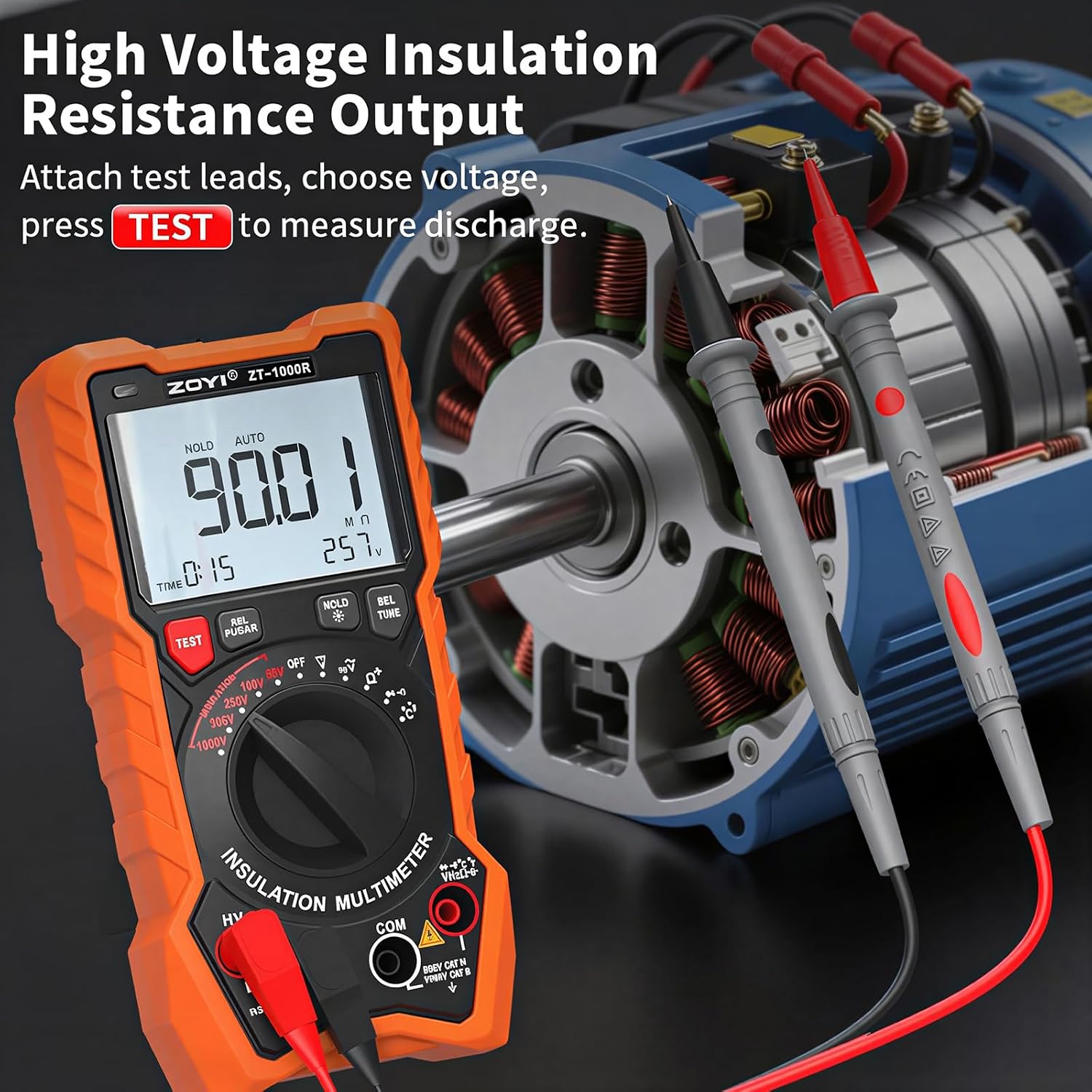
Picture this: you’ve just pulled a 15-year-old 480 V pump motor out of service for annual maintenance, and before you close the panel and re-energize, you need to know whether the insulation around the copper windings is still doing its job. That insulation — the thin varnish-and-polymer coating that keeps the live copper from touching the motor frame — degrades over time from heat, moisture, vibration, and electrical stress. When it starts to fail, you get leakage current, nuisance trips, and eventually a ground fault or a fire. A megohmmeter (also called a “megger,” after the brand that popularized the test, or an insulation resistance tester) answers that question by applying a high DC voltage — typically 500 V to 5,000 V — between the conductor and ground, then measuring how much current sneaks through the insulation. Healthy insulation resists that leakage into the hundreds of megaohms (MΩ) or even gigaohms (GΩ). Bad insulation bleeds current and reads low. This guide walks you through which instrument to buy, what specs actually matter, and how to match the tool to the application.
| EDITOR'S PICKFluke 1503 Insulation Tester | Mid-tierHIOKI Insulation Tester IR4056 | Budget pickKAIWEETS Megohmmeter | |
|---|---|---|---|
| Test Voltage | — | — | 50V/100V/250V/500V/1000V |
| Max Reading | — | — | 100GΩ |
| DAR/PI | — | — | ✓ |
| AC/DC Volt | — | — | ✓ |
| Price | $390.00 | $188.00 | $119.99 |
| See on Amazon → | See on Amazon → | See on Amazon → |
Why a Regular Multimeter Won’t Do This Job
A standard multimeter tops out at resistance measurements in the megaohm range using its own 9 V battery — nowhere near enough voltage to stress the insulation the way the operating voltage will. Insulation can look fine at low voltage and fail catastrophically at line voltage. That’s why IEEE Std 43-2013 (Recommended Practice for Testing Insulation Resistance of Electric Machinery) specifies test voltages that correspond to the rated system voltage: 500 V DC for equipment rated up to 1,000 V, 1,000 V DC for mid-voltage equipment, and up to 5,000 V or higher for high-voltage systems. You need a dedicated instrument that can safely source and hold those voltages while accurately measuring the resulting resistance.
There’s also the safety question. An insulation resistance test on a live or capacitively charged conductor can dump stored energy back into your meter. Instruments rated to IEC 61010-1 CAT III 600 V or CAT IV 600 V have input protection designed to survive that impulse. The cheap handheld “mega-ohm meters” that show up on third-party marketplaces for $30 frequently carry no verifiable CAT rating — or a printed rating that doesn’t reflect internal component quality. Per Megger’s published guidance on insulation testing, using an unrated instrument on industrial cables isn’t just inaccurate; it can be dangerous to the technician.
The Three Core Applications — and Why They Pull the Spec Sheet in Different Directions
Motor windings are the bread-and-butter application. You’re testing phase-to-ground and phase-to-phase insulation resistance on coils that see thermal cycling, vibration, and contaminants. IEEE 43-2013 is the governing document here and it establishes the minimum acceptance threshold for motors rated under 1 kV: at least 100 MΩ corrected to 40 °C, or a Polarization Index (PI) — the ratio of the 10-minute reading to the 1-minute reading — of at least 2.0 for Class B/F/H insulation. That PI calculation means your meter needs a built-in timer and ideally automated PI calculation. Budget instruments that only hold a test for 60 seconds and display a single reading won’t get you there without manual logging.
Power cables — feeders, branch circuits, medium-voltage distribution cables — are tested to confirm insulation integrity after installation, after a dig-in or physical damage event, or as part of a scheduled maintenance program per NFPA 70B 2023. Test voltages here scale with cable voltage rating: 500 V DC for 600 V-rated cable, 1,000 V for 1 kV rated, and up to 5 kV or 10 kV for medium-voltage distribution. A meter that tops out at 1,000 V test voltage closes the door on any medium-voltage cable work — plan for your next job, not just today’s.
Solar PV arrays introduce a wrinkle that surprises technicians coming from the motor side: the insulation test must be done at a voltage that approximates the array’s open-circuit voltage, and the IEC 62446-1 standard for PV system commissioning specifies a minimum 500 V test. More importantly, solar arrays have both a positive and negative conductor that must each be tested to ground, and a ground fault in a floating PV system can be silent under normal operation but catastrophic during a fault. Owners and commissioning technicians report that meters with auto-discharge capability — which bleeds off the capacitive charge stored in the array before you touch anything — are a non-negotiable feature on PV work. The Fluke 1550C and Megger MIT430 both carry that feature; many sub-$200 instruments do not.
By the Numbers: Test Voltage vs. Application
| Application | Typical Rated Voltage | Recommended Test Voltage (IEEE/IEC) | Minimum Instrument Range |
|---|---|---|---|
| 480 V motor | 480 V AC | 500–1,000 V DC | 500 V, 1,000 V |
| 600 V feeder cable | 600 V | 1,000 V DC | 1,000 V |
| Medium-voltage cable (5 kV) | 5,000 V | 5,000–10,000 V DC | 5,000 V |
| Solar PV array (≤1,500 V DC) | Up to 1,500 V | 500–1,000 V DC | 500 V, 1,000 V |
How to Read the Spec Sheet: Five Numbers That Actually Matter
1. Maximum test voltage. The ceiling determines your applications. A 1,000 V instrument handles most commercial and residential motor and cable work. A 5,000 V instrument opens up medium-voltage cable and switchgear. The Megger MIT430 — one of the most-cited instruments in the $700 range — maxes out at 1,000 V, which is appropriate for motors and 600 V-class cables but not for 5 kV distribution work. The Fluke 1555 (approximately $1,400–$1,600) reaches 10,000 V for high-voltage applications.
2. Maximum measurable resistance. Good insulation in a well-maintained motor can read 1,000 MΩ or higher. An instrument with a 200 MΩ ceiling will pin out (“OL”) and tell you nothing useful about a healthy asset. Look for at least 200 GΩ (that’s gigaohms — 200,000 MΩ) on a professional instrument. Spec sheets from Fluke’s application notes and Megger’s product literature both flag this as a common oversight by buyers new to insulation testing.
3. Polarization Index (PI) and Dielectric Absorption Ratio (DAR) automation. PI requires a timed 10-minute test; DAR requires a 1-minute vs. 30-second ratio. Manual timing is error-prone and inconvenient on a noisy job site. Automated PI/DAR is a mid-range and above feature — it’s present on the Megger MIT430 and Fluke 1507, and absent on most instruments below $200.
4. CAT rating and voltage rating on the measurement inputs. The test output voltage gets all the attention, but the input terminals — where you’re measuring the leakage — need to be protected against transients from adjacent energized conductors. IEC 61010-1 CAT III 600 V is the minimum for industrial work. CAT IV 600 V is appropriate if you’re working at the service entrance or in outdoor environments. Instruments without a published IEC 61010-1 category are unverified and should not be trusted on industrial sites.
5. Auto-discharge. When the test ends, the cable or winding under test holds a charge proportional to its capacitance. Auto-discharge bleeds this safely through the instrument. Solar PV arrays, long cable runs, and large motor windings can store enough charge to deliver a painful or dangerous shock. This feature is standard on professional-grade meters and absent on most budget instruments.
The Decision Frame: Matching Instrument to Job Profile
Here’s where you spend your money based on what’s in front of you, not on spec-sheet bragging rights.
If your work is residential and light commercial — motors under 100 HP, 480 V feeders, occasional troubleshooting: The Fluke 1507 (approximately $550–$600) hits the sweet spot. It tests to 1,000 V, measures to 2,000 GΩ, automates PI and DAR, carries a CAT III 600 V / CAT IV 300 V rating, and has auto-discharge. Electricians and maintenance technicians in aggregated reviews consistently cite its build quality and the clarity of its PI readout. It’s the most-referenced mid-tier insulation tester in published NETA technician forums and training materials.
If you’re a facilities manager or industrial maintenance tech running a predictive maintenance program on 480 V motors: The Megger MIT430 (approximately $700–$750) adds step voltage testing — which applies incrementally higher voltages to stress the insulation in a controlled way and catch weaknesses the standard PI test misses. NFPA 70B 2023 recommends step voltage testing for motors with service histories of concern. Megger’s own published application literature describes the MIT430 as their entry point for full motor diagnostic capability.
If you’re a solar PV commissioning tech or EV charging infrastructure installer: Either the Fluke 1507 or the Fluke 1587 FC (approximately $600–$650, which adds a built-in true-RMS multimeter) covers the 500 V and 1,000 V test voltages specified in IEC 62446-1 for PV commissioning. The 1587 FC’s combination of insulation tester and multimeter is specifically noted in Fluke’s application resources as reducing equipment carried on PV commissioning jobs, and owners report the dual-function design earns its cost on jobs that require both tests in sequence.
If you’re working on medium-voltage cables (5 kV class) or HV switchgear: You need a 5,000 V or 10,000 V instrument — the Fluke 1555, Megger MIT510, or equivalent. This is a different tier of investment ($1,200–$2,000+) and typically a specialist role; if you’re there, you already know it.
If you’re a student, apprentice, or occasional user who just needs a basic go/no-go test on a residential motor or 120/240 V circuit: The Extech MG300 (approximately $120–$150) tests at 500 V and 1,000 V, measures up to 4,000 MΩ, and will satisfy basic IEEE 43 minimum pass/fail criteria. It doesn’t automate PI or have auto-discharge, but for an occasional-use instrument on low-voltage residential work, it’s a defensible entry point. Don’t take it near solar arrays or anything with significant capacitance.
A Word on Counterfeit and Unrated Instruments
Third-party marketplace listings for “insulation testers” in the $40–$80 range are a recurring hazard. Megger’s published guidance and independent analysis published by Test Equipment Depot have both flagged instruments that display CAT ratings on the front panel that are not supported by internal fusing, MOV protection, or component voltage ratings. On an insulation test, the consequences of an unrated instrument failing under a transient aren’t just a dead meter — they’re an arc flash or a shock to the technician. Buy from authorized distributors: Fluke’s own channel, Megger’s authorized dealer network, Test Equipment Depot, or similar industrial supply houses. The few dollars saved on an unverified marketplace listing are not worth the exposure.
The Bottom Line
If X is motors and cables in commercial and industrial 480 V environments, then the Fluke 1507 or Megger MIT430 is the right bracket — don’t go below it. If X is solar PV commissioning, the Fluke 1507 or 1587 FC covers the IEC 62446-1 requirements without overbuying. If X is medium-voltage cable work, you need a 5,000 V minimum instrument and should budget accordingly. And regardless of which instrument you choose: verify the CAT rating against the IEC 61010-1 standard on the manufacturer’s published spec sheet, not just the label on the front panel.