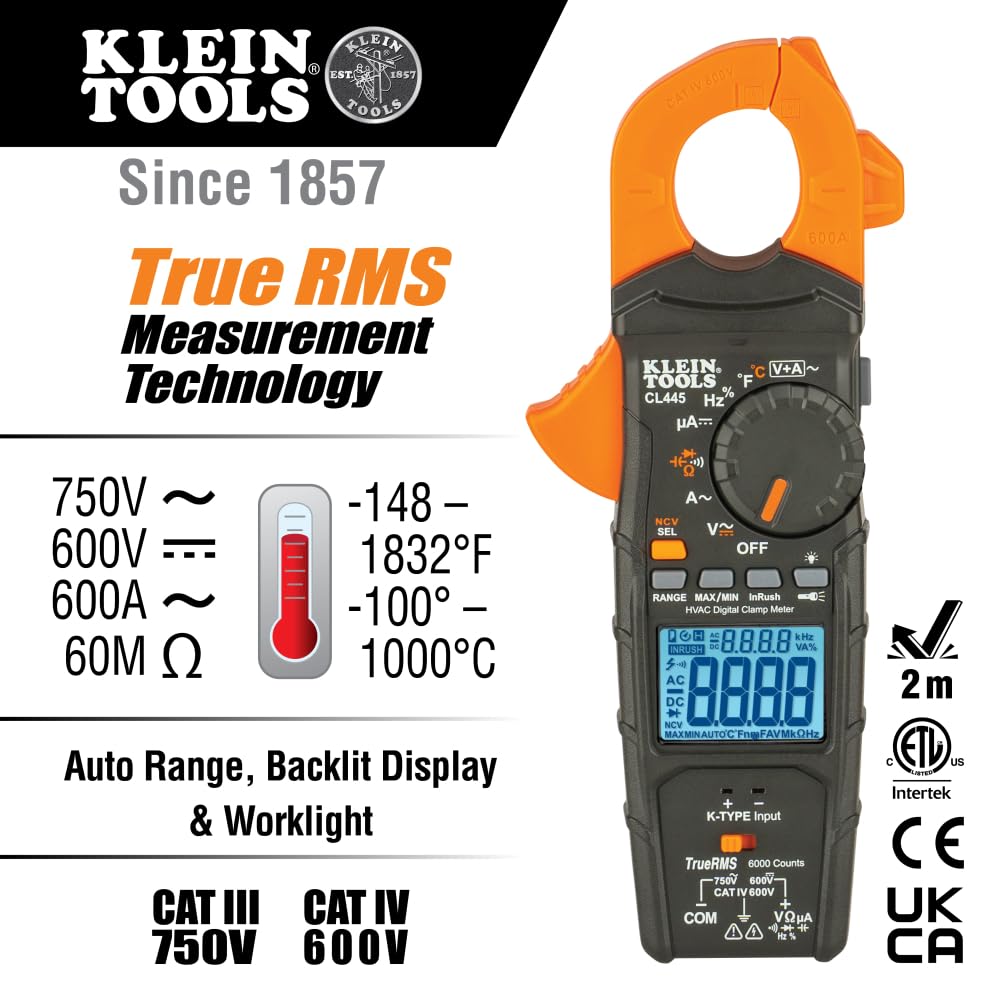
You’re on a service call for a gas furnace that keeps locking out on a “no flame” fault — but when you fire the burner manually, the flame looks fine. The control board disagrees. To prove the flame-sensor rod is passing enough signal current to satisfy the board, you need to measure micro-amps: a unit of electrical current so small (one micro-amp is one millionth of an amp) that a standard clamp meter — the tool that clips around a wire to read current without breaking the circuit — simply can’t see it. Most clamp meters bottom out at 1 amp of resolution, which is like trying to weigh a postage stamp on a bathroom scale. Add to that the reality that HVAC work drags your meter from a 130 °F attic in July to a 20 °F rooftop condenser in January, and it becomes clear that the right clamp meter for HVAC is a genuinely different animal from what an electrician uses to pull panel loads.
This article walks through the two specs that actually determine whether your HVAC clamp meter earns its place in the bag: micro-amp flame-sensor measurement capability and operating temperature range. We’ll name real instruments, show the math on why resolution matters, and give you a clear decision framework so you can stop borrowing the senior tech’s meter and start carrying the right one yourself.
Why Micro-Amp Measurement Is an HVAC-Specific Problem
A flame-sensor rod in a gas furnace works by allowing the flame itself to conduct a tiny AC current from the rod to the burner ground. The control board reads that current to confirm combustion is happening. If the signal drops below the board’s threshold — typically 0.5 to 2.5 micro-amps DC — the board shuts the gas valve and locks out, calling a no-flame fault even if the burner is lit.
Here’s where meter selection becomes a diagnostic outcome question, not just a spec preference.
Standard clamp meters (think of a Fluke 323 or Klein CL110) are designed to measure current in amps — they’re optimized for ranges like 0–400 A or 0–600 A. Their clamp jaws use a current transformer that physically cannot resolve anything below about 0.1 A (100 mA). A flame sensor signal at 1.2 micro-amps is literally 100,000 times smaller than that. You will get a zero reading every time, learn nothing, and potentially condemn a perfectly good control board.
HVAC-specific clamp meters solve this by adding a dedicated micro-amp mode that bypasses the jaw transformer entirely. In this mode, the meter uses its internal test lead inputs (the same banana jacks used for voltage), and the unit reads DC current in the micro-amp range — typically 0–200 µA or 0–999 µA depending on the instrument. You’re using the clamp meter body, but the flame-sensor test runs through the leads, not the jaws.
Fluke’s application notes for the Fluke 116 describe this workflow explicitly: the meter is wired in series between the sensor rod and its lead wire, and the µA DC mode reads the live flame signal. Specifications for the Fluke 116, as published by Fluke Corporation, list a micro-amp range of 0–400 µA with a resolution of 0.1 µA. That resolution is meaningful — it lets you see the difference between a sensor reading 0.8 µA (marginal, board may nuisance-trip in cold weather) and 1.4 µA (healthy). You can’t make that call with a standard clamp.
By the Numbers: Flame Sensor Current at a Glance
| Condition | Typical Signal | Standard Clamp Reads | HVAC Clamp Reads |
|---|---|---|---|
| Healthy sensor, clean flame | 1.5–4.0 µA | 0 (below range) | 1.5–4.0 µA ✓ |
| Marginal / dirty sensor | 0.5–1.4 µA | 0 (below range) | 0.5–1.4 µA ✓ |
| Failed / cracked sensor | < 0.5 µA | 0 (below range) | Detectable ✓ |
| Board lockout threshold (typical) | ≈ 0.5–2.5 µA | Cannot confirm | Diagnosable ✓ |
Sources: Fluke Corporation application notes; EC&M editorial coverage of HVAC diagnostic instrumentation.
Without that micro-amp window, you’re guessing. With it, you’re measuring.
Temperature Range: The Spec That Gets Ignored Until It Bites You
The second differentiator is operating temperature range, and it’s underappreciated until you’re standing on a rooftop at 14 °F watching your meter give you nonsense readings — or worse, refuse to power on.
Most general-purpose clamp meters specify an operating range of 0 °C to 40 °C (32 °F to 104 °F). That covers a temperate office or a residential panel room. It does not cover:
- A rooftop condenser unit in Minneapolis in February (-20 °F ambient is not unusual)
- An uncooled mechanical room in a Sunbelt commercial building in August (130–140 °F equipment surfaces are common)
- A walk-in freezer compressor room (-10 °F to 0 °F routinely)
HVAC technicians routinely work in all three environments — sometimes in the same day. When a meter operates outside its rated temperature window, the manufacturer’s published accuracy specifications no longer apply. The instrument may still produce readings, but you have no documented basis to trust them. For a flame-sensor test where you’re making a parts-replacement decision on a marginal 0.9 µA reading, that matters.
HVAC-targeted clamp meters extend both ends of the range. The Fluke 116, per Fluke’s published specs, carries an operating range of -10 °C to 50 °C (14 °F to 122 °F). The UEi DL369 — a competing HVAC clamp meter listed at Test Equipment Depot — is similarly specified for cold-environment work. These aren’t dramatic numbers, but the shift from 0 °C to -10 °C at the low end covers a significant percentage of real winter HVAC service conditions in northern climates.
It’s also worth noting that temperature range affects battery performance and display contrast, not just measurement accuracy. LCD displays can slow or blank at sub-zero temperatures. Alkaline batteries lose a significant fraction of their capacity below freezing — this is a documented electrochemistry property, not a brand-specific issue. Some HVAC-focused meters use lithium AA batteries or include low-temperature battery guidance precisely because technicians work in freezer applications.
The CAT Rating Connection
Operating environment also raises a safety question. HVAC work involves both low-voltage control circuits (24 V thermostat wiring) and line-voltage connections (240 V compressor circuits, 480 V commercial RTUs). Per NFPA 70 (NEC) Article 440, air-conditioning and refrigerating equipment has specific overcurrent protection and branch-circuit requirements that mean you’re regularly working at 240 V and above.
An HVAC clamp meter should carry at minimum a CAT III 300 V rating — ideally CAT III 600 V — to cover commercial RTU and split-system work safely. CAT ratings are the IEC 61010 standard’s way of classifying how much transient energy a meter can survive on a given type of circuit: a higher CAT number means better protection against voltage spikes caused by inductive loads like compressor motors. EC&M’s coverage of clamp meter selection for HVAC applications consistently flags CAT III 600 V as the floor for any commercial HVAC work. The micro-amp capability is useless if the meter fails catastrophically on the 240 V compressor circuit you test five minutes later.
Matching the Meter to the Work: A Decision Framework
By now the tradeoffs are visible. Let me put them into a direct decision structure.
If you are doing residential-only HVAC service — single-family homes, 240 V max, routine furnace and AC calls — and you want micro-amp capability without overspending, the Fluke 116 sits around $150–$180 at major distributors and covers flame-sensor work, HVAC-specific temperature measurement via Type K thermocouple input, and the CAT III 300 V rating appropriate for residential panel work. Across aggregated reviews, residential HVAC techs consistently cite the 116 as the entry point where flame-sensor diagnosis becomes reliable. This is the tier where you stop borrowing tools.
If you are doing light commercial work — packaged rooftop units, walk-in refrigeration, 480 V three-phase systems — you need the CAT III 600 V or CAT IV 300 V rating, a wider temperature operating range, and enough current range on the jaw (typically 600 A or higher) to read compressor locked-rotor current on startup. The Fluke 902 FC or the UEi DL379 step into this tier. Spec sheets for the Fluke 902 FC show CAT III 600 V / CAT IV 300 V ratings alongside a 999.9 µA micro-amp range and Bluetooth data logging — the latter being relevant when you’re taking multiple readings across a rooftop array of units and want a record that goes into the work order.
If your work is primarily electrical with occasional HVAC crossover — you’re an electrician, not an HVAC tech, but you get called to troubleshoot a control circuit now and then — carrying a general-purpose Fluke 87V or Hioki DT4282 for your primary electrical work and a sub-$200 dedicated HVAC clamp meter as a secondary tool is more practical than buying one meter that compromises on both. The math: a Fluke 87V True-RMS multimeter at ~$400 gives you the measurement performance your panel and motor work demands. A Fluke 116 at ~$160 handles the HVAC-specific µA tests. Total outlay is less than a single premium HVAC-specialty instrument, and neither tool is compromised.
If you are a flame-sensor skeptic — meaning you typically condemn the sensor on visual inspection or customer complaint without measuring — consider that a marginal sensor reading 0.8 µA may trip the board on a cold-start in February but test visually clean. Replacing a sensor that reads 0.8 µA costs a return trip when it trips again on a 10 °F night. Measuring first costs 90 seconds. The decision-rule here is economic, not just technical.
One More Thing: Counterfeit and Off-Brand Micro-Amp Clamps
A caution worth naming explicitly: “HVAC clamp meter” has become a search-optimized label that shows up on third-party marketplace listings for instruments with no published accuracy specifications, no traceable CAT rating documentation, and micro-amp ranges that are listed in the specs but not validated by any recognized third-party safety lab. EC&M and Test Equipment Depot editorial coverage have both flagged the proliferation of under-documented instruments in this segment.
If a meter doesn’t have a visible UL, ETL, or CE mark on the instrument body — not just the box — and the manufacturer cannot provide an IEC 61010 test report, the CAT rating is a marketing label, not a safety specification. On a flame-sensor test at 24 V, the risk is low. On the 240 V compressor circuit ten feet away, it isn’t.
Buy from distributors who stock instruments with documented safety certifications. The price delta between a name-brand HVAC clamp meter and an off-brand alternative is $40–$80. The risk delta is not proportional.
The Bottom Line
Two specs drive HVAC clamp meter selection above everything else: micro-amp resolution that reaches down to the sub-2 µA flame-sensor signal window, and an operating temperature range that covers real northern winters and hot mechanical rooms. CAT III 600 V is the safety floor for commercial work. Everything else — jaw capacity, display brightness, Bluetooth logging — is secondary to getting those two right.
If you’re doing residential HVAC service today and don’t have micro-amp capability in your bag, that’s the first gap to close. If you’re moving into commercial work and your meter is rated to 0 °C, the operating temperature spec is the gap that will bite you on your first February rooftop call. Pick the instrument that matches the environment you actually work in — then carry it to every call, not just the ones you think will need it.