Clamp Meters for HVAC Technicians: Micro-Amp, Inrush, and Capacitance Features Ranked
If you’re an HVAC technician — even a relatively new one — you already know that diagnosing a system isn’t just about measuring whether current is flowing. It’s about measuring how much, when, and in what form. A clamp meter (a tool that measures electrical current by clamping around a wire without cutting into it) is one of your most-reached-for instruments. But the standard electrician’s clamp meter — the kind designed to read 200A on a panel circuit — doesn’t give you the fine-grained measurements HVAC work demands. You need micro-amp sensitivity to test flame sensors. You need inrush capture to catch compressor startup faults. You need capacitance measurement to diagnose run capacitors without pulling a second meter from your bag. This guide breaks down exactly which features matter, why they matter, and how the Fieldpiece SC440, Klein CL390, Klein CL445, and Fluke 902 FC stack up for the HVAC tech making a buying decision right now.
| EDITOR'S PICKFluke 902 FC HVAC True-RMS Clam… | Mid-tierFieldpiece SC440 True RMS Clamp… | Budget pickKlein Tools CL120 Digital Clamp… | |
|---|---|---|---|
| True RMS | ✓ | ✓ | — |
| Inrush | — | ✓ | — |
| Capacitance | — | ✓ | — |
| Temperature | — | ✓ | — |
| Max AC Amps | — | — | 400 |
| NCV | — | — | ✓ |
| Price | $365.68 | $236.30 | $59.97 |
| See on Amazon → | See on Amazon → | See on Amazon → |
Why HVAC Diagnostics Demand More Than a Standard Clamp Meter
A residential or light commercial electrician can get through most of a career with a solid 400A clamp meter and a good multimeter. HVAC work breaks that model almost immediately.
Here’s what separates HVAC electrical diagnostics from general electrical work:
Flame sensors. A gas furnace flame sensor produces a rectified signal that’s typically between 1 and 10 microamps (µA) — that’s millionths of an amp. A standard clamp meter bottoms out around 200mA (milliamps), which is roughly 20,000 times too coarse to read a flame sensor current. If your meter can’t resolve µA-range signals, you’re guessing at whether a flame sensor is dirty or failed.
Compressor inrush. When a compressor starts, it draws a surge of current — often 5 to 10 times its rated running amperage — for a fraction of a second. That inrush spike can trip breakers, blow fuses, or indicate hard-start problems. But most meters average their readings and miss the spike entirely. You need a meter with a dedicated inrush capture mode that holds the peak value long enough to read it.
Run capacitors. A failed or weak run capacitor is one of the most common HVAC failures. Run capacitors are measured in microfarads (µF) — a unit of capacitance, which describes how much electrical charge a capacitor stores. A meter without a capacitance function sends you back to your truck for a multimeter or a dedicated capacitor tester.
The meters reviewed here are chosen because they address all three of these needs — at varying price points and with different workflow tradeoffs.
Feature Comparison: By the Numbers
| Meter | Micro-Amp Measurement | Inrush Capture | Capacitance | CAT Rating |
|---|---|---|---|---|
| Fieldpiece SC440 | Yes (µA mode) | Yes | Yes | CAT III 600V |
| Klein CL390 | No | Yes | Yes | CAT III 600V |
| Klein CL445 | Yes | Yes | Yes | CAT III 600V |
| Fluke 902 FC | Yes | Yes | Yes | CAT III 600V |
All four meters carry a CAT III 600V rating, which is appropriate for residential panels and light commercial HVAC equipment. Per NFPA 70E Standard for Electrical Safety in the Workplace, 2024 edition, CAT III is the minimum appropriate category for measurements at distribution panels — which you’ll encounter on every commercial rooftop unit installation.
Fieldpiece SC440: The Consolidator’s Case Study
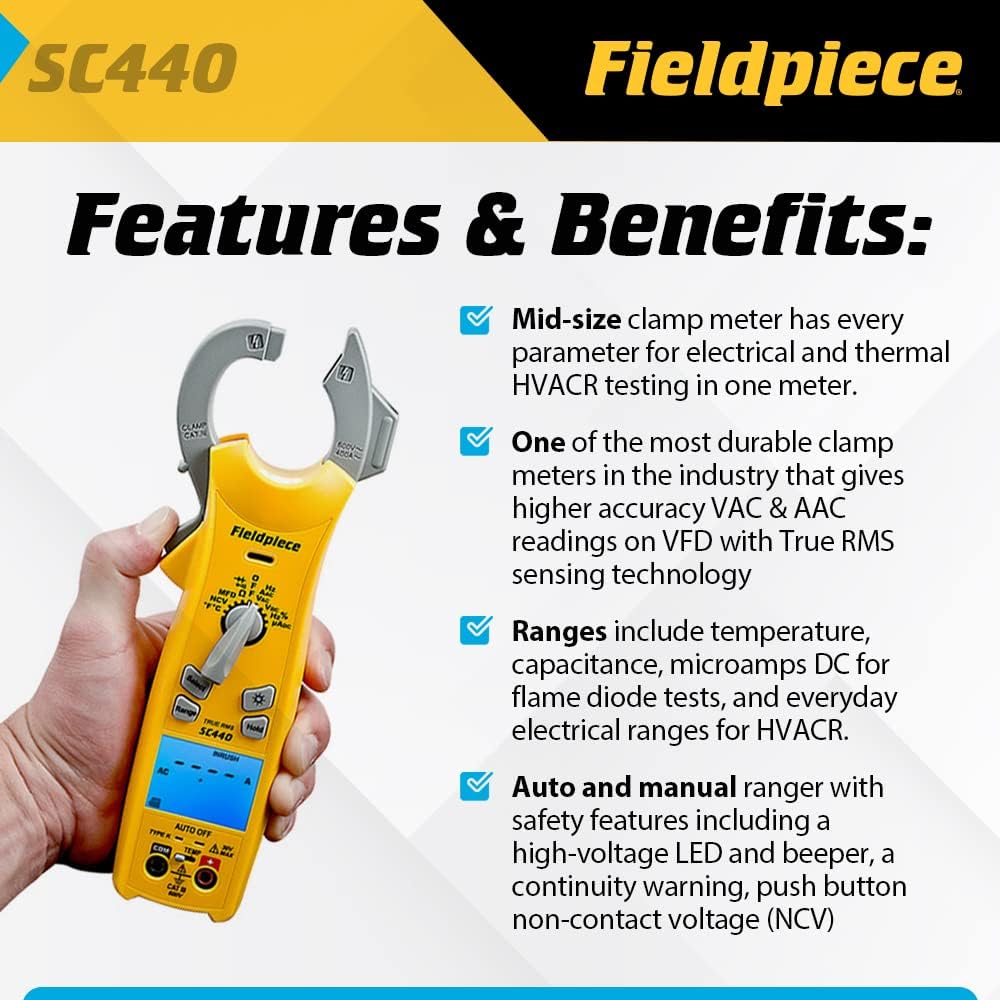
The most telling endorsement of the Fieldpiece SC440 in aggregated HVAC technician reviews isn’t a spec — it’s a workflow story. One experienced tech described carrying two separate Flukes for years: one for fine-resolution and capacitor measurements, one for amp clamp work. After switching to the SC440, they carry only one meter. That before-and-after is concrete: the SC440 eliminated a redundant instrument from the bag.
Published specs confirm why: the SC440 measures current in standard clamp mode, offers a dedicated micro-amp mode for flame sensor testing, captures inrush peaks, and reads capacitance — all in a single housing. Fieldpiece built this meter specifically for HVAC technicians, and that focus shows in what they included.
The one friction point that same reviewer flagged: reaching amp-clamp mode requires cycling through the function select button rather than a direct rotary dial position. If you’re switching frequently between capacitance and amp measurements on a diagnostic call, that navigation adds a step. Here’s the practical workaround: before you clamp onto a wire, set the function first. Develop the habit of dialing the mode before the clamp jaw touches anything, and the extra button press becomes part of the motion rather than an interruption. It’s a real workflow consideration — not a dealbreaker, but worth knowing before you buy so it doesn’t feel like a surprise.
For HVAC techs who want one meter that genuinely replaces two, the SC440 is the clearest argument on the market. The HVAC-specific design also means the software ergonomics — the hold functions, the display layout — are tuned for the sequence of tasks you actually perform on a service call rather than adapted from an electrician’s workflow.
Klein CL390: Solid All-Arounder With One Diagnostic Gap
The Klein CL390 collects consistently positive reviews from newer HVAC technicians entering the field. One field reviewer provided a detailed capability rundown: inrush capture, capacitance measurement, solid clamp sensitivity, and a display that reads well in varying light. For a tech building their first kit, it checks most of the boxes.
The gap that same reviewer specifically named: the CL390 cannot measure very small amperage draws. In HVAC terms, that maps directly to a specific set of fault conditions. The most common: ECM blower motor diagnostics. ECM (electronically commutated motor) blower motors — the variable-speed motors increasingly common in modern air handlers and furnaces — draw very low current at low speeds, sometimes under 100mA at minimum speed. Diagnosing whether an ECM is operating correctly at partial load requires resolving those low-end draws. The CL390 can’t get there.
Similarly, flame sensor current (1–10µA range) is completely outside the CL390’s range. If your service mix includes newer furnaces with dirty flame sensors — and it will — you’ll still need a multimeter with µA capability for that specific test.
The honest decision frame: if you’re primarily doing refrigeration and air conditioning work (compressor diagnostics, capacitor testing, inrush capture on condenser units), the CL390 covers you well. If your book includes furnace diagnostics or variable-speed air handler troubleshooting, the micro-amp gap becomes a real limitation.
Klein CL445: Engineering-Confirmed Feature Set, One Storage Annoyance
The Klein CL445 rounds out the CL line with micro-amp measurement added to the CL390’s foundation. An electrical engineer reviewing the CL445 confirmed it has all the required HVAC features and noted one specific, minor complaint: the included storage pouch is too small to hold the meter with accessories attached or organized alongside it. That’s the kind of detail that doesn’t show up on spec sheets but matters when you’re working from a crowded service bag.
The feature set is legitimate: µA measurement, inrush capture, capacitance, and the same CAT III 600V safety rating as its siblings. For a technician who’s evaluated the CL390 and wants micro-amp capability without changing brands, the CL445 is the direct upgrade path. Get a larger aftermarket tool pouch — that problem has a $10 solution.
Fluke 902 FC: The Durability Loyalty Story
The Fluke 902 FC earns its reputation partly on specs and partly on an honest durability narrative that shows up consistently in long-run reviews. One tech’s account is representative: their original 902 FC broke after three years of daily use. When they got a repair estimate, the cost was close enough to the replacement price that buying new made more economic sense. So they bought the same model again — specifically because three years of daily HVAC service work is the bar they’d want any meter to clear, and the 902 FC cleared it.
That’s not a story about indestructibility. It’s a story about value-per-year: if a meter lasts three years of hard daily use before it needs attention, and the replacement makes sense over repair, you’re looking at a known cost of ownership. Per Fluke’s published spec sheet, the 902 FC includes iFlex flexible current probe compatibility (expanding its clamp range for large conductors), inrush capture, µA measurement, capacitance, and Fluke Connect wireless data logging.
The wireless logging — syncing readings to the Fluke Connect app — is worth noting for commercial HVAC work where service documentation is part of the contract. If you’re maintaining rooftop units under a service agreement and your customer expects reports, the 902 FC fits that workflow in a way the other meters here don’t.
The tradeoff is price: the 902 FC sits at the top of this comparison. For a solo residential tech, the premium may not justify itself. For a commercial HVAC service contractor who needs wireless documentation and already runs Fluke test equipment, it’s the natural choice.
Frequently Asked Questions
What does micro-amp measurement do on an HVAC clamp meter and why does it matter?
Micro-amp (µA) measurement lets you read extremely small current flows — millionths of an amp. In HVAC, the primary application is flame sensor testing. A furnace flame sensor produces a tiny rectified current (typically 1–10µA) when it’s sensing a flame. If that current drops too low, the control board shuts the furnace off as a safety measure. Without µA resolution, you can’t distinguish a dirty flame sensor (fixable with light sanding) from a failed one (requires replacement). A clamp meter without µA capability can’t make that call.
Can I use a standard electrician’s clamp meter for HVAC work?
For some tasks, yes — reading running amperage on a compressor or condenser fan motor is within any decent clamp meter’s range. But standard electrician clamp meters typically lack micro-amp sensitivity and often omit capacitance measurement. If your HVAC work includes furnace diagnostics, ECM motor troubleshooting, or capacitor testing (which it almost certainly does), a general electrician’s clamp meter leaves you reaching for a second instrument constantly. The meters in this guide are designed to reduce that.
What is inrush current and why do I need to measure it on a compressor?
Inrush current is the surge of electrical current a motor draws the instant it starts, before it reaches running speed. Compressors are among the highest-inrush loads in HVAC — they can draw 5 to 10 times their rated running current for a fraction of a second at startup. A meter in standard averaging mode misses this spike. An inrush capture mode holds the peak value so you can read it. High inrush that trips breakers or blows fuses consistently points toward a hard-start condition, a weak capacitor, or a failing compressor — three very different repairs with very different costs. Capturing the inrush number helps you make the right call.
Is the Fieldpiece SC440 worth buying over a Klein or Fluke at a similar price?
If your diagnostic mix includes both fine-measurement work (flame sensors, ECM motors) and standard HVAC electrical work, and you want to carry one meter instead of two, the SC440 makes a strong case. The design is HVAC-first in a way that Fluke and Klein meters — which are adapted from broader electrical product lines — are not. The select-button navigation is the one real tradeoff. If you’re coming from a Fluke background and value brand familiarity or wireless documentation, the Fluke 902 FC remains competitive. If you primarily do A/C and refrigeration without heavy furnace diagnostics, the Klein CL390 covers most of your needs at a lower price point.
How do I test a run capacitor with a clamp meter?
A clamp meter with a capacitance function can measure a run capacitor directly. Disconnect power to the unit and discharge the capacitor (using an insulated screwdriver across the terminals or a proper discharge tool — never skip this step). Set the meter to capacitance mode (typically marked µF), connect the test leads to the capacitor terminals, and read the value. Compare it to the capacitor’s rated µF printed on the label — most manufacturers consider anything more than 5–10% below the rated value a replacement candidate. Per Fieldpiece’s published documentation, the SC440 supports this test directly in its capacitance mode. Always verify the unit is fully de-energized before handling capacitors; even after disconnect, a capacitor can hold a dangerous charge.
The Decision Rule
If you diagnose furnaces, variable-speed systems, or ECM motors with any regularity — go to a meter with micro-amp capability. That means the SC440, CL445, or Fluke 902 FC. The CL390 is the right call only if your work is primarily A/C and refrigeration where µA sensitivity isn’t in your diagnostic workflow.
If carrying one meter instead of two is the priority — the SC440 is the strongest consolidation argument. If wireless documentation for commercial service contracts matters — the Fluke 902 FC earns its premium. If you’re brand-loyal to Klein and want the full feature set — the CL445 closes the gap, just budget for a better pouch.