Plug a basic outlet tester — a small device shaped like a fat electrical plug with a few indicator lights on the face — into a standard wall receptacle, and it reads the wiring inside that outlet in about one second. The lights that blink on (or don’t) tell you whether the outlet is wired correctly, whether the hot and neutral wires are reversed (a condition called “reversed polarity”), and whether the ground wire is missing. For outlets protected by a GFCI — a Ground Fault Circuit Interrupter, the safety device that cuts power within milliseconds if it detects electricity leaking toward a person — the tester can also trip and reset that safety device to confirm it’s actually working. What sounds simple gets complicated fast once you’re doing residential service work, pre-move-in inspections, or commercial rough-in verification and you realize not all testers give you the same information with the same clarity. This article ranks the most common outlet tester formats — from the classic three-LED indicator models up through full LCD display units — by how well they actually communicate what they find, and where each format earns its place in a working electrician’s bag.
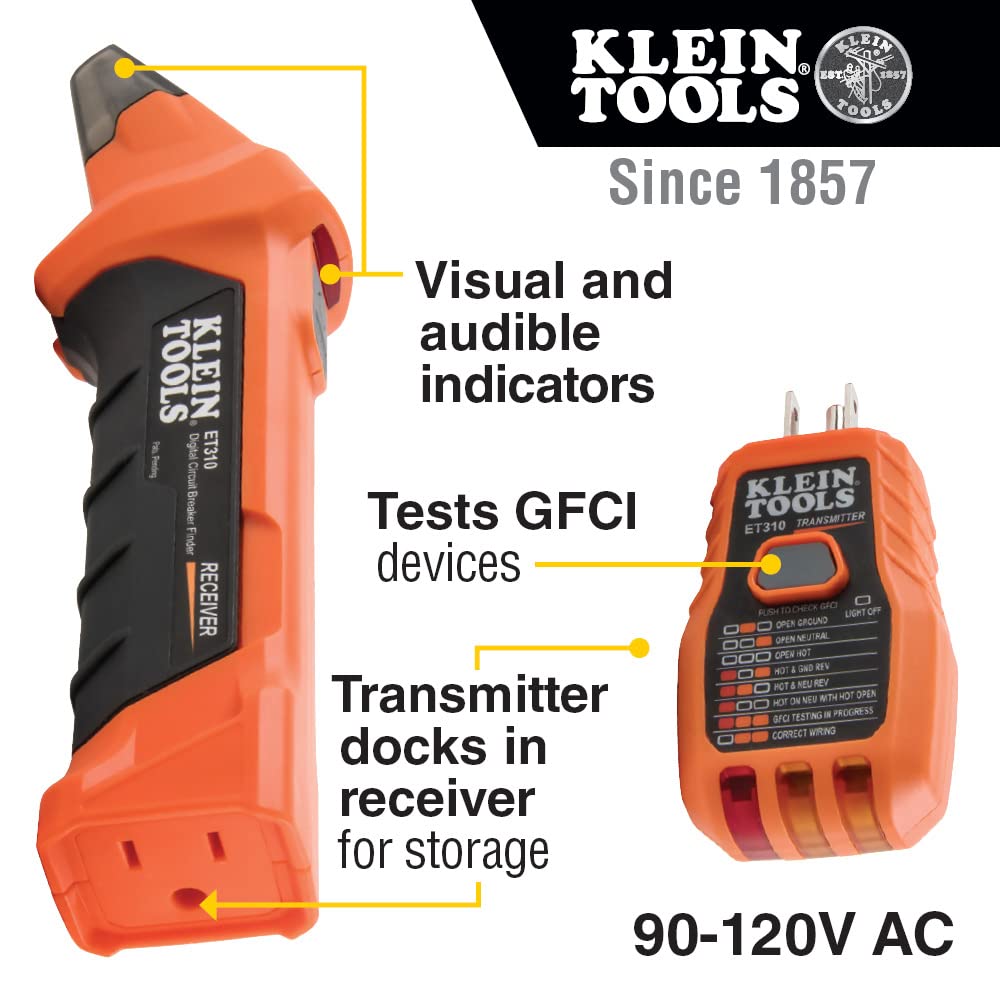
| EDITOR'S PICKKlein Tools ET310 AC Circuit Br… | Mid-tierKlein Tools RT250 GFCI Outlet T… | Budget picknVent GARDNER BENDER GK-5 House… | |
|---|---|---|---|
| Display | — | LCD | — |
| Circuit finder | ✓ | ✗ | ✗ |
| Pieces included | 1 | 1 | 4 |
| Price | $49.97 | $24.97 | $18.57 |
| See on Amazon → | See on Amazon → | See on Amazon → |
Why Display Format Is the Real Differentiator Right Now
Here’s the honest state of the market as of mid-2026: accuracy is essentially a non-issue across the major brands. Trade professionals who discuss these testers raise almost zero complaints about incorrect fault readings. The Klein Tools RT250, the Sperry Instruments STK001, the Gardner Bender GK-5 kit, and the ubiquitous three-LED generic models all correctly identify the wiring faults they’re designed to catch. The complaints — and the praise — are almost entirely about how the tester tells you what it found.
That matters more than it sounds. A misread tester result on a 20-amp kitchen circuit or a bathroom GFCI outlet isn’t just a nuisance. NFPA 70, the National Electrical Code, Article 210 (National Fire Protection Association, NFPA 70, 2023 edition) requires GFCI protection on nearly every receptacle in wet or potentially wet locations — bathrooms, kitchens, garages, outdoor outlets, and crawl spaces, among others. If you’re doing an inspection walk, verifying a completed rough-in, or handing a unit over to a property manager, a tester you can’t read reliably under job-site lighting conditions is a liability.
By the numbers — what separates the display tiers:
| Display type | Information density | Outdoor readability | GFCI trip time shown? | Tier |
|---|---|---|---|---|
| Three-LED (standard) | Fault code only | Poor in direct sun | No | nVent — $18.57 |
| Six-LED / enhanced LED | Fault code + polarity detail | Fair | No | Klein — $24.97 |
| Full LCD (e.g., Klein RT250) | Fault code + GFCI trip time in ms | Good | Yes | Klein — $49.97 |
Three-LED and Enhanced-LED Models Compared
Three-LED Standard Testers: The Reliable Indoor Workhorse
The three-LED outlet tester format has been the trade standard for decades, and for indoor use in normally lit rooms it is genuinely fine. Three lights in different combinations correspond to a reference chart — usually printed right on the tester body — that decodes the wiring condition. Correct wiring lights up two LEDs in a specific pattern; open ground, open neutral, reversed hot/neutral, and similar faults each produce their own pattern.
The fatal weakness shows up the moment you walk outside or into a space with bright ambient light. In direct sunlight, on an outdoor deck, at an exposed garage panel, or on a construction site with work lights flooding the space, those small LEDs wash out to the point where you genuinely cannot tell which are lit and which aren’t. This is not a quality-control failure — it is a physics problem. LEDs produce light and therefore compete with ambient light sources. An LCD display, by contrast, is read by reflected light, which means it becomes more readable as the environment gets brighter, the same principle that makes a printed label easier to read outside than an emissive screen with a dim backlight.
For indoor-only work — apartment building walk-throughs, finished-basement circuits, interior panel verification — the basic three-LED format remains a legitimate choice. It is fast, durable, requires no battery, and does exactly what it says. The decision only gets complicated when outdoor circuits or bright job-site conditions enter the picture.
Best for: Electricians doing primarily indoor residential or light-commercial work who want the fastest, lowest-maintenance tool at the lowest price point.

nVent
$18.57
In stock on Amazon
Check price on AmazonEnhanced Six-LED and Combination Testers: The Middle Ground
The Sperry Instruments STK001 and comparable enhanced-LED models add additional indicator lights that surface more granular fault information than the classic three-light arrangement — polarity detail, load-side versus line-side fault differentiation, and in some configurations a separate indicator for GFCI trip confirmation. The result is a tool that provides genuinely more diagnostic detail without requiring a battery or a backlit display.
The Gardner Bender GK-5 kit fits comfortably in this tier. Rather than competing on LED count alone, it bundles a standard outlet tester with an enhanced LED indicator alongside a USB port tester that multiple owners describe as more capable than they expected: the USB component measures actual voltage at the port rather than simply detecting the presence of power. For electricians doing smart-home installations, EV-adjacent device setup, or verifying USB outlet receptacles on a commercial build-out, having a voltage-measuring USB tool in the same purchase as the outlet tester is a meaningful efficiency gain. Electrical Construction and Maintenance (ECM Web) has noted in coverage of modern outlet testing practice that USB receptacle verification is increasingly part of the residential walk-through checklist as USB-integrated outlets become standard in new construction.
The outdoor readability weakness remains. Enhanced LEDs are brighter than basic LEDs, which helps at the margins, but the format does not close the gap with a reflective LCD display under direct sunlight. And neither the Sperry STK001 nor the GK-5 kit provides GFCI response time in milliseconds — they confirm trip/no-trip, not trip speed.
Best for: Electricians who want broader diagnostic coverage across outlet types including USB receptacles, or who need a versatile kit at a price point below dedicated LCD testers.
Klein
$24.97
In stock on Amazon
Check price on AmazonFull LCD Testers: Professional Documentation in a Plug-In Tool
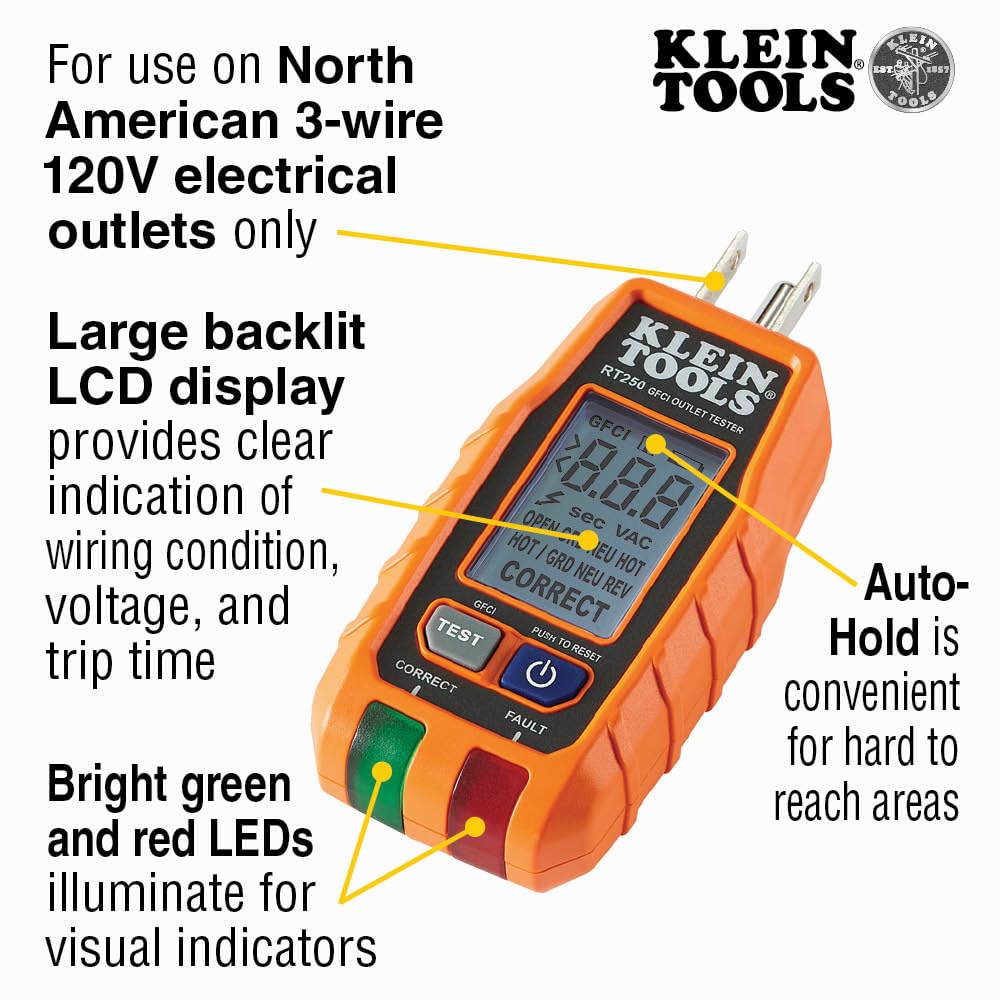
The Klein Tools RT250 represents the current benchmark for what a dedicated outlet tester display can do. The full LCD readout resolves the outdoor readability problem cleanly — the reflective display is easy to read in bright conditions where LED models struggle. But the feature that trade reviewers consistently return to is the GFCI response time display, which shows the actual trip time in milliseconds.
A properly functioning GFCI must trip within 25 milliseconds at 5 milliamps of ground-fault current, per UL Standard 498, Attachment Plugs and Receptacles, published by Underwriters Laboratories — the standard that governs these devices. The RT250’s LCD gives you the actual measured trip time. A reading of 12 ms means the device is operating with a healthy safety margin. A reading that creeps toward or past the 25 ms specification means the GFCI technically tripped but is operating near the boundary of compliance — a finding that justifies recommending replacement rather than simply noting the device as functional.
Fluke Corporation, in its application note “Understanding Ground Fault Circuit Interrupter (GFCI) Testing” (Fluke Corporation application note, available at fluke.com), describes exactly this distinction between a functional test (does the device trip at all?) and a compliance-level test (does it trip within the time window required by the applicable standard?). For a homeowner checking a bathroom outlet once a decade, the binary trip/no-trip result is sufficient. For an electrician signing off on a commercial kitchen installation, verifying GFCI protection in a healthcare environment, or producing documentation for a property manager, the millisecond reading is professional evidence that the device is not just working but working within specification.
Electrical Construction and Maintenance (ECM Web), in coverage of GFCI testing practice, similarly distinguishes these two levels of verification, noting that response time measurement is the threshold between a basic functional check and a compliance-grade inspection result.
The RT250 also surfaces a genuinely surprising capability that its own marketing does not emphasize: the tester’s built-in trip button has been reported by multiple owners to successfully reset GFCI outlets whose wall-mounted reset button had become physically stuck or unresponsive. The mechanism is straightforward — the tester triggers the GFCI’s internal circuit electronically from the line side, bypassing the mechanical path of the face-mounted reset button. This is a real-world finding documented across independent owner reviews in the trades, not a spec-sheet claim.
Best for: Electricians doing commercial work, outdoor circuits, healthcare or high-stakes residential installations, or any situation where GFCI compliance documentation with measured trip times is expected.
Klein
$49.97
In stock on Amazon
Check price on AmazonThe Decision Rule: If X, Then Y
The market segments cleanly once you identify your primary use case:
If you’re doing indoor-only residential work — apartment inspections, finished-space circuit verification, interior panel walk-throughs — a quality three-LED tester does the job without additional investment. Save the display upgrade budget elsewhere.
If you regularly work outdoors or in high-ambient-light environments — outdoor receptacles, garage circuits, construction site verification, deck and patio work — the LCD display on the Klein RT250 pays for itself in eliminated re-reads and second-guessing. Owners consistently describe the outdoor readability difference as dramatic, not marginal.
If you’re doing commercial work, healthcare, or any installation where GFCI compliance documentation matters — the millisecond trip time display on the RT250 moves from “nice feature” to professional necessity. You are not just checking that the GFCI works; you are confirming it works within the specification required by UL Standard 498 (Underwriters Laboratories, Attachment Plugs and Receptacles).
If you need a versatile kit that covers USB outlet verification alongside standard outlet testing — the Gardner Bender GK-5 bundles genuine utility into a single purchase that single-function LED testers don’t match.
No accuracy tradeoff exists between these options. The choice is entirely about what information you need, how you need to read it, and whether the additional display capability justifies the price delta for your specific work pattern.
Frequently Asked Questions
Can an outlet tester reset a GFCI that the wall reset button won’t reset?
Yes — and this is one of the more genuinely surprising real-world findings from owners of testers like the Klein RT250. Multiple owners report that pressing the built-in trip button on the tester successfully reset a GFCI outlet whose wall-mounted reset button had become physically stuck or unresponsive. The tester’s button triggers the GFCI’s internal circuit electronically from the line side rather than through the face button’s mechanical path. This is not a marketed feature, but it is a real capability that owners in the electrical trades have documented independently.
What does the GFCI response time reading on the Klein RT250 actually tell me?
It tells you how many milliseconds the GFCI took to trip after the tester introduced a simulated ground fault. Per UL Standard 498 (Underwriters Laboratories, Attachment Plugs and Receptacles), a compliant GFCI must trip within 25 milliseconds. A reading well below that — say, 8–15 ms — confirms the device is operating with healthy margin. A reading approaching or exceeding 25 ms means the device tripped but is operating near the boundary of its specification. Fluke Corporation, in its application note on GFCI testing, identifies this as the distinction between a functional check and a compliance-level verification.
Why are LED outlet testers hard to read outside?
LEDs emit light, which means they compete directly with ambient light. An LCD display works by reflecting ambient light rather than emitting its own, so it becomes more readable as the environment gets brighter. This is a physics-level difference, not a manufacturing quality issue.
Does the Gardner Bender GK-5 USB tester measure voltage or just detect power?
Based on owner reports across aggregated reviews, the USB component in the GK-5 kit measures actual voltage at the USB port rather than simply detecting whether power is present. This makes it a meaningful diagnostic tool for USB outlet receptacles — particularly relevant as USB-integrated outlets become common in new residential and commercial construction, a trend noted in Electrical Construction and Maintenance (ECM Web) coverage of modern outlet installation standards.
Is the Klein RT250 worth the higher price over a basic three-LED tester for a homeowner?
For a homeowner who only tests indoor receptacles a couple of times a year, the honest answer is probably not. The three-LED format handles the basic wiring fault detection that most home outlet checks require. The RT250 earns its price premium for anyone who regularly tests outdoor outlets, needs GFCI trip time documentation, or finds themselves struggling to read LED indicators in bright conditions. If that describes your situation — even occasionally — the upgrade is worth it.