If you’ve ever stood in an electrical supply house staring at a wall of Fluke meters wondering which one is actually worth your money, you’re not alone. A multimeter is the instrument that measures the core electrical quantities you work with every day — voltage (the pressure pushing electricity through a circuit), current (the volume of electricity flowing), and resistance (how much a circuit opposes that flow). Fluke is the brand that licensed electricians, facilities managers, and industrial technicians reach for when accuracy and safety ratings genuinely matter, and three of their professional-tier models — the 115, the 117, and the 87V — sit at price points that span roughly $150 to $400. The right one depends on what trade you’re in and what problems you’re actually solving in the field. This guide lays out exactly where each meter earns its price and where it doesn’t.
| EDITOR'S PICKFluke 87V Industrial Digital Mu… | Mid-tierFluke 117 Digital Multimeter | Budget pickFluke 15B+ Digital Multimeter | |
|---|---|---|---|
| Max Voltage | 1000V AC/DC | — | 1000V AC/DC |
| Capacitance | — | ✓ | ✓ |
| AC/DC Select | — | Auto | — |
| Low Pass Filter | ✓ | — | — |
| Low Impedance | — | ✓ | — |
| Price | $401.53 | $252.99 | $116.14 |
| See on Amazon → | See on Amazon → | See on Amazon → |
What the Three Meters Actually Are (and Aren’t)
Before diving into comparisons, let’s level-set on what you’re buying in each box.
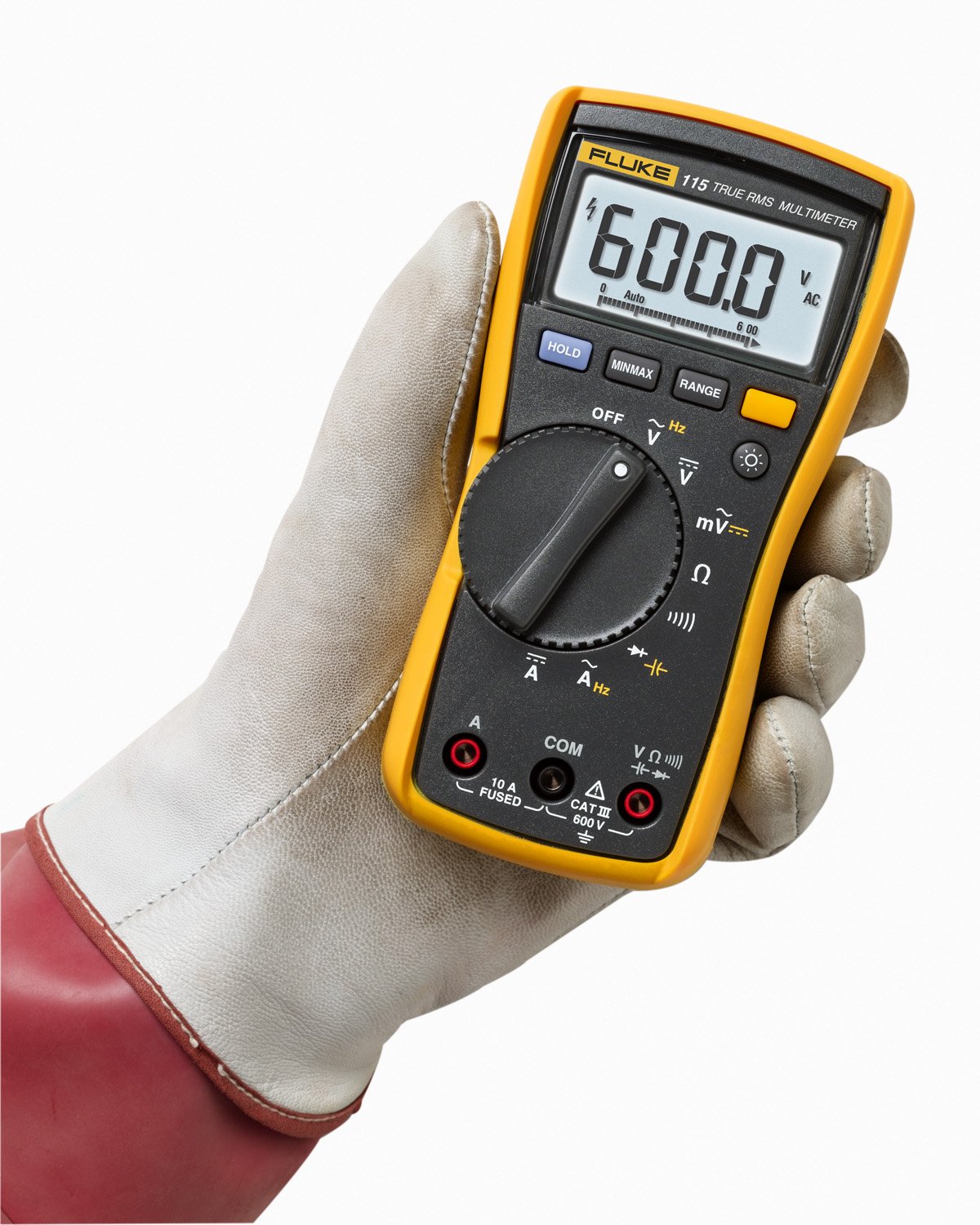
Fluke 115 (~$150–$170): Entry point for the professional 100-series. True RMS, CAT III 600V safety rating, basic continuity and diode check, compact form factor. No frequency measurement, no capacitance, no MIN/MAX recording. It’s a lean tool.
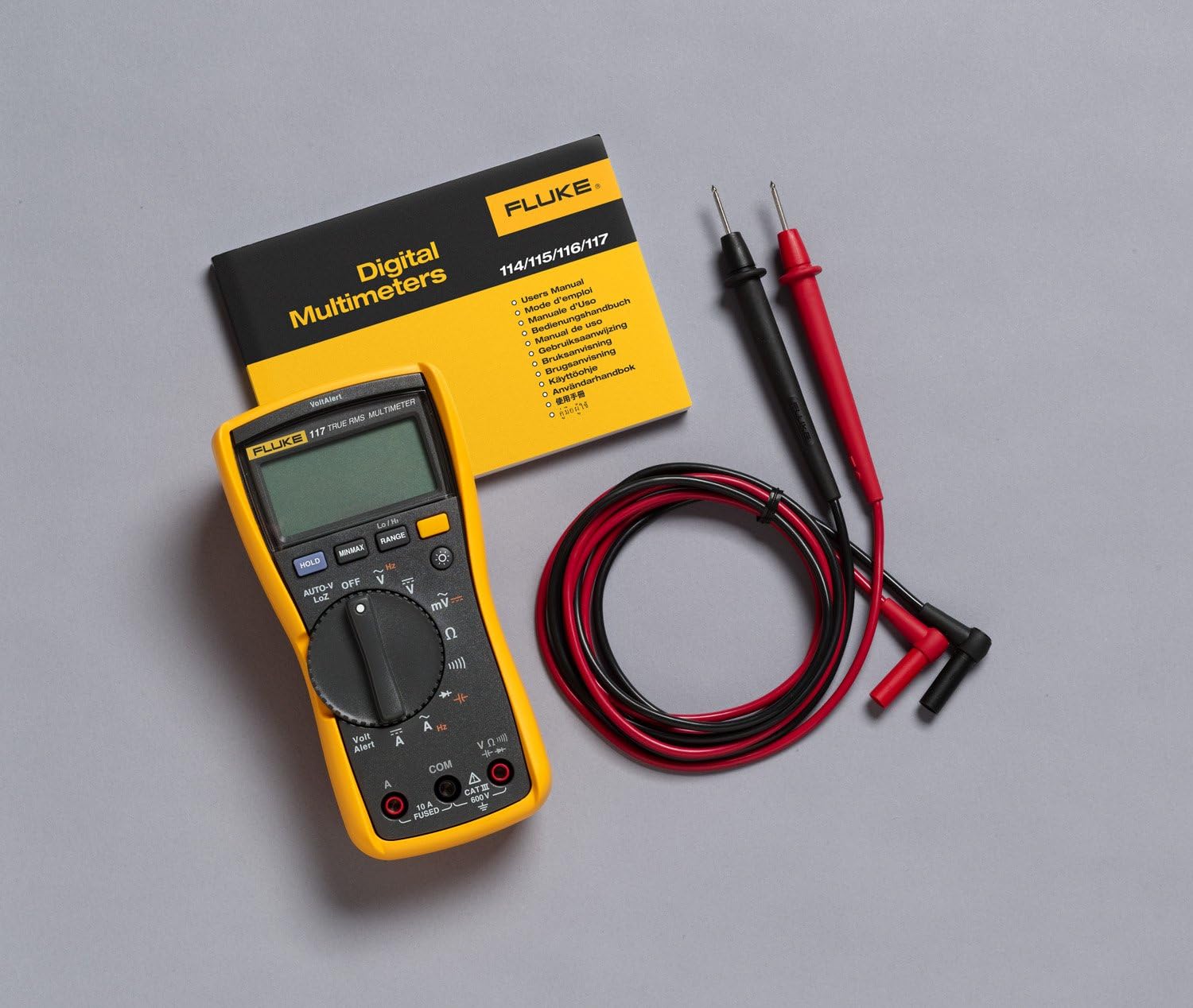
Fluke 117 (~$165–$185): Looks almost identical to the 115, but adds two features that matter enormously in commercial electrical and HVAC work — VoltAlert (a non-contact voltage detector built into the tip) and AutoVolt (automatic AC/DC voltage selection). It also adds a microamps function useful for flame-sensor diagnostics. Same CAT III 600V safety rating.
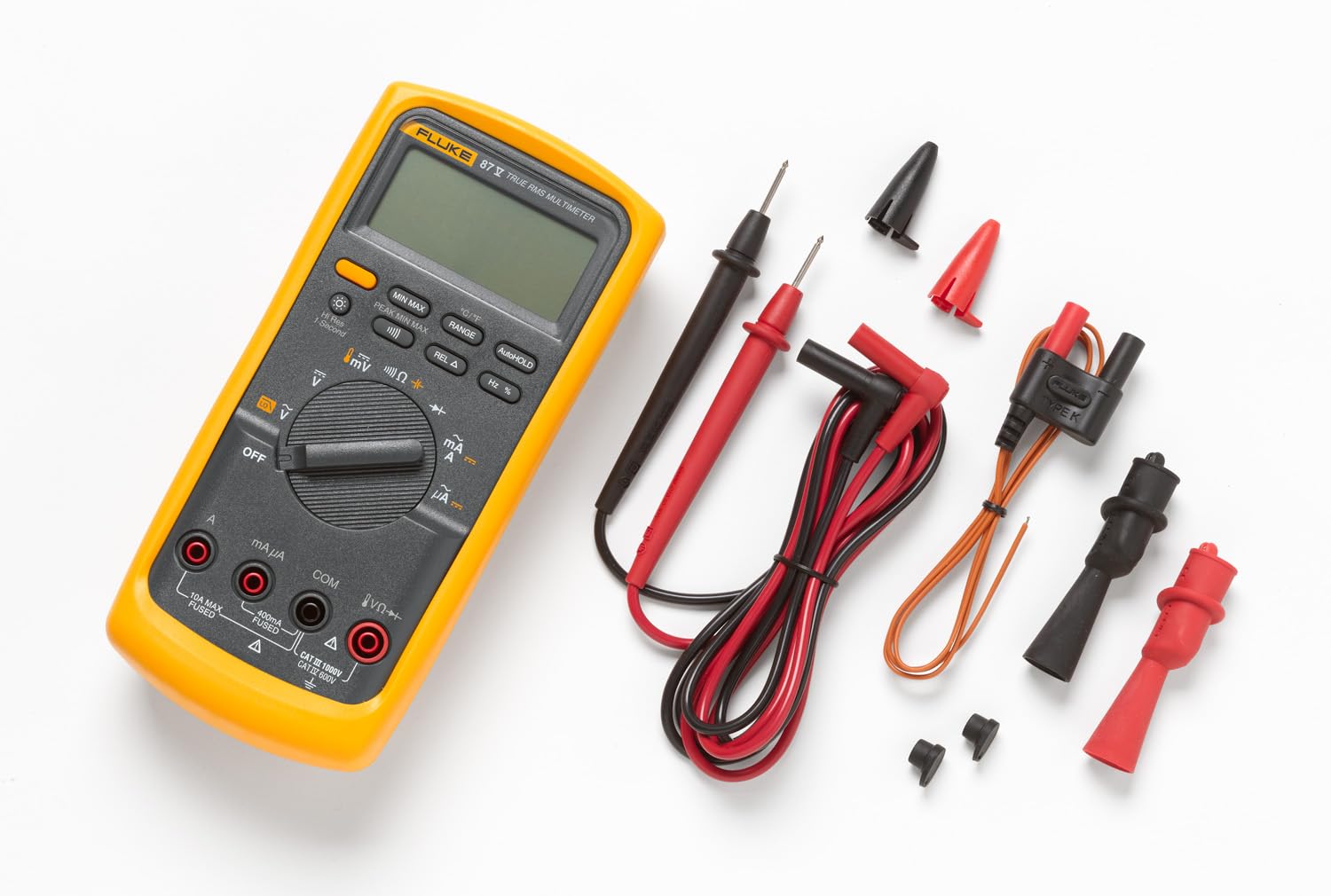
Fluke 87V (~$380–$420 as of mid-2026): The industrial workhorse. CAT III 1000V / CAT IV 600V rated, True RMS with a 0.05% basic DC accuracy specification, 20,000-count display versus the 6,000-count display on the 115/117, frequency measurement up to 200 kHz, duty cycle, capacitance up to 9,999 µF, MIN/MAX/Average recording with a 250 µs peak capture, temperature with a thermocouple input, and a low-pass filter for inverter-driven motor diagnostics. It’s a significantly more capable instrument in almost every dimension.
By the Numbers
| Feature | Fluke 115 | Fluke 117 | Fluke 87V |
|---|---|---|---|
| Display counts | 6,000 | 6,000 | 20,000 |
| Basic DC accuracy | 0.5% | 0.5% | 0.05% |
| CAT rating | CAT III 600V | CAT III 600V | CAT III 1000V / CAT IV 600V |
| Frequency measurement | No | No | Yes (to 200 kHz) |
| MIN/MAX recording | No | No | Yes (250 µs peak) |
| Approximate street price (2026) | ~$155 | ~$175 | ~$400 |
Sources: Fluke Corporation product specification sheets (fluke.com); Test Equipment Depot product listings (testequipmentdepot.com).
The True RMS Question — And Why It Matters More Than You Think
All three meters are True RMS instruments. RMS stands for Root Mean Square — it’s the math that converts an AC waveform into the equivalent DC value that would deliver the same heating effect. The reason this matters: a True RMS meter reads accurately on non-sinusoidal waveforms (distorted, choppy waveforms from variable frequency drives, LED dimmer circuits, electronic ballasts, and switched-mode power supplies), while a cheaper average-responding meter will give you a reading that’s off by a significant margin on those same circuits.
If you’re doing any commercial or industrial work — or residential work involving smart dimmer systems, EV chargers, or solar inverters — True RMS isn’t a nice-to-have, it’s table stakes. The good news: you get it across all three Fluke models discussed here.
The 87V extends that advantage further with its built-in low-pass filter (LPF), which suppresses high-frequency noise from variable frequency drives so you can accurately read the fundamental 50/60 Hz voltage on a motor circuit without the drive’s switching noise corrupting the measurement. EC&M (Electrical Construction & Maintenance) has consistently flagged the low-pass filter as a differentiating feature for industrial maintenance technicians working on motor control centers and drive panels, noting that without it, VFD-fed circuits can produce readings inflated well above the true fundamental voltage.
Match the Meter to the Trade
Residential Electricians and HVAC Technicians: The 117
If your daily work is residential service panels, outlet circuits, HVAC equipment, and light commercial spaces, the Fluke 117 is the better spend over the 115 — for roughly $20 more.
The reason comes down to VoltAlert and AutoVolt. On a residential jobsite, you’re constantly checking whether circuits are live before you touch them. Having a non-contact voltage detector built into the meter tip eliminates the step of pulling out a separate tick tracer, and it removes one more point of user error when you’re moving fast. AutoVolt — automatic switching between AC and DC voltage measurement — sounds like a small convenience, but residential electricians and HVAC technicians consistently report that it speeds up troubleshooting on equipment with both AC supply and DC control circuits, such as thermostat wiring, control boards, and zone valves.
The microamps (µA) function on the 117 is a genuine standout for HVAC contractors. Flame sensors on furnaces and boilers produce a DC microamp signal that tells the control board the burner is lit. According to Fluke Corporation’s application documentation for the 117, flame-sensor verification is a primary intended use case for the microamps function. Without that function, you’re either borrowing a meter or guessing at burner health. With it, you’re reading actual sensor current and identifying a failing sensor before the no-heat call comes at midnight in January.
The 115 costs roughly $20 less and skips VoltAlert, AutoVolt, and microamps entirely. Unless you genuinely never work on HVAC equipment or mixed AC/DC control circuits, that’s not a trade worth making.
Fluke
$252.99
In stock on Amazon
Check price on AmazonCommercial Electricians and Facilities Managers: The 87V
Step into a commercial building — a hospital, a school, a manufacturing facility — and the job complexity changes substantially. Circuits are longer, panels are bigger, loads are non-linear (motor starters, VFDs, UPS systems, LED drivers), and the cost of a wrong reading or a missed intermittent fault is measured in production downtime, not a tripped breaker.
The 87V’s 20,000-count display versus the 6,000-count display on the 115/117 is the difference between resolving 117.3V and 117.32V. That extra resolution matters when you’re trending voltage over time or diagnosing a dropout on a sensitive control circuit. The 0.05% basic DC accuracy (versus 0.5% on the 115/117, per Fluke Corporation specification sheets) matters when you’re calibrating current loops or verifying sensor signals against a known reference.
The MIN/MAX/Average recording with 250 µs peak capture changes the nature of troubleshooting. An intermittent voltage sag that causes a drive to fault, a momentary overvoltage on a lighting circuit when a large motor kicks on — these events happen in milliseconds. A meter with no recording function misses them entirely: you stand there watching the display, and nothing happens. With the 87V in MIN/MAX mode, you leave the meter connected, step away, and return to find the peak capture has logged a 487V spike on a 480V circuit. That’s actionable data.
The CAT IV 600V rating (alongside CAT III 1000V) is the other critical differentiator for commercial and industrial work. CAT ratings describe how much fault energy an instrument can safely interrupt if you contact a live circuit during measurement. CAT IV covers equipment at the utility entrance — the meter base, service entrance conductors, and main distribution panel. NFPA 70E, Standard for Electrical Safety in the Workplace (2024 edition), establishes that using an instrument rated below the CAT category of the circuit being tested is a workplace electrical safety hazard, not merely a measurement concern. Technicians who regularly work at the service entrance or utility side of large commercial installations need CAT IV-rated instruments. The 115 and 117, rated CAT III 600V, do not meet that requirement.
Fluke
$401.53
In stock on Amazon
Check price on AmazonSolar and EV Installation Contractors: A Nuanced Call
Solar and EV installation occupies interesting territory between the two tiers above.
On the DC measurement side — array open-circuit voltage, string currents, battery bank voltage — the 87V’s superior accuracy and higher voltage ratings are meaningful. Residential PV string voltages commonly reach 600V DC, and commercial systems frequently reach 1,000V DC. The 87V’s CAT III 1000V rating covers commercial arrays; the 115/117 at CAT III 600V does not. For EV charging infrastructure, particularly commercial Level 2 and DC fast-charger installation, you’re working at service entrance voltages and three-phase distribution — conditions where the 87V’s CAT IV 600V rating again becomes relevant.
That said, if your solar work is purely residential (sub-600V arrays, single-phase inverters, standard load-center connections) and your EV work is limited to residential EVSE on standard 240V circuits, the Fluke 117 paired with a quality clamp meter rated for higher DC current covers most of what you’ll encounter day-to-day. The 87V is the better instrument across every specification, but whether the $225 price gap is justified depends on your actual scope of work.
The decision rule is straightforward: if you’re working at service entrances, industrial motor circuits, or commercial solar and EV installations above 600V, the 87V is the correct instrument — buy it. If your work is residential and light commercial, buy the 117 and invest the $225 you saved in a quality clamp meter or a full-function insulation tester.
Fluke
$401.53
In stock on Amazon
Check price on AmazonCAT Ratings, Safety Standards, and the Counterfeit Problem
One issue that appears repeatedly in professional trades circles: counterfeit or under-rated instruments sold as equivalent to name-brand meters through unauthorized third-party channels. Instruments that claim CAT III or CAT IV ratings without legitimate third-party certification testing can fail catastrophically under fault conditions — not “reads incorrectly” fail, but arc-flash and explosion fail.
NFPA 70E, Standard for Electrical Safety in the Workplace (2024 edition), addresses instrument selection as part of broader electrical safety program requirements, and the standard’s language on using appropriately rated test equipment is unambiguous. Fluke Corporation publishes guidance recommending purchase through authorized distributors to ensure instrument authenticity. Test Equipment Depot, along with electrical supply houses such as Grainger, Rexel, and Graybar, are authorized Fluke distribution channels. Purchasing a Fluke meter through an unauthorized third-party listing at a price significantly below street value introduces risk that no professional jobsite should accept.
The Bottom Line
Three meters, three use cases, one clear framework:
The Budget-Conscious Professional: Fluke 115
Buy the 115 if budget is the binding constraint and you need True RMS measurement in a compact, reliable form factor. Understand precisely what you’re leaving behind: no frequency measurement, no capacitance, no recording, no VoltAlert, no AutoVolt, no microamps. It’s a capable basic meter, not a capable all-around one.
Fluke
$116.14
In stock on Amazon
Check price on AmazonThe Residential and HVAC Professional: Fluke 117
The right professional daily-driver for residential, light commercial, and HVAC work. VoltAlert and AutoVolt deliver genuine speed and safety advantages on real jobsites. The microamps function for flame-sensor diagnostics is the feature that makes HVAC technicians specifically choose the 117 over the 115. At roughly $20 more than the 115, it’s an easy call.
Fluke
$252.99
In stock on Amazon
Check price on AmazonThe Commercial and Industrial Professional: Fluke 87V
The correct instrument for commercial, industrial, and high-voltage solar and EV work. The 0.05% DC accuracy, CAT IV 600V rating, 20,000-count resolution, MIN/MAX peak capture, low-pass filter, and frequency measurement are not features you’ll use once and forget — they’re the reason you reach for this meter on every complex diagnostic. Per Fluke Corporation’s own specification documentation, no other meter in this comparison group approaches the 87V’s measurement capability across this range of functions.
Buy the meter that matches the work you’re actually doing, not the one that sounds most impressive on the truck. The 87V is exceptional, but an exceptional instrument you don’t need is just an expensive anchor.
Fluke
$401.53
In stock on Amazon
Check price on Amazon