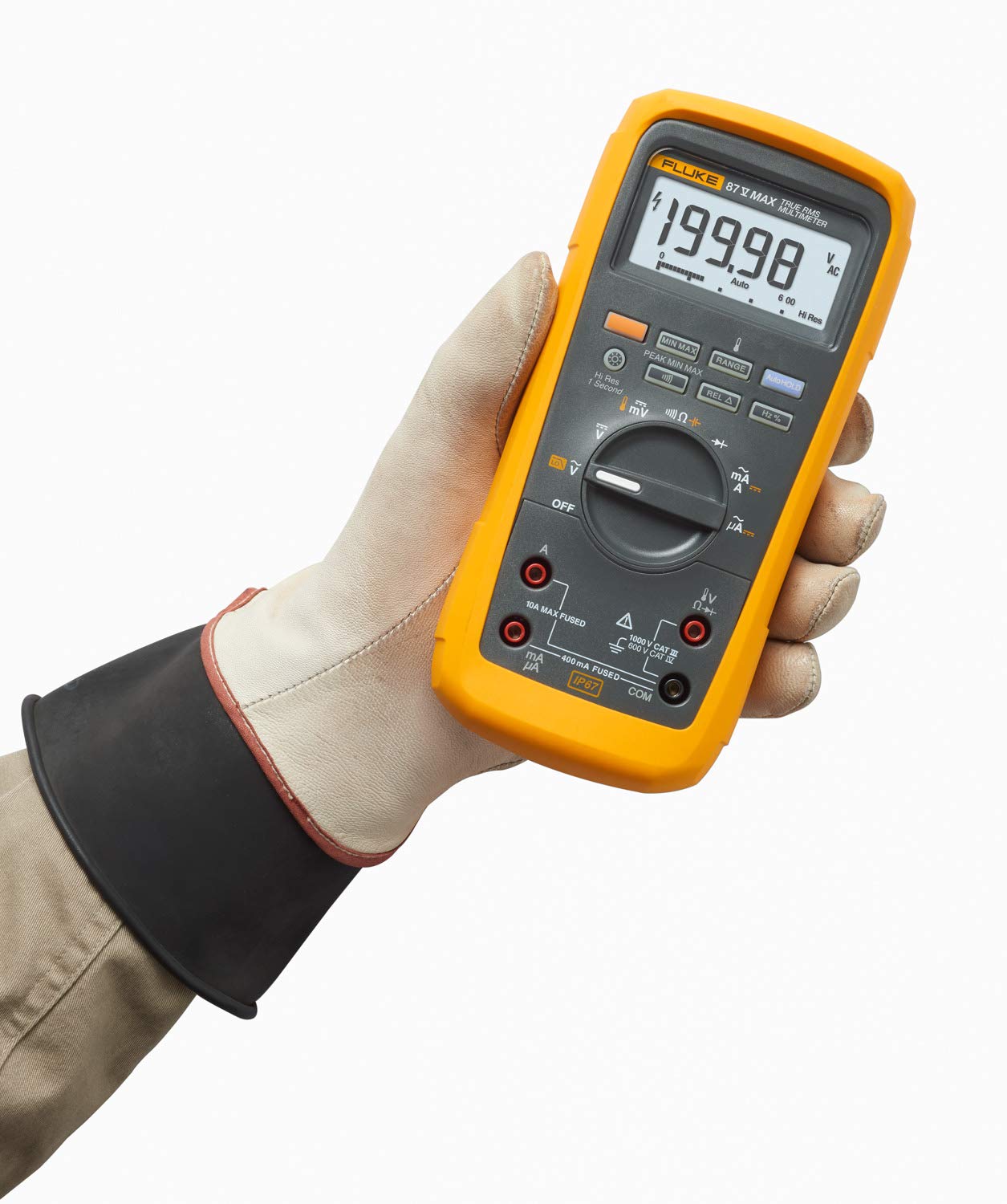
A multimeter — the handheld device electricians use to measure voltage, current, and resistance — is one of those tools where the model you grab in the morning can genuinely affect what you find (and miss) on a job. If you’ve been using a standard Fluke 87V for a while, or you’re deciding between that meter and its newer sibling, the Fluke 87V MAX, you’re in the right place. The core question here is simple: the MAX adds an IP67 rating — meaning it’s sealed against dust and can survive a 30-minute submersion in up to one meter of water — but it costs more, and some experienced users have noticed it feels subtly different to operate. This article walks through the real tradeoffs so you can make the call with clear eyes, whether you’re specifying gear for a shop or deciding what goes in your own bag.
What You Actually Get with IP67 — and What It Changes
Let’s be clear about what IP67 means in practical terms. The “IP” stands for Ingress Protection, a standardized rating system defined by IEC 60529. The “6” means it’s fully dust-tight. The “7” means it survives submersion in one meter of water for 30 minutes. For a multimeter, that’s a meaningful jump from the standard 87V, which carries an IP40 rating — dust-protected on the entry side but essentially not water-rated.
On a dry industrial panel or a residential service call in a controlled environment, IP40 versus IP67 is largely academic. But in the real world — think underground utility vaults with standing water, outdoor solar string combiner boxes after a rainstorm, HVAC mechanical rooms where condensate lines run overhead, or chemical plant environments with wash-down areas — the gap between those two ratings is the difference between a working meter and a dead one.
The Fluke Corporation’s published documentation for the 87V MAX explicitly markets it toward these harsh-environment use cases: outdoor utility work, industrial processing environments, and anywhere the tool is likely to get wet or coated. The standard 87V, meanwhile, has spent decades earning its reputation in the more controlled environments that represent the majority of commercial and residential electrical work.
By the numbers:
| Feature | Fluke 87V (Standard) | Fluke 87V MAX |
|---|---|---|
| IP Rating | IP40 | IP67 |
| CAT Rating | CAT III 1000V / CAT IV 600V | CAT III 1000V / CAT IV 600V |
| True RMS | Yes | Yes |
| Display Counts | 6000 | 6000 |
| Temperature Input | Type K thermocouple | Type K thermocouple |
| AC Frequency Measurement | Yes | Yes |
The safety ratings are identical — both meters are CAT III rated to 1000V and CAT IV rated to 600V, which means both are appropriate for measurements at the service entrance level and in industrial distribution environments. That’s important context: you’re not giving up any safety rating to get the IP upgrade.
The Response-Time Issue: A Real Signal from the Field
Here’s where this comparison gets genuinely useful for practitioners, and it’s something that doesn’t show up in spec sheets.
Across aggregated owner reviews, a recurring pattern appears with the 87V MAX that’s worth surfacing directly: at least one documented owner report describes the meter as feeling “a little slower on startup” compared to the standard 87V, and notes behavioral differences in how it responds during diagnostic routines. Critically, this reviewer attributed the behavior not to a defect or a bad unit, but to a firmware or hardware characteristic of the MAX — and found it disqualifying enough to return the meter.
That’s a real data point. The standard 87V has decades of field endorsement behind it. Reviewers and long-career professionals across the electrical trades have consistently called the 80-series Fluke their “bread and butter” instrument, precisely because of its predictable, snappy response in diagnostic workflows where you’re moving quickly through a panel or tracing a circuit fault. If your work involves that kind of high-speed diagnostic rhythm — checking breakers one after another, verifying feed voltage at multiple points on a motor control center — even a small hesitation in response time changes the ergonomics of your day.
Per Test Equipment Depot’s overview notes, the 87V MAX uses the same core measurement engine, but the waterproofing enclosure adds mechanical complexity that can affect startup and display behavior in ways that feel different to an experienced 87V user. This isn’t a quality failure — it’s an engineering tradeoff. To achieve IP67, the physical design has to change. Gaskets, sealed battery compartments, and ruggedized case geometry all add mass and change thermal behavior. Some users adapt quickly. Others find it genuinely disruptive to muscle memory built around the standard unit.
The decision frame here is straightforward: If you already own a standard 87V and you’re considering the MAX as a primary meter replacement, spend time with the MAX before committing. If it’s going to a field tech who has never used an 87V before, this distinction matters less — they’ll calibrate to whatever they start with.
Where the IP67 Upgrade Clearly Earns Its Price
For the right environments, the MAX is the obvious call. Here’s where the argument is essentially closed:
Outdoor utility and solar work. Solar string combiner boxes, DC disconnect panels, and rooftop inverter systems all live in environments where rain and condensation are routine. EC&M’s editorial coverage of industrial multimeter selection consistently emphasizes that IP-rated meters earn their premium through longevity — a standard meter that gets moisture-damaged on a wet jobsite becomes expensive very quickly when you factor in replacement cost.
Underground and vault work. If you’re pulling measurements in underground utility vaults, manholes, or any confined space where standing water is a realistic scenario, IP67 is less a luxury and more a minimum standard. A non-rated meter failing in that environment creates both an equipment cost and a potential safety situation.
Industrial process environments. Chemical plants, food processing facilities, and pulp and paper operations often have wash-down protocols that can catch a non-rated meter at any moment. In these environments, the MAX’s sealed design is the right tool specification, full stop.
HVAC mechanical rooms and refrigeration. Condensate, refrigerant leaks, and high-humidity environments make water ingress a routine concern. HVAC technicians who use the built-in Type K thermocouple input — available on both the 87V and the 87V MAX — will find the MAX’s IP protection genuinely relevant when probing near cooling coils or drain pans.
A retired avionics engineer reviewing the closely related Fluke 115 noted that it covered roughly 90% of their aircraft systems work, which is a useful benchmark: the 87V MAX sits above even that — it’s a top-of-pyramid instrument built for the 10% of environments where a standard professional meter would be at risk.
Where the Standard 87V Still Wins
Outside of wet, dirty, or submersion-risk environments, the standard 87V’s decades of refinement show. Owners in long-run reviews describe using it through prototype automotive electrical builds and complex commercial control panel diagnostics, crediting the meter’s consistency and the community of professionals around it. When colleagues with 20-year careers describe the 80-series as Fluke’s “bread and butter,” they’re pointing at something real: the standard 87V is a known quantity in a way that the MAX, being newer to market, hasn’t fully accumulated yet.
For residential electrical work, light commercial service work, industrial panel maintenance in dry indoor environments, and any application where IP40 is more than adequate — the standard 87V is the better instrument on the margin, specifically because of the response-time and startup-feel characteristics some MAX owners flag.
Where Both 87V Variants Fit in the Broader Fluke Hierarchy
If you’re evaluating whether you need an 87V at all versus a Fluke 115 or Fluke 117, here’s the honest positioning:
The Fluke 115 and 117 are excellent meters for residential work, HVAC, and facilities maintenance where voltage, continuity, and basic AC current measurement cover the vast majority of tasks. A retired avionics professional’s observation that the 115 handled 90% of their aircraft electrical work frames the 115’s ceiling clearly — it’s a capable instrument that stops short of the 87V’s specialties.
What the 87V adds — in both standard and MAX forms — is frequency measurement for variable-frequency drives (VFDs), a higher display resolution (6000 counts versus 4000 on the 115/117), enhanced low-pass filter mode for noisy drive environments, and a temperature measurement input via Type K thermocouple. For industrial maintenance, motor diagnostics, and drive troubleshooting, those aren’t optional features — they’re the whole point of the upgrade.
Frequently Asked Questions
Is the Fluke 87V MAX the same meter as the standard 87V with just an IP rating added?
Not exactly. The core measurement specification — True RMS, 6000-count display, CAT III 1000V / CAT IV 600V safety rating — is shared between both meters. But to achieve IP67, the physical enclosure design changes significantly, and some owners have noted behavioral differences in startup speed and operational feel. It’s more accurate to say it’s a variant built around the same measurement engine, not simply a waterproofed copy. Per Fluke’s published documentation, both models share the same fundamental architecture, but the MAX’s sealed design represents meaningful engineering changes.
Does IP67 protection affect measurement accuracy or response time?
Published specifications show identical accuracy ratings for both meters, so on paper there’s no difference. However, aggregated owner reviews include at least one credible account of the MAX feeling “a little slower on startup” than the standard 87V — attributed to a hardware or firmware characteristic, not a defect. Measurement accuracy (the numbers it reports) appears equivalent based on published specs. The difference, where it exists, is in operational responsiveness and feel during rapid diagnostic work.
How long do Fluke 87V meters typically last in daily professional use?
Owner accounts in long-run reviews consistently describe Fluke 87-series meters lasting 10 to 20 years in active professional service with basic maintenance. Fluke’s broader reputation in the industry, documented extensively in EC&M’s coverage of professional-grade test instruments, is built around longevity as a core value proposition. Battery replacement and occasional probe replacement represent the primary maintenance costs for most users.
Is the built-in thermometer on the 87V MAX useful for HVAC or industrial work?
Both the standard 87V and the 87V MAX accept a Type K thermocouple probe for temperature measurement, making them legitimately useful for HVAC differential temperature readings, motor winding temperature checks, and industrial process monitoring. The MAX’s IP67 rating makes this combination particularly practical for HVAC work where moisture exposure is a routine concern — you’re using the thermometer near condensate, cooling coils, or refrigerant lines where a standard meter’s IP40 rating starts to feel thin.
What does the Fluke 87V offer that the Fluke 115 or 117 does not?
The three differences that matter most for practitioners: first, the 87V includes a low-pass filter mode designed for accurate measurements on variable-frequency drive (VFD) outputs, where the 115 and 117 can give misleading readings due to high-frequency switching noise. Second, the 87V has a higher display resolution at 6000 counts versus 4000 counts on the 115/117, relevant when you need more granularity on small voltage differences. Third, the 87V includes frequency measurement and the Type K thermocouple input, features that are absent or limited on the 115/117. For residential work, those additions rarely matter. For industrial and motor-control environments, they’re frequently the deciding factor.
The Decision Rule
If your work involves wet environments, outdoor installations, underground vaults, industrial wash-down areas, or any regular exposure scenario where a non-rated meter is at legitimate risk — go with the 87V MAX. The IP67 protection will pay for the price premium the first time a meter survives something the standard unit wouldn’t.
If you’re working primarily in dry commercial and industrial environments, you already know the standard 87V’s feel, and you depend on its snappy response for high-speed diagnostic work — stay with the standard 87V. The startup and response characteristics that some MAX owners flag aren’t trivial if your workflow involves rapid sequential measurements. You’re not giving up safety ratings or measurement capability. You’re keeping the instrument you’ve already built intuition around.
If you’re buying your first 87V and environmental exposure is genuinely uncertain, lean toward the MAX — you’ll never regret having the IP protection on a day when you need it.