A clamp meter is a handheld electrical tester shaped like a C — you open the jaw and clamp it around a single wire, and the meter reads how much current (measured in amps) is flowing through that wire without cutting into the circuit. No probes, no disconnecting anything. For a residential electrician, that’s the difference between a five-second measurement on a live branch circuit and a half-hour shutdown. If you’re newer to the trade, think of current as the volume of electricity flowing, and the clamp meter as the speedometer that reads it. This article compares three popular entry-to-mid clamp meters — the Fluke 323, the Klein CL120, and the Klein CL220 — so you can pick the right one before your next service call, not after.
These three meters sit in a similar price band and are aimed squarely at residential and light commercial work: panel inspections, load calculations, circuit troubleshooting, and HVAC checks. They are not the same tool. The differences are subtle on paper and significant on the job, and the wrong choice costs you either money or capability. Let’s break it down.
| EDITOR'S PICKFluke 323 Clamp Meter for Comme… | Mid-tierKlein Tools CL220 Digital Clamp… | Budget pickKlein Tools CL120 Digital Clamp… | |
|---|---|---|---|
| TRMS | — | ✓ | — |
| Temp Measurement | — | ✓ | — |
| NCVT | — | ✓ | ✓ |
| Warranty | 2 Year | — | — |
| Price | $165.97 | $69.97 | $59.97 |
| See on Amazon → | See on Amazon → | See on Amazon → |
What Each Meter Actually Does — and Doesn’t Do
Fluke 323: The Premium Workhorse
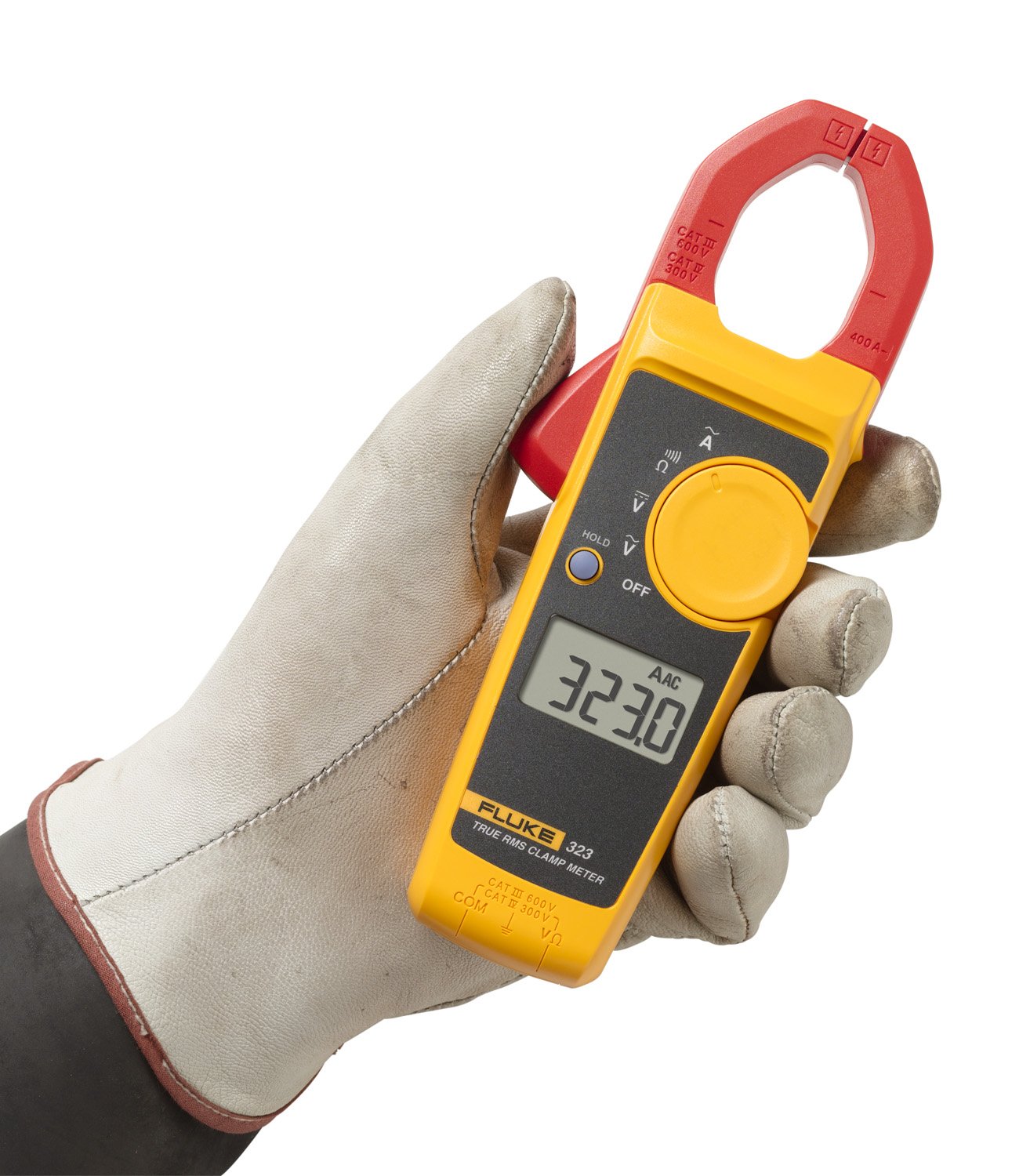
Fluke
$165.97
In stock on Amazon
Check price on AmazonThe Fluke 323 is a True-RMS clamp meter, which means it accurately measures non-sinusoidal AC waveforms — the kind produced by variable-speed motor drives, dimmers, and inverters. If you’re only measuring resistive loads (baseboard heaters, straight-resistance water heaters), True-RMS doesn’t buy you much. If you’re measuring loads with any electronics in them — and in 2026, most residential loads have something with a switching power supply — True-RMS matters. A non-True-RMS meter can read 10–20% low on those loads, which throws off your load calculations.
According to Fluke Corporation’s published Fluke 323 True-RMS Clamp Meter Product Specification Sheet, the 323 delivers 400A AC jaw capacity, basic voltage measurement up to 600V AC/DC, resistance, and continuity. The accuracy specification is ±2% ±5 digits for AC current. More on what that means in the FAQ section below.
What the 323 does not do: no DC current measurement via the clamp jaw, no temperature, no capacitance, no frequency on current. It is deliberately stripped down. Owners consistently describe it using words like “solid” and “dependable,” and many report using their second unit after wearing out the first — which is a different kind of endorsement than feature enthusiasm. It’s a workhorse that does a focused job well.
Per Fluke Corporation’s product specification documentation, the 323 is CAT III 600V / CAT IV 300V rated. CAT ratings describe how much transient energy a meter can survive on a given type of electrical system — CAT III covers distribution panels and fixed installations; CAT IV covers the utility service entrance and outdoor conductors. Having both ratings on a residential meter gives you real working margin.
Fluke
$165.97
In stock on Amazon
Check price on AmazonKlein CL120: The Budget Entry Point
Klein
$59.97
In stock on Amazon
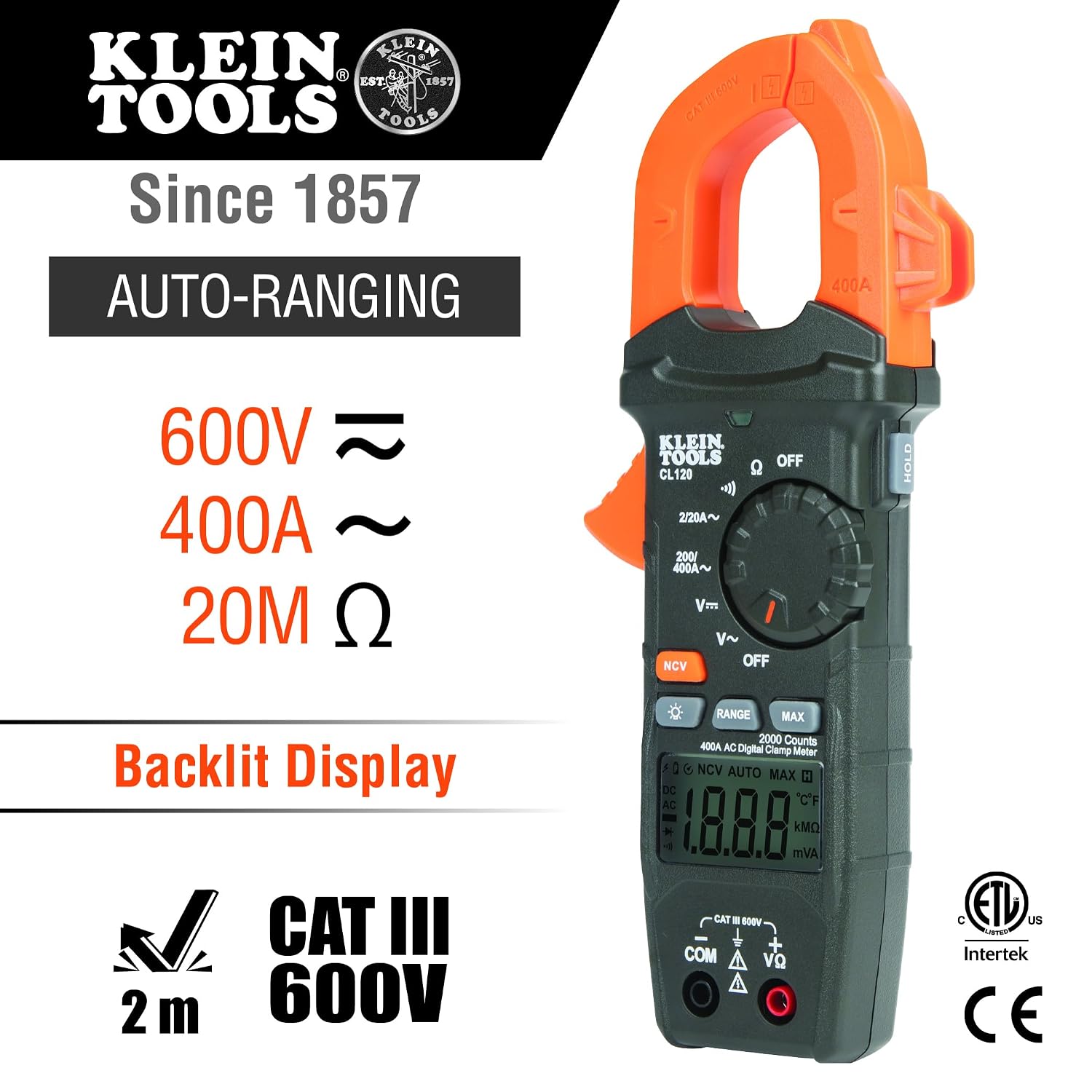
Check price on AmazonThe Klein CL120 targets the same residential workflow with a slightly different feature set. According to Klein Tools’ CL120 product specification documentation, it measures AC current to 400A, AC/DC voltage to 600V, resistance, continuity, and diode test. Like the 323, it is True-RMS.
What the CL120 adds over the 323: non-contact voltage detection (NCV) is built in, which many owners find useful for quick live-wire checks before touching anything. What it lacks compared to the CL220: no temperature measurement, no DC current clamp measurement, and no capacitance.
One specific use case the CL120 is well-suited to: load-balancing 240V circuits. Because the CL120 reads each hot leg independently, you can clamp leg A, note the amps, clamp leg B, and compare — a quick sanity check that the load is balanced and you’re not overloading one leg of a split-phase service. That’s a practical, repeatable task where the CL120 earns its place.
Per Klein Tools’ specification documentation, the CL120 is CAT III 600V rated — one step below the dual CAT III/IV rating of the 323 and CL220. For most residential panel work that distinction is academic, but at the utility meter socket or service entrance conductors the CAT IV margin matters.
Klein
$59.97
In stock on Amazon
Check price on AmazonKlein CL220: The Mid-Tier Versatility Pick
Klein
$69.97
In stock on Amazon
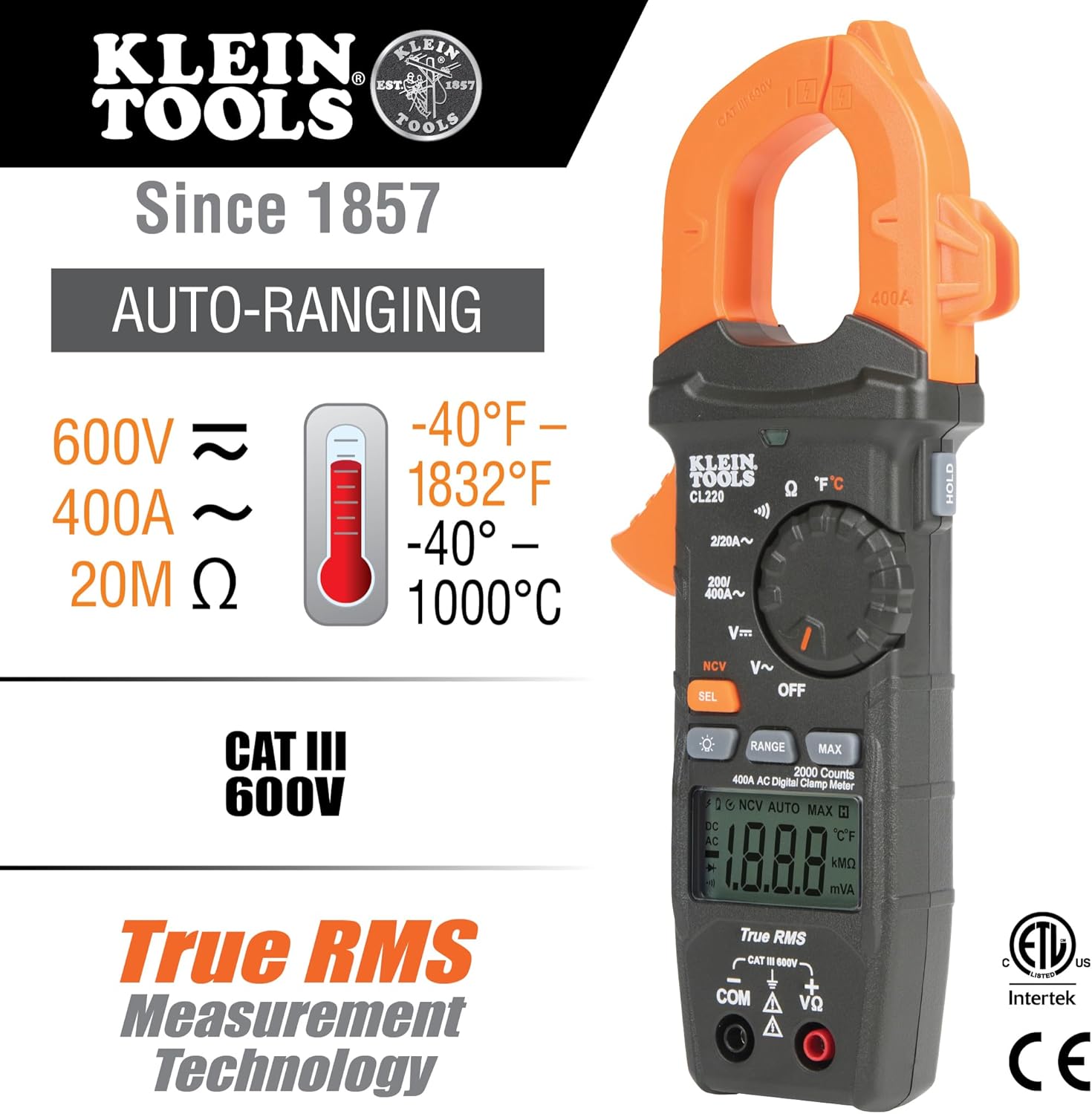
Check price on AmazonThe CL220 is the CL120’s bigger sibling, and the most important addition is temperature measurement via a Type K thermocouple input. For residential electricians who also do any HVAC-adjacent work — checking suction line temps, verifying heat strip operation, or spotting a hot connection at a terminal — the thermocouple input turns this from a single-discipline tool into something more versatile.
According to Klein Tools’ CL220 product specification documentation, the meter measures AC current to 400A, AC/DC voltage to 600V, resistance, continuity, diode test, and capacitance. Like the CL120, it is True-RMS and includes NCV. It does not measure DC current via the clamp jaw — a limitation worth knowing if you’re doing any solar or battery storage work.
CAT rating per Klein Tools’ published specifications: CAT III 600V / CAT IV 300V — matching the Fluke 323 and giving you full coverage from the service entrance through the distribution panel.
Klein
$69.97
In stock on Amazon
Check price on AmazonBy the Numbers
| Meter | AC Current | True-RMS | Temp | Capacitance | DC Clamp | CAT Rating | Approx. Street Price |
|---|---|---|---|---|---|---|---|
| Fluke 323 | 400A | ✓ | ✗ | ✗ | ✗ | CAT III 600V / CAT IV 300V | ~$100–$130 |
| Klein CL120 | 400A | ✓ | ✗ | ✗ | ✗ | CAT III 600V | ~$60–$80 |
| Klein CL220 | 400A | ✓ | ✓ | ✓ | ✗ | CAT III 600V / CAT IV 300V | ~$90–$120 |
Street prices reflect 2026 market conditions and vary by retailer and bundle.
Brand Reputation, Build Quality, and Trust at the Panel
This is where the honest conversation gets harder. On spec sheets, the three meters look nearly equivalent for core residential tasks. The differentiation is in build durability, support ecosystem, and trust at the panel.
Fluke’s reputation in the trade is earned over decades. The 323 is manufactured to Fluke’s quality control standards and backed by their warranty and support network. Test Equipment Depot’s Clamp Meter Accuracy and CAT Rating Overview consistently cites Fluke instruments as a technician benchmark for reliability in field conditions. That’s not marketing — it’s why journeymen on commercial jobs insist on Fluke even when the spec sheet on a cheaper option looks similar.
Klein Tools is a legitimate, U.S.-based hand tool and instrument manufacturer with a real engineering team and a long history in the electrical trade. Their clamp meters are not counterfeit-market instruments. EC&M (Electrical Construction & Maintenance), in their Clamp Meter Selection Guide, acknowledges Klein as a credible entry-to-mid option, particularly for electricians already working within the Klein ecosystem for hand tools.
The gap between Fluke and Klein in this price tier is real but narrower than it was five years ago. If you’re a residential electrician working alone or in a small crew, the Klein CL220 at its price point is a defensible choice. If you’re on a commercial crew where a meter failure means pulled work or a callback, the Fluke 323’s track record earns the premium.
Decision Framework: If X, Then Y
Here’s the plain-language decision rule:
If you want the most field-proven tool in this tier and you don’t need temperature: Get the Fluke 323. The CAT IV 300V rating gives you margin at the service entrance. It does less than the CL220, but what it does, it does with a depth of reliability that justifies the price over years of daily use.
If you’re price-sensitive and your work is residential-only with no HVAC crossover: The Klein CL120 covers the basics at the lowest entry cost in this comparison. The NCV is a practical bonus. Just know you’re on CAT III only and the brand depth isn’t Fluke’s.
If you do any HVAC-adjacent work or want one tool to serve two disciplines: The Klein CL220 is the rational pick. The temperature input is genuinely useful, the CAT III 600V / CAT IV 300V rating matches the Fluke 323, and the price delta over the CL120 is modest relative to the capability gain.
If you’re buying the CL120KIT: The kit adds voltage test leads, a carrying case, and additional accessories — practical value if you’re outfitting from scratch. The base meter’s specifications and limitations don’t change.
Frequently Asked Questions
1. Can the Fluke 323 measure DC current or only AC?
The Fluke 323 measures AC current only via the clamp jaw. It measures both AC and DC voltage with probe leads, but the clamp function is AC-only. Per Fluke Corporation’s published Fluke 323 True-RMS Clamp Meter Product Specification Sheet, there is no DC current clamp mode. If DC current measurement matters to you — solar string current, battery bank current, EV charging verification — you need a different tool, such as the Fluke 324 or a meter with a Hall-effect DC clamp function.
2. What is the difference between the Klein CL120 and CL220 beyond temperature?
The temperature input (Type K thermocouple) is the headline difference, but the CL220 also adds capacitance measurement and carries a CAT IV 300V rating alongside CAT III 600V, matching the Fluke 323’s full safety envelope. Per Klein Tools’ CL120 specification documentation, the CL120 is CAT III 600V only. In practice, the CAT IV rating matters most at the utility meter socket and service entrance conductors — two locations a residential electrician visits regularly on service upgrades and new installs.
3. Is the CL120KIT worth buying over the bare CL120 meter?
The CL120KIT bundles the CL120 clamp meter with voltage test leads, a carrying case, and additional accessories. If you’re building your first tool kit or replacing worn accessories, the bundle represents practical convenience value. A common use case cited by owners: using the kit to load-balance 240V split-phase circuits by clamping each hot leg independently to compare draw. If you already have leads and a case you like, the bare meter makes more sense.
4. What does ±5 counts mean in practice for residential load measurements?
Accuracy specs like ±2% ±5 digits have two components. The ±2% is a percentage of the reading. The ±5 digits (counts) is a fixed error floor — the last digit of the display can be off by up to 5 regardless of the reading value. Test Equipment Depot’s Clamp Meter Accuracy and CAT Rating Overview explains this dynamic clearly: at high currents — say, 200A on a main feeder — 5 counts on a 400-count display is a rounding error. At low currents — say, 1.2A on a lighting circuit — 5 counts can represent a meaningful percentage of your reading. For residential load calculations where you’re measuring 10A or more, this is rarely a real-world problem. For measuring standby loads or branch circuits with very light draw, it’s worth knowing before you rely on the reading.
5. Do any of these entry clamp meters support inrush current measurement?
None of the three — the Fluke 323, Klein CL120, or Klein CL220 — include an inrush current capture mode. Inrush capture (sometimes called peak capture or in-rush hold) holds the peak current spike that occurs when a motor or compressor starts, which can be 6–10× running current for a fraction of a second. Per Fluke Corporation’s product line documentation, that feature appears in mid-to-upper-tier clamp meters such as the Fluke 325 or 376 FC. If you’re troubleshooting nuisance breaker trips on motor loads or compressors, the absence of inrush measurement in this tier is a real limitation, and it’s worth knowing before you buy.
Across these three meters, the honest ranking for a residential electrician in 2026 is: CL220 for versatility, 323 for proven reliability, CL120 for budget entry. None of them are wrong choices for residential work. All three are real instruments from manufacturers with accountable supply chains — not counterfeit-market junk. The decision comes down to how much you value temperature measurement, how deeply you weight Fluke’s multi-decade track record, and what your current workflow actually demands day to day.