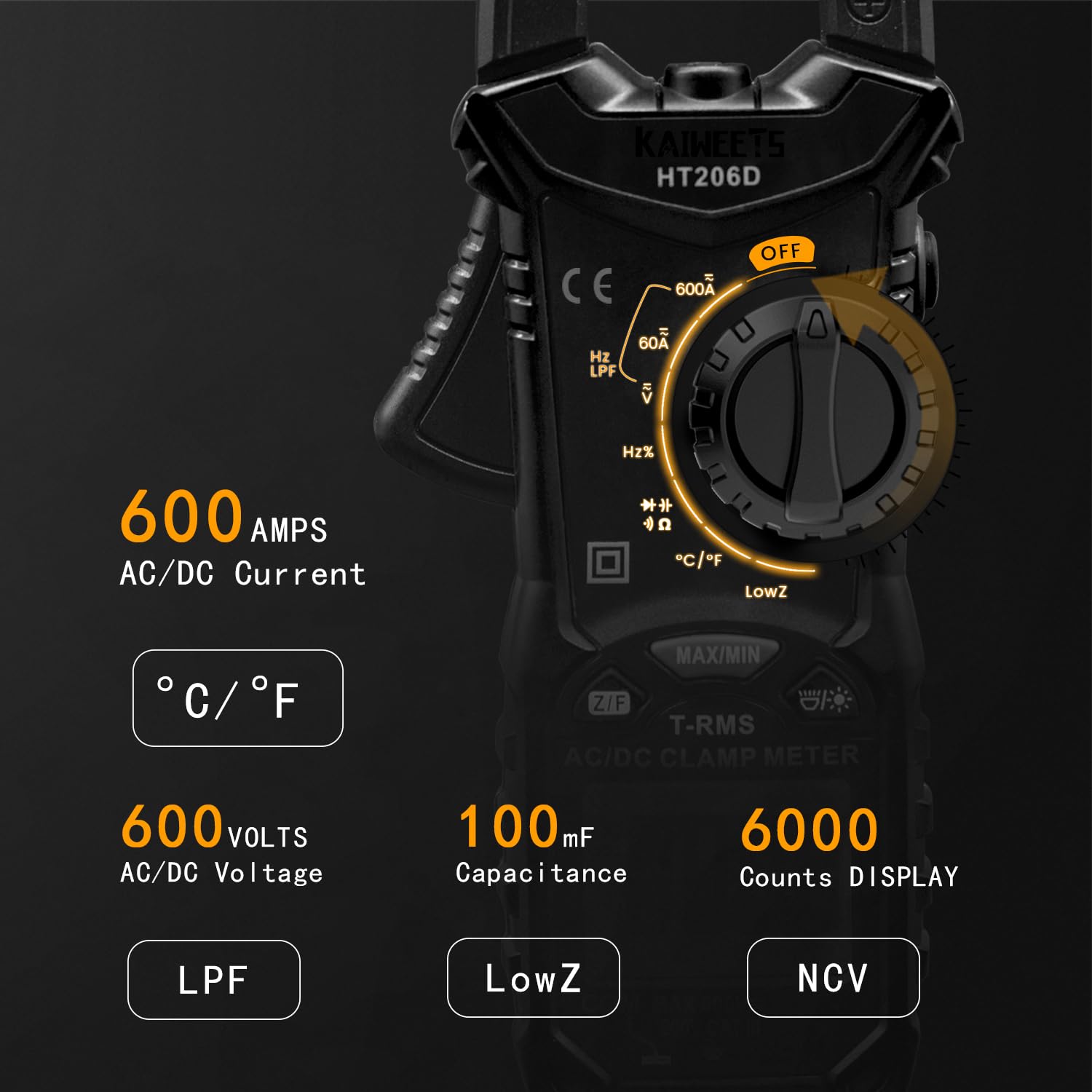
A clamp meter is exactly what the name suggests: a meter with a hinged jaw that clamps around a single wire so you can read the current flowing through it — no need to cut the circuit, no need to touch the live conductor. Most electricians carry one from day one. But the clamp meters designed for standard residential panel work can quietly fail you on a solar or EV installation, not because they’ll give you the wrong reading on your first measurement, but because they may not measure DC current at all, may not be rated for the voltage environment you’re working in, or may have a jaw too small to fit around a 4/0 aluminum service conductor. This guide walks through the three specs that actually separate the right tool from the wrong one for photovoltaic (solar) and EV charging work — so you can make a clean decision before the job starts.
Why Solar and EV Work Breaks the Rules for Ordinary Clamp Meters
Standard clamp meters work on a principle called electromagnetic induction: when AC current flows through a conductor, it creates a changing magnetic field, and the meter’s jaw acts like a transformer core to sense that field. It’s elegant and it works great — for AC.
The problem is that solar panels generate DC (direct current), and so does the battery side of every EV charging circuit. DC doesn’t create a changing magnetic field. A basic inductive clamp meter reads zero on a DC conductor, full stop. To measure DC current with a clamp meter, the instrument needs a different sensing technology — typically a Hall-effect sensor, a semiconductor device that responds to static magnetic fields. This adds cost and manufacturing complexity, which is why Hall-effect clamp meters cost more than their AC-only counterparts.
On the EV side, the DC fast-charging infrastructure story is similar. A Level 2 EVSE (Electric Vehicle Supply Equipment — the charger box on the wall) is technically AC, but the current levels are high — 40 A to 80 A is common on commercial sites — and the conductors are often bundled tightly, which creates the jaw-size problem discussed below. DC fast chargers (DCFC) operating at 480 V DC and above introduce an even more serious concern: CAT ratings, the safety classification system that determines whether your meter can survive a voltage spike without arcing through the instrument and into you.
CAT Ratings: The Number That Determines Whether You Go Home
Every professional-grade meter sold in North America and Europe carries a CAT rating defined by IEC 61010-1. The categories run from CAT I (low-energy electronics) to CAT IV (utility service entrance, outdoor transmission), and each step up represents a higher overvoltage pulse the meter is designed to withstand without failure.
Here’s where solar and EV work gets genuinely dangerous if you reach for the wrong meter:
| Environment | Minimum CAT Rating | Typical Voltage |
|---|---|---|
| Residential panel (AC load side) | CAT III 300 V | 120 / 240 V |
| Commercial distribution (feeder) | CAT III 600 V | 480 V |
| PV array combiner box / string wiring | CAT III 600 V | 600–1000 V DC |
| Utility-interactive inverter output | CAT III 600 V | 240 / 480 V AC |
| DC fast charger bus (DCFC) | CAT III 1000 V | up to 1000 V DC |
| Service entrance / utility transformer | CAT IV 600 V | 208–480 V |
Per Fluke Corporation’s Clamp Meter Selection Guide, the CAT rating must match the installation category of the measurement point, not just the nominal voltage of the system. A residential-grade CAT II 600 V meter on a 600 V DC PV combiner box is underrated for the transient energy available at that point — the meter can survive continuous voltage, but a lightning-induced surge or capacitive discharge can exceed its impulse withstand rating and cause catastrophic failure.
Equally important: NFPA 70E (2024 edition) requires that test equipment be rated for the available fault energy at the measurement point. If your instrument isn’t rated for the environment, using it isn’t just risky — it’s a code compliance issue on commercial and industrial sites.
One more thing about counterfeits. The market for test instruments sold through third-party online storefronts has a documented counterfeit problem. Meters labeled “CAT III 1000V” from unfamiliar brands frequently have their safety ratings silk-screened on but not engineering-validated. Test Equipment Depot’s product listings consistently note that name-brand instruments (Fluke, Hioki, Ideal, Klein, Greenlee) carry independently verified CAT ratings — and that’s a strong reason to buy from an authorized distributor rather than a third-party marketplace seller.
DC Accuracy: Not All Hall-Effect Sensors Are Equal
Once you’ve confirmed a clamp meter has a Hall-effect sensor for DC, the next question is how accurately it measures — and this matters more in solar work than almost anywhere else.
A PV string’s performance is calculated from its current output relative to its rated short-circuit current (Isc). If you’re troubleshooting why String 3 in a 10-string array is underperforming, you need to detect a difference of maybe 0.3 A on a 10 A string. A meter with ±3% DC accuracy introduces ±0.3 A of uncertainty on a 10 A reading — which means the measurement noise is as large as the defect you’re trying to find.
The professional benchmark for solar and EV diagnostic work is ±1.5% or better DC accuracy. Here’s how three commonly specified instruments stack up on that number, based on published specifications:
By the numbers — DC clamp accuracy at 10 A (manufacturer-rated):
- Fluke 393 FC (solar-rated, True-RMS, CAT III 1500 V): ±1.5% + 5 counts
- Hioki CM4373 (DC/AC clamp, CAT III 600 V): ±1.0% + 5 counts
- Fluke 376 FC (general high-current, CAT III 600 V): ±2.0% + 5 counts
The Fluke 393 FC is the instrument that comes up most consistently in Electrical Construction & Maintenance coverage of PV commissioning work — it’s rated specifically to 1500 V DC CAT III, which aligns with modern residential and commercial PV systems that have moved to 1000 V and 1500 V string voltages. The Hioki CM4373 offers tighter DC accuracy and is frequently specified by facilities managers handling EV charging infrastructure alongside HVAC loads, per aggregated reviews on Test Equipment Depot. The Fluke 376 FC costs less and handles most Level 2 EVSE commissioning work, but its DC accuracy spec puts it at the edge for string-level PV troubleshooting.
If you’re doing system commissioning only and not fault diagnosis, ±2% may be acceptable. If you’re troubleshooting an underperforming string or validating a DC fast charger output, spend the extra money for ±1.5% or better.
Jaw Size: The Spec Everyone Forgets Until They’re on the Roof
Jaw opening diameter is listed in every spec sheet and ignored by most buyers until they’re standing in front of a cable tray and realizing the jaw won’t close around the conductor.
PV systems increasingly run on 4 AWG to 2/0 AWG copper or aluminum for homerun conductors, and commercial arrays may use 350 kcmil or 500 kcmil aluminum for feeder runs from the combiner box to the inverter. A standard clamp meter jaw opens to about 30–32 mm (roughly 1.25 inches). That’s fine for most residential branch circuits. It is not fine for 350 kcmil aluminum, which has an insulated outside diameter closer to 38–42 mm depending on insulation thickness.
EV charging infrastructure adds a different wrinkle: Level 2 commercial EVSE installations often run conductors in tight conduit bundles, and you need to get the jaw around a single conductor in a crowded conduit box. A slim-jaw design (narrow profile, standard opening) is more useful here than a wide-jaw design, even if the wide-jaw version has a larger maximum diameter.
What to look for in the spec sheet:
- Jaw opening: 40 mm (1.57 in) or larger for large-conductor feeder work
- Jaw depth: Check this too — a 40 mm opening on a shallow jaw won’t fit around a 40 mm cable because the conductor needs to clear the full depth of the jaw
- Jaw profile: Slim/pencil-jaw designs (like the Fluke 376 FC’s optional flex probe configuration) work better in crowded junction boxes
The Fluke 393 FC has a 55 mm jaw opening, which handles 500 kcmil with room to spare. The Hioki CM4373 opens to 55 mm as well. If you’re spec-ing a clamp meter purely for Level 2 EVSE work and won’t be dealing with large feeders, a 40 mm jaw is generally sufficient and the instrument will be more compact and easier to work in tight spaces.
True-RMS and Why It Matters on Inverter Outputs
One more spec that earns its keep on solar and EV work: True-RMS measurement for the AC side.
Modern grid-tied inverters and variable-frequency drives (used in some EV charging systems) produce AC waveforms that are clean-looking but not perfectly sinusoidal. A basic average-responding meter — which calculates RMS by assuming a perfect sine wave — will read low on these waveforms. The error can be 2–10% depending on waveform distortion. A True-RMS meter measures the actual root-mean-square value regardless of waveform shape, which is the only reliable method on inverter outputs.
Per IEEE Std 1584-2018’s arc-flash framework, measurement accuracy directly affects the protective relay settings calculations that feed into arc-flash analysis. Inaccurate current readings aren’t just a billing or performance issue — they can propagate through system design decisions. For any work where you’re validating output at an inverter, a True-RMS clamp meter isn’t optional.
The Decision Frame: Which Meter for Which Job
Here’s the clean if-then breakdown based on everything above:
If you’re doing PV string-level diagnostics and commissioning on systems above 600 V DC → You need a CAT III 1000 V or 1500 V DC clamp meter with ±1.5% DC accuracy and True-RMS. The Fluke 393 FC is the go-to spec here.
If you’re doing Level 2 EVSE installation and commissioning (AC, up to 80 A) → A CAT III 600 V True-RMS clamp meter with a 40 mm jaw handles the job. The Fluke 376 FC or Hioki CM4373 both cover this at different price points. Prioritize slim-jaw design if you’re regularly working in tight J-boxes.
If you’re doing DC fast charger (DCFC) work at 480–1000 V DC → This is where nothing less than CAT III 1000 V DC with Hall-effect sensing is acceptable. The Fluke 393 FC or Hioki CM4373 are the two instruments consistently named in this category.
If you’re buying one meter to cover all three scenarios → Spend for the 1500 V DC / CAT III / True-RMS / 55 mm jaw instrument. The Fluke 393 FC at roughly $300–$350 (street price as of mid-2026, per Test Equipment Depot listings) handles every scenario above. The Hioki CM4373 runs slightly less and gives you tighter DC accuracy, though its 600 V DC CAT III rating makes it a weaker fit for 1000 V+ PV string work.
The market for solar and EV infrastructure is expanding fast — commercial EV charging corridor buildouts and residential solar incentives under current federal programs have kept installer workloads high through 2026. The instruments that were adequate for 600 V residential solar five years ago are being pushed past their limits on modern high-voltage systems. Getting the right clamp meter isn’t upselling yourself — it’s making sure your measurement results mean something, and making sure you’re still around to do the next job.