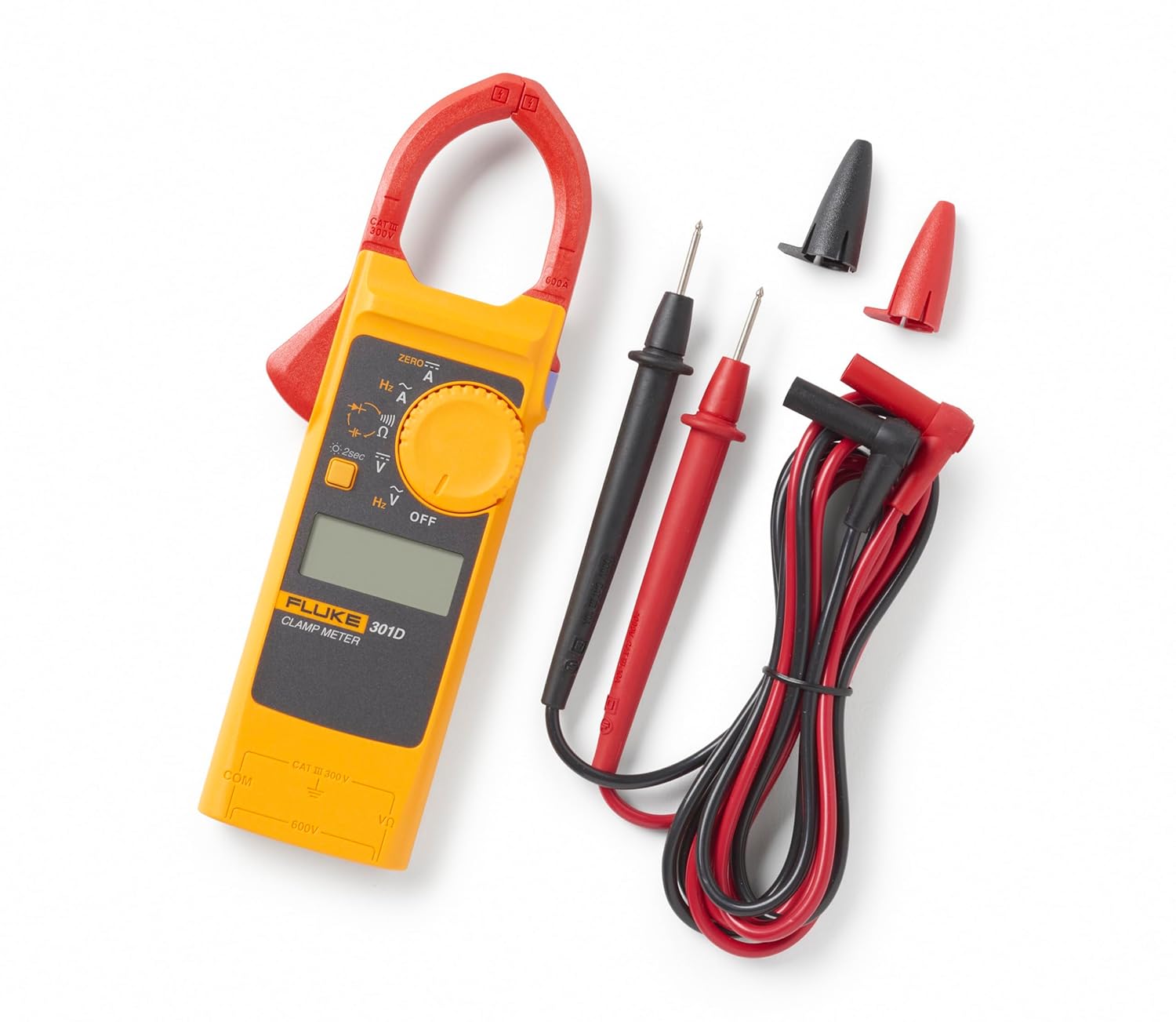
A clamp meter is exactly what it sounds like: a meter with a hinged jaw that clamps around a wire so you can read the current — measured in amperes, or “amps” — flowing through it without cutting into the circuit or interrupting power. That one feature, measuring live current safely and non-invasively, makes it the most-reached-for tool in an electrician’s bag. But not every clamp meter handles every job. Jaw size determines whether you can physically fit around a conductor in a crowded panel. DC capability determines whether the meter can even read current from a solar array or battery bank — and most inexpensive clamp meters cannot. Display quality determines whether you can read a number in the dark corner of a utility room without pulling out your phone flashlight. This article compares three specific meters across those three axes — the Fluke 301D, the Klein CL390, and the FNIRSI DMC-100 — so you can match the tool to the work you’re actually doing.
| EDITOR'S PICKFluke 323 Clamp Meter for Comme… | Mid-tierKlein Tools CL120 Digital Clamp… | Budget pickKAIWEETS HT206D Digital Clamp M… | |
|---|---|---|---|
| AC Current | 400 A | 400 A | — |
| DC Current | ✗ | ✗ | — |
| AC/DC Voltage | 600 V | — | — |
| Temperature | — | — | ✓ |
| Capacitance | — | — | ✓ |
| Non-Contact Voltage | — | ✓ | — |
| Price | $165.97 | $59.97 | $47.99 |
| See on Amazon → | See on Amazon → | See on Amazon → |
Why Jaw Size Is the Hidden Dealbreaker in Tight Panels
Fluke 301D: Built for the Crowded Residential Panel
The Fluke 301D’s defining characteristic, and the reason it shows up consistently in residential and light commercial electricians’ discussions, is its unusually compact form factor. According to the Fluke Corporation 301D AC Clamp Meter Product Specifications Sheet (fluke.com), the jaw opening accommodates conductors up to approximately 30 mm in diameter. More importantly, the body itself is slim enough to maneuver inside a crowded 200A residential load center where standard clamp meters cannot physically rotate into position. Practitioners consistently identify this ergonomic advantage as the primary purchase reason — not the accuracy spec, not the brand name, but the ability to get the jaw around an individual circuit breaker feed without disturbing adjacent wiring.
This matters more than it gets credit for. A standard residential panel with 30–40 breakers, service entrance conductors, and a mix of 12 AWG and 10 AWG branch circuits doesn’t leave much room for a wide-bodied meter. The Fluke 301D is AC-only — it measures AC current up to 400A — and that is a genuine limitation worth flagging upfront. But for the electrician doing service calls, troubleshooting residential loads, or checking branch circuit balance, AC measurement is the daily task, and a slim jaw that actually fits the workspace is worth more than DC capability you will never use.
KAIWEETS
$47.99
In stock on Amazon
Check price on AmazonKlein CL390: The Larger-Jaw General-Purpose Workhorse
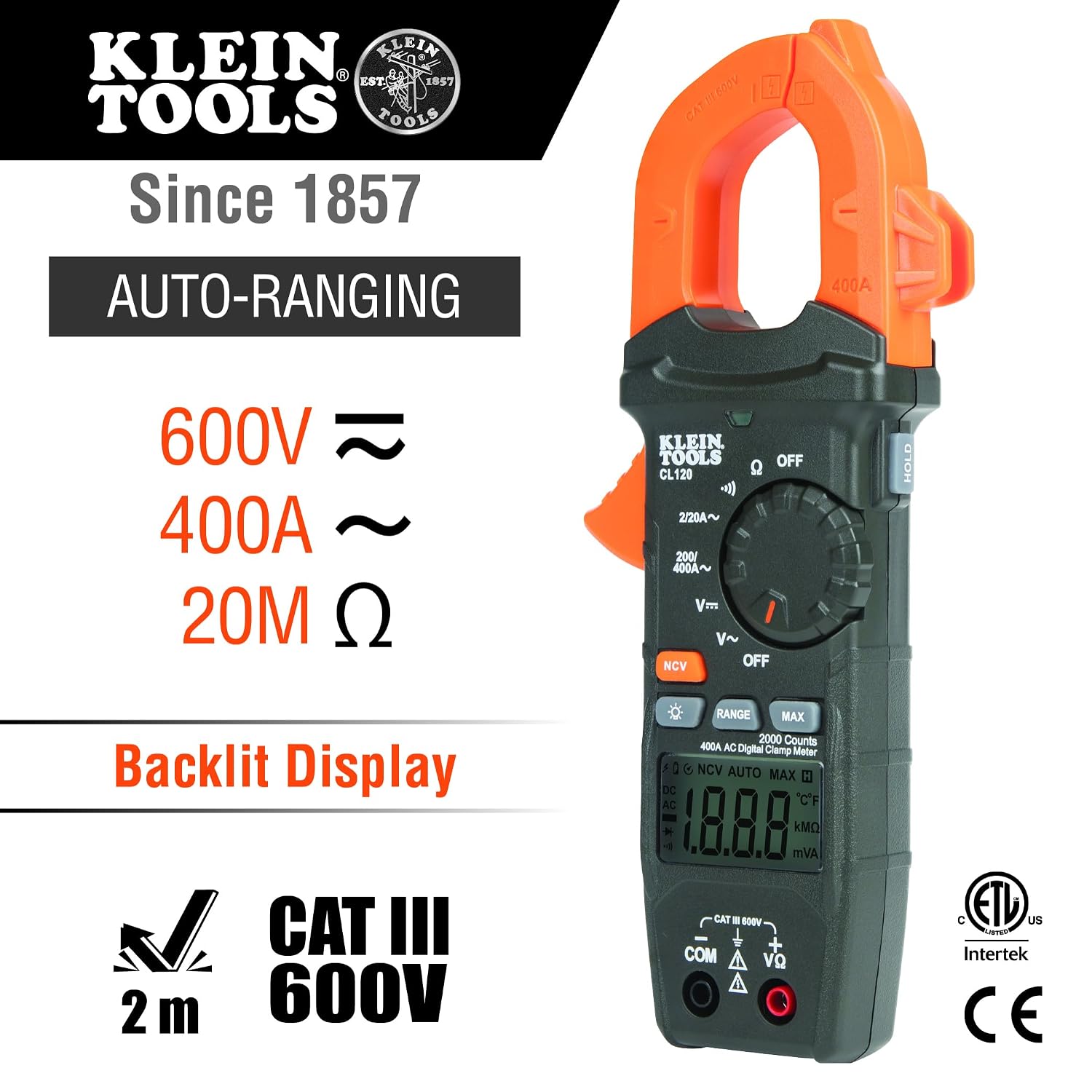
The Klein CL390 is a capable, rugged general-purpose meter. According to the Klein Tools CL390 Digital Clamp Meter Specifications (kleintools.com), the jaw opens to 53 mm — substantially larger than the 301D — which is useful on commercial feeders and conduit runs where conductors are physically bigger. It handles most HVAC and residential tasks without complaint. Its limitation surfaces at the low end of the current scale: like many average-responding clamp meters, the CL390 becomes less reliable below roughly 5A, which matters in HVAC diagnostics when you are trying to confirm whether a relay coil or transformer primary is drawing correctly.
True RMS capability is one of the CL390’s genuine advantages over the 301D. Non-linear loads — variable frequency drives, electronic ballasts, switching power supplies — produce distorted current waveforms that average-responding meters misread. A True RMS meter calculates the actual heating value of the waveform regardless of shape, which is why ECM Web (ecmweb.com) consistently recommends True RMS instruments for commercial and industrial environments where non-linear loads are common.
Klein
$59.97
In stock on Amazon
Check price on AmazonFNIRSI DMC-100: AC/DC Measurement and Color TFT in One Package
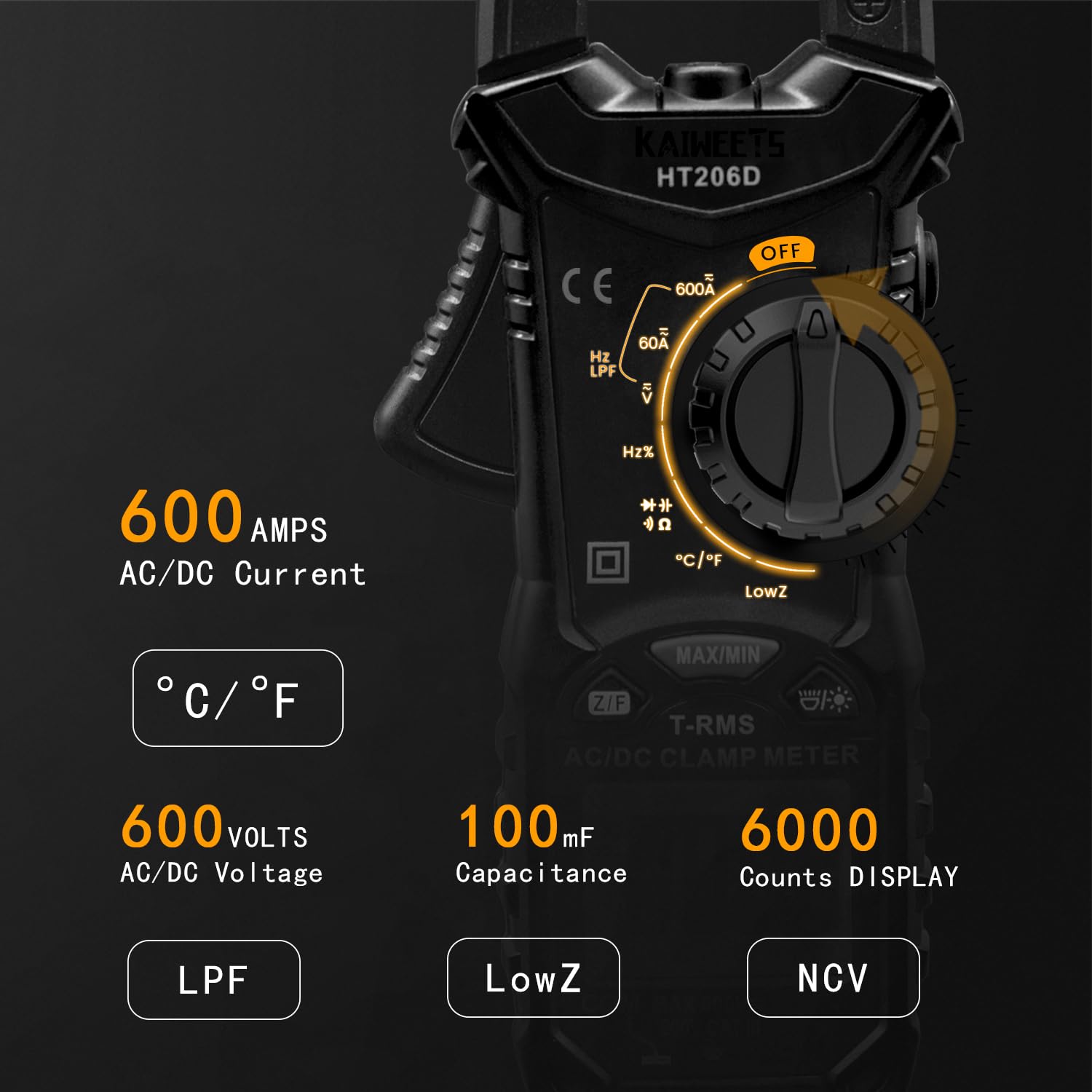
The FNIRSI DMC-100 addresses both the DC gap and the display gap in one instrument. According to the FNIRSI DMC-100 Smart Digital Clamp Meter User Manual and Specifications (fnirsi.com), the jaw opens to approximately 40 mm, handles AC current to 600A, and extends to 600A DC — a range that covers residential solar strings, battery bank feeders, and EV charging conductors. The color TFT display is a genuine departure from the standard segmented LCD found on the Fluke 301D and Klein CL390, and the curve recording mode allows technicians to capture transient events like motor startup inrush that happen faster than the human eye can track.
Klein
$59.97
In stock on Amazon
Check price on AmazonJaw Opening and Measurement Range Summary
| Meter | Jaw Opening | AC Range | DC Range | True RMS |
|---|---|---|---|---|
| Fluke 301D | ~30 mm | 400A | None | No (average-responding) |
| Klein CL390 | 53 mm | 400A | None | Yes |
| FNIRSI DMC-100 | ~40 mm | 600A | 600A DC | Yes |
DC Capability: Not a Spec-Sheet Luxury If You Work Solar or EV
The Physics Gap: Why AC-Only Meters Fail on DC Circuits
Here is the fundamental issue: a standard clamp meter uses a current transformer (CT) in its jaw to detect current. Current transformers only work on alternating current — the magnetic field alternates with the AC waveform, and the transformer captures that change. DC current creates a static magnetic field, and a CT simply ignores it. That is why every AC-only clamp meter reads zero when you clamp around a solar DC combiner output or a battery bank cable. The Fluke 301D and Klein CL390 are both AC-only instruments. Neither will return a meaningful reading on a DC solar string — you will get a zero or a small noise value, not a current measurement.
KAIWEETS
$47.99
In stock on Amazon
Check price on AmazonHall-Effect Technology: How the DMC-100 Reads DC
The solution is Hall-effect sensing — a technology that detects the static magnetic field produced by DC current directly. Hall-effect sensors can measure both AC and DC, which is why AC/DC clamp meters carry a meaningful price and complexity premium over their AC-only counterparts. The FNIRSI DMC-100 uses Hall-effect technology to deliver DC current measurement up to 600A, as documented in the FNIRSI DMC-100 Smart Digital Clamp Meter User Manual and Specifications (fnirsi.com). This is the specific reason experienced solar and electrical practitioners choose it for DC work — AC/DC clamp capability has migrated from premium-instrument territory into prosumer and commercial-adjacent products at accessible price points.
For solar installation contractors: if you are commissioning a string inverter or checking DC conductor balance in a combiner box, an AC-only meter is useless for that task. You need either Hall-effect clamp capability or a true DC clamp meter. For Hall-effect DC in Fluke’s own product lineup, instruments such as the Fluke 376 FC and Fluke 381 carry that capability — but at a substantially higher price point than the DMC-100.
ECM Web (ecmweb.com) notes in its coverage of clamp meter technology that Hall-effect sensors in lower-cost instruments can drift more noticeably at very low DC currents — below 1–2A — compared to high-end implementations, and that performing a zero-adjustment (nulling) before each DC measurement is a recommended practice to minimize offset error. The DMC-100 includes a zero function specifically for this purpose; use it every time on DC work.
Klein
$59.97
In stock on Amazon
Check price on AmazonLow-Current Accuracy: The Math That Makes the Limitation Concrete
Why Count-Based Error Dominates at Low Readings
This is where instrument selection becomes genuinely consequential for diagnostic work. The accuracy specification for clamp meters typically combines a percentage-of-reading term with a fixed count-based term. IEEE Std 1459-2010, “Definitions for the Measurement of Electric Power Quantities Under Sinusoidal, Nonsinusoidal, Balanced, or Unbalanced Conditions” (ieee.org), defines the analytical framework within which count-based error terms must be understood: at low readings, fixed count error becomes the dominant uncertainty source, not the percentage term.
To make this concrete: consider a 400A-range meter with a published accuracy of ±2% ±5 counts, a specification representative of the class of instrument these meters belong to per Fluke Corporation product documentation (fluke.com). At a 2A reading on a 4000-count display:
- 2% of 2A = 0.04A
- 5 counts at 0.05A per count = 0.25A
- Combined worst-case error: ±0.29A, or roughly ±14.5% of reading
At 50A, that same ±5-count term becomes negligible. At 2A, it dominates and produces the jumping, unstable display that practitioners associate with clamp meters at low current. This is not a defective meter — it is physics and resolution. Any clamp meter with a 400A full-scale range reading a 2A load is working near its noise floor, and the count-based error term guarantees instability.
Both the Klein CL390 and the Fluke 301D carry this structural limitation at low currents. For HVAC technicians checking transformer secondary current or motor current on small loads, this is consequential. The practical workaround is either a dedicated low-current clamp accessory used with a logging multimeter, or switching to a multimeter with a current shunt for readings reliably under 10A.
Klein
$59.97
In stock on Amazon
Check price on AmazonWhen the DMC-100’s Curve Recording Mode Earns Its Keep
The FNIRSI DMC-100’s curve recording mode addresses a related but distinct diagnostic problem: capturing transient events like motor startup inrush or compressor kick-in that happen faster than the human eye can track on a standard 4-digit display. A conventional segmented LCD updates two to four times per second and simply cannot display a 200ms inrush event in a readable form. The DMC-100’s color TFT display renders the waveform over time in a manner that allows a technician to see peak inrush amplitude and duration — information that is invisible on a standard clamp meter. Whether this feature earns its keep depends entirely on the diagnostic task. For steady-state load monitoring, a standard LCD is sufficient. For characterizing startup behavior or confirming soft-starter performance, the curve recording capability is genuinely useful.
Klein
$59.97
In stock on Amazon
Check price on AmazonDisplay Clarity: Color TFT vs. Standard LCD on a Real Job Site
In a well-lit shop or open commercial space, a standard 4-digit LCD with a backlight is perfectly readable, and both the Fluke 301D and the Klein CL390 handle that environment without issue. In confined spaces — crawl spaces, equipment rooms, panel corners — a brighter, higher-contrast display reduces misread risk. The DMC-100’s TFT also renders waveform data in a way a segmented LCD cannot, which matters specifically when using curve recording for transient diagnostics.
The honest trade-off: color TFT screens add cost, consume more battery, and introduce questions about long-term durability in dusty, high-vibration environments. The Fluke 301D and Klein CL390 both carry years of field data behind them in harsh conditions. The FNIRSI DMC-100 is newer to the market. Early practitioner feedback is positive, but the long-term durability record is not yet as established as either the Fluke or Klein instruments. That is not a reason to dismiss it — it is a reason to weight it appropriately for how you are deploying the tool.
Clamp Meter vs. Multimeter with Current Shunt: When to Switch Tools
A clamp meter and a multimeter measuring current through lead-based shunt mode (the A or mA input jacks) solve the same problem through different physics. Clamp meters win on safety and convenience: no circuit interruption, no exposed current path, no risk of accidentally leaving probes in the current input while switching to voltage. For any current above 10A on live circuits, a clamp meter is the correct tool.
A multimeter’s shunt-based current measurement wins on resolution. Most multimeters with a 10A range and 4-digit display resolve to 1 mA — an order of magnitude finer than what a 400A clamp meter can deliver. For confirming whether a sensor circuit is drawing 150 mA versus 200 mA — the kind of low-current diagnostic that matters in controls work or PLC troubleshooting — use the multimeter, de-energize the circuit if at all possible, and follow lockout/tagout procedure.
Never use a multimeter in current shunt mode on a live circuit above its rated input without explicitly verifying the meter’s current input protection rating, and never leave test leads in the current jacks while switching measurement functions — that failure mode has damaged both meters and technicians.
Frequently Asked Questions
What jaw size do I need to fit around wires in a crowded residential panel? Most 200A residential service entrance conductors are 2/0 or 4/0 AWG aluminum, with outer diameters (including insulation) of roughly 20–28 mm. A jaw opening of 30 mm clears those conductors comfortably. The tighter challenge is maneuvering the meter body between adjacent conductors and breakers — which is exactly the physical clearance problem the Fluke 301D’s slim body design addresses.
Can a standard clamp meter measure DC amperage from a solar array? No. Standard clamp meters use current transformer technology that only responds to alternating current. DC measurement requires Hall-effect sensor technology. If you are measuring DC string current, combiner output, or battery bank current, you need an AC/DC clamp meter with explicit DC current capability — such as the FNIRSI DMC-100 — or a dedicated Hall-effect clamp probe paired with a logging multimeter.
Why does my clamp meter give unstable readings below 5A? The count-based error term in the accuracy specification becomes significant relative to the reading. On a 400A-range meter, each display count can represent 0.05–0.1A. At a 2A reading, five counts of error equals 25–50% of the reading value. The display will jump as the meter’s analog-to-digital converter resolves near its noise floor. This is normal behavior, not a defective meter. For sub-5A measurements, use a multimeter in current shunt mode or a dedicated low-current clamp accessory.
What does Hall-effect technology in a clamp meter actually mean? A Hall-effect sensor detects the static magnetic field surrounding any current-carrying conductor — AC or DC. When current flows through a conductor, it creates a magnetic field proportional to that current. A Hall-effect element in the clamp jaw produces a voltage proportional to that field, which the meter converts to an ampere reading. Because the sensor responds to field strength rather than field change, it works on DC as well as AC — the fundamental enabling technology for any clamp meter that can read solar or battery DC current.
When should I use a clamp meter versus a multimeter with current shunt leads? Use a clamp meter on any live circuit where interrupting current flow is not practical — which covers most field work. Use a multimeter’s shunt-based current mode when you need fine resolution below 10A and can safely de-energize and break into the circuit.
The Decision Rule
If you work primarily in residential panels and need a clamp meter that physically fits where others don’t: the Fluke 301D is the purpose-built answer. Its AC-only limitation is real, but it is the right limitation for that job profile.
KAIWEETS
$47.99
In stock on Amazon
Check price on AmazonIf you are doing solar, battery storage, or EV charging DC work: you need Hall-effect AC/DC capability. The FNIRSI DMC-100 is the accessible entry point for that feature set, with curve recording and color TFT as genuine bonuses for motor and inverter transient diagnostics.
Klein
$59.97
In stock on Amazon
Check price on AmazonIf you need a versatile general-purpose clamp meter for HVAC, commercial service, and residential work without DC requirements: the Klein CL390 is a solid, proven workhorse with a True RMS advantage over the 301D and a larger jaw for commercial feeders. Go in clear-eyed about its low-current limitations and you will rarely be disappointed.
Klein
$59.97
In stock on Amazon
Check price on AmazonThe wrong answer is buying any of these for work outside their design envelope and blaming the meter.