You’re staring at a panel with 42 breakers and no directory — or worse, a directory someone filled out in pencil in 1987 that says things like “upstairs?” and “kitchen stuff.” You need to know which breaker controls the outlet in room 214 before you pull the wire. Meanwhile, the inspector is asking whether the GFCI (Ground-Fault Circuit-Interrupter — a safety device that shuts off power within milliseconds if it detects a fault to ground) on the bathroom circuit is actually tripping at the right current threshold, or just clicking like it is. These are two different problems that electricians run into every single day, and they each have a dedicated tool built to solve them. This guide breaks down circuit breaker finders and GFCI testers — what they do, how they work, which specs actually matter, and how to spend your money wisely depending on what kind of work you’re doing.
How a Circuit Breaker Finder Actually Works (and Where It Can Fool You)
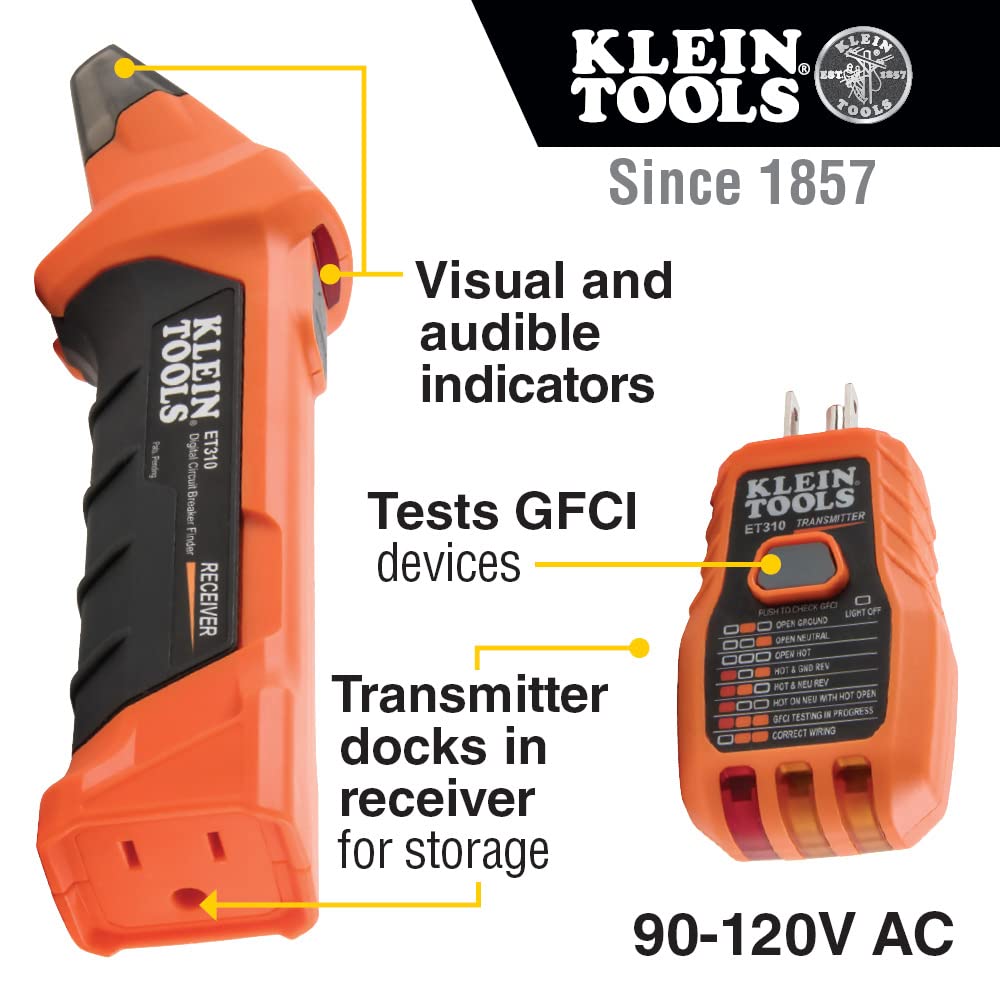
A circuit breaker finder is a two-piece system: a transmitter that plugs into an outlet and injects a low-frequency signal onto the hot conductor, and a receiver that you drag across breakers in the panel until it detects that signal and beeps or lights up. Simple concept — but the execution has a lot of variables that separate a tool you’ll trust from one you’ll throw across the room.
The signal injection side is where cheap units fall apart first. A transmitter that puts out an inconsistent or weak signal will give you ambiguous readings in a crowded panel, especially in commercial settings where you have parallel conductors, shared neutrals, or long wire runs creating enough capacitive coupling to confuse the receiver into lighting up on the wrong breaker. Manufacturers like Fluke publish their transmitter output frequency and signal strength specifications; reviewers and electricians posting in trade forums consistently note that units operating in the 5–10 kHz range with strong shielded receivers outperform budget units on anything more complex than a 15-breaker residential sub-panel.
The receiver sensitivity matters just as much. You want adjustable sensitivity — a fixed-high-sensitivity receiver will pick up adjacent breakers and leave you guessing. Adjustable sensitivity lets you dial it down when you’re close and need to discriminate between two breakers that are physically adjacent in the panel. The Klein Tools circuit breaker finder (the ET300 series, around $45–55) covers residential work adequately; operators in long-run reviews note it performs reliably on 15A and 20A residential circuits but can struggle with 240V circuits where the signal path is different. The Sperry Instruments BF-240 (~$60–80) adds 240V two-pole circuit identification capability, which matters the moment you’re trying to trace a dryer or HVAC circuit — a spec gap worth paying for if your work regularly involves double-pole breakers.
One real-world limitation nobody puts in the manual: circuit breaker finders do not tell you the condition of a circuit. They confirm which breaker is connected to a conductor. They don’t tell you whether that circuit has a loose neutral, reversed polarity, a bad GFCI downstream, or is code-compliant. That’s a completely separate diagnostic conversation — which is exactly why you need the second tool in this discussion.
GFCI Testers: What They Check and What “Tripped” Doesn’t Mean
A GFCI outlet is designed to trip (cut power) when it senses a difference of about 4–6 milliamps (mA) between the hot and neutral conductors — the signature of current leaking to ground through something it shouldn’t, like a person. Per UL Standard 943, which governs GFCI device requirements in the United States, a GFCI must trip within 1/40th of a second at 6mA ground-fault current. The standard outlet-style “push to test” button on the GFCI itself checks basic mechanical function, but it doesn’t verify the actual trip threshold or trip time.
That’s the job of a GFCI outlet tester with a built-in load test function.
Your basic 3-light outlet tester ($8–15, various brands) tells you wiring configuration — open ground, reversed polarity, open neutral — but does not test GFCI trip function with a calibrated load. When it does have a GFCI test button, it simply creates a small simulated fault and checks whether the outlet goes dead. That’s useful for quick verification on a new install, but it doesn’t tell you how fast the GFCI tripped or at what current level.
For most residential and light commercial work — new construction walk-throughs, pre-occupancy checks, annual facility inspections — a quality 3-function tester with a GFCI trip button is sufficient. The Sperry Instruments GFI6302 ($15–20) and the Klein Tools RT210 ($18–25) are consistently cited by electrical inspectors and journeymen as reliable for this purpose. Reviewers note both units give clear, unambiguous light patterns and have durable plugs that survive the pocket abuse of daily use.
Where it gets more serious: healthcare facilities, commercial kitchens, and anywhere the NEC 2023 (NFPA 70, Article 210.8) mandates GFCI protection on specific circuits — and where someone needs documented proof that protection is functional. In those environments, you want a tester that can actually measure trip time in milliseconds and log it. The Ideal Industries SureTest Circuit Analyzer (the 61-164 series, ~$220–260) does this, displaying trip time, voltage, line impedance, and wiring faults on a digital readout. Facilities managers and industrial maintenance techs who need to maintain service records on electrical safety equipment cite this class of tool as worth the step up from the basic plug-in tester. Per Test Equipment Depot’s buyer documentation on circuit analyzers, trip-time measurement capability is the primary feature differentiating basic outlet testers from circuit analyzers in this price band.
By the Numbers: Feature Tiers at a Glance
| Tool Type | Price Range | Key Capability | Best For |
|---|---|---|---|
| 3-light outlet tester (basic) | $8–20 | Wiring fault indication, basic GFCI trip | Quick installs, apprentice kits |
| Outlet tester with GFCI test | $15–30 | Wiring faults + simulated GFCI trip | Residential, light commercial |
| Circuit breaker finder (residential) | $40–65 | Hot conductor tracing, 120V circuits | Residential service, resi remodels |
| Circuit breaker finder (240V-capable) | $60–90 | 120V + 240V two-pole tracing | HVAC, dryer circuits, small commercial |
| Circuit analyzer with trip-time display | $200–280 | Trip time (ms), voltage, impedance, faults | Commercial inspections, facilities management |
Where These Tools Fit Into Code-Compliant Work
The 2023 NEC expanded GFCI requirements significantly compared to previous cycles. Article 210.8 now mandates GFCI protection in areas including laundry rooms, unfinished basements, boathouses, and outdoor receptacles — categories that weren’t universally required in older code editions. If you’re doing service upgrades or additions on an older house, ECM Web’s coverage of NEC 2023 GFCI expansion notes that local AHJs (Authorities Having Jurisdiction — the local inspection body that enforces code in your area) have been actively flagging non-compliant circuits during permit inspections, making functional GFCI verification a practical necessity on every rough-in and final.
This is where the combination of a circuit breaker finder and a proper outlet tester pays off as a workflow rather than as two separate purchases. The sequence looks like this: identify which breaker controls a circuit using the finder → verify wiring configuration at each outlet using the tester → confirm GFCI trip function where code requires it → document. That three-step process is the same whether you’re a solo residential electrician or a maintenance tech running a quarterly safety audit on a 50,000-square-foot commercial facility, just with different documentation requirements at the end.
One counterfeit risk worth naming explicitly: the market for plug-in outlet testers and basic circuit finders has a meaningful counterfeit presence on third-party marketplace listings. Units sold as “UL Listed” that are not actually UL certified have shown up consistently enough that the Electrical Safety Foundation International (ESFI) has published warnings about non-compliant testers. The risk with a fake outlet tester isn’t that it shocks you — it’s that it gives you false confidence on a GFCI circuit that isn’t actually tripping correctly. Buy from electrical supply houses (Graybar, Rexel, CED) or from distributors whose stock you can verify, not from unverified third-party sellers on general marketplaces. The $8 you save isn’t worth a failed inspection or a missed fault.
Decision Rules: Which Tool Configuration Is Right for Your Work
Here’s the honest “if X, then Y” breakdown:
If you’re an apprentice or first-year journeyman doing residential work: A $40–55 residential circuit breaker finder plus a $15–20 outlet tester with a GFCI button covers 90% of your daily needs. Start there. The Klein ET300 and Sperry GFI6302 together run under $75 and will handle everything you’ll encounter in residential service for your first several years.
If you regularly work on HVAC circuits, dryer circuits, or anything 240V: Step up to a 240V-capable finder like the Sperry BF-240. The added cost is $15–25 over a residential-only unit and pays back the first time you don’t spend 20 minutes chasing a double-pole breaker by process of elimination.
If you’re doing commercial work, pre-occupancy inspections, or facilities maintenance where documentation matters: The Ideal SureTest 61-164 or equivalent circuit analyzer is the right investment at ~$220–260. It consolidates wiring fault detection, GFCI trip time measurement, voltage readings, and circuit impedance into a single device with a display that gives you actual numbers to document. Reviewers in the facilities management space consistently note that having the trip time in milliseconds — rather than just “it tripped” — is what satisfies both internal safety audits and third-party inspectors.
If you’re doing solar or EV charging infrastructure installations: GFCI compliance on EV circuits is a specific and evolving area. NEC 2023 Article 625 requires GFCI protection on certain EV charging equipment, and the outlet tester’s ability to verify that protection is functional belongs in the startup checklist for every installation. A circuit analyzer that can also check line impedance is useful here because long circuit runs to exterior EV charger locations can produce voltage drop patterns that a simple outlet tester won’t flag but an impedance reading will catch.
The panel directory problem and the GFCI compliance problem are both solvable with the right tools and a clear workflow. Neither one requires expensive test equipment to handle correctly — but both require the right tool, not just any tool that plugs in. Get that distinction right and you stop guessing, start tracing, and finish the job documented and clean.