A multimeter is the instrument you reach for when you need to measure electrical quantities — voltage (how hard the electricity is pushing), current in amps (how much electricity is flowing), and resistance in ohms (how much a circuit opposes that flow). Whether you’re checking an outlet, diagnosing a dead circuit breaker, or hunting a parasitic drain killing a car battery, a multimeter is your first tool out of the bag. This article is for the electrician, HVAC tech, or automotive specialist who has heard budget Chinese brands dismissed out of hand — but who has also seen real professionals quietly pulling a $40 meter from a truck box with zero apologies. We reviewed aggregated owner feedback, published manufacturer specifications, and trade commentary to give you an honest look at three meters that keep surprising people: the KAIWEETS HT118E, the FNIRSI DMT-99, and the Fluke 106. We’ll tell you where each earns its paycheck and where it hits a wall.
| EDITOR'S PICKFluke 106 (U.S.) Palm-Sized Dig… | Mid-tierKAIWEETS Digital Multimeter TRM… | Budget pickFNIRSI DMT-99 Digital Multimete… | |
|---|---|---|---|
| Counts | — | 6000 | 9999 |
| Auto-ranging | — | ✓ | ✓ |
| TRMS | — | ✓ | ✓ |
| AC Voltage | 600V | — | — |
| Rechargeable | — | — | ✓ |
| Temperature | — | ✓ | — |
| Price | $90.28 | $37.99 | $35.99 |
| See on Amazon → | See on Amazon → | See on Amazon → |
Count vs. Reality: What 20,000 Counts Actually Buys You
Display count is a spec thrown around constantly and misunderstood almost as often. Here’s the short version: a 6,000-count meter can show up to 5,999 in its readout. A 20,000-count meter can show up to 19,999. More counts mean finer resolution — the meter can detect smaller differences in a reading. According to Test Equipment Depot’s multimeter resolution explainer, a 6,000-count meter reading 120 V AC resolves to about 0.1 V. A 20,000-count meter reading the same 120 V resolves to about 0.01 V — one-tenth the step size.
Does that matter for typical residential work? Honestly, not as often as the spec-sheet debate implies. Checking that a 15-amp circuit is live, verifying a neutral is bonded, confirming a 240 V dryer outlet — 6,000 counts handles all of that without breaking a sweat. Where higher counts pay off is in precision applications: verifying voltage drop against NEC 210.19 recommendations, calibrating battery systems in solar installations, or checking small resistance values on motor windings. ECM Web’s instrument selection guidance for field electricians has consistently noted that resolution becomes a meaningful factor once you move into commercial or industrial work where tolerances tighten.
The Three Contenders: Head-to-Head Breakdown
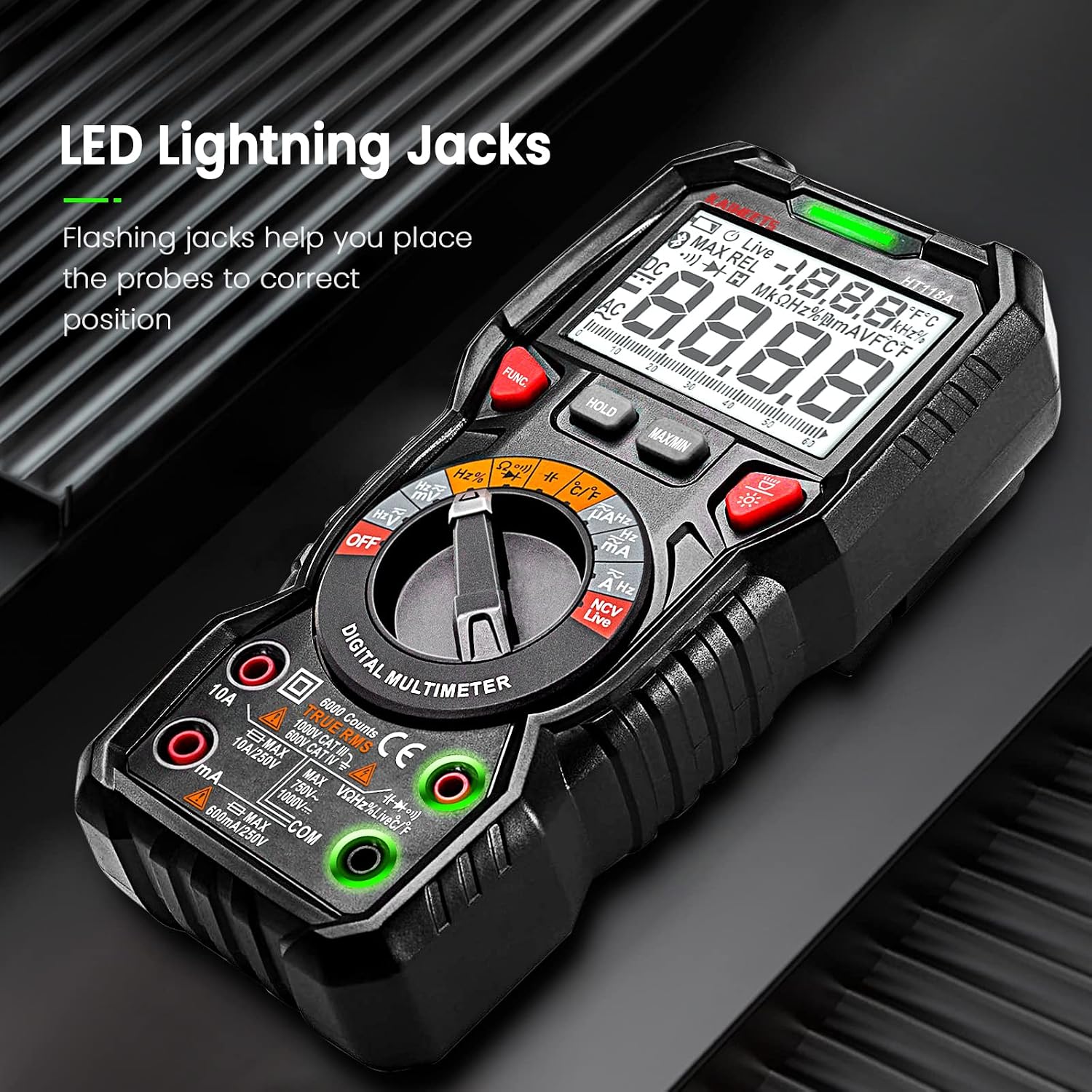
KAIWEETS HT118E — Six Years of Trust, Upgraded
FNIRSI
$35.99
In stock on Amazon
Check price on AmazonThe KAIWEETS HT118A earned a following the straightforward way — by not failing. Long-run owner reviews from engineers who used the 6,000-count HT118A for six or more years before upgrading to the 20,000-count HT118E describe the accuracy as consistent across years of regular use, with no meaningful drift. That kind of longevity report carries more weight than any single bench measurement.
The HT118E steps up to 20,000-count resolution, True RMS measurement (meaning it reads non-sinusoidal waveforms accurately — critical for anything with a variable-speed motor, inverter, or LED dimmer), and auto-ranging. Per the manufacturer’s published specifications, basic DC voltage accuracy is rated at ±0.5%, which is competitive with meters at two and three times the price. At roughly $40 as of mid-2026, that is a real value proposition.
The recurring “amps don’t work” complaint — and why it’s almost always user error. Across aggregated reviews, the most consistent complaint about the KAIWEETS HT118E is that the current reading shows zero or near-zero. Here is what is actually happening: multimeters have a separate input jack for measuring current — typically labeled A or mA — and a corresponding fuse protecting that circuit. When the red lead is plugged into the voltage/resistance input (labeled V/Ω) and the user rotates the dial to the amps setting, the meter reads nothing because the signal path is physically disconnected. The meter is not broken. The lead is in the wrong jack. Fluke Corporation’s safety documentation on multimeter input protection explains this architecture as a deliberate design choice: the current path requires its own fuse because measuring current puts the meter in series with the load, creating fault-current risk if miswired. Move the red lead to the correct current input jack and the reading appears. This pattern shows up in reviews for nearly every multimeter brand at every price point — it is a training issue, not a defect.
A limitation worth disclosing: on clamp-style variants in the KAIWEETS lineup, owners with evident field experience note that AC current readings through test leads have limitations compared to a dedicated clamp meter with a larger jaw and hall-effect sensor. That is expected and honest. A general-purpose DMM measuring AC current through test leads is not the same instrument as a purpose-built clamp meter.
FNIRSI
$35.99
In stock on Amazon
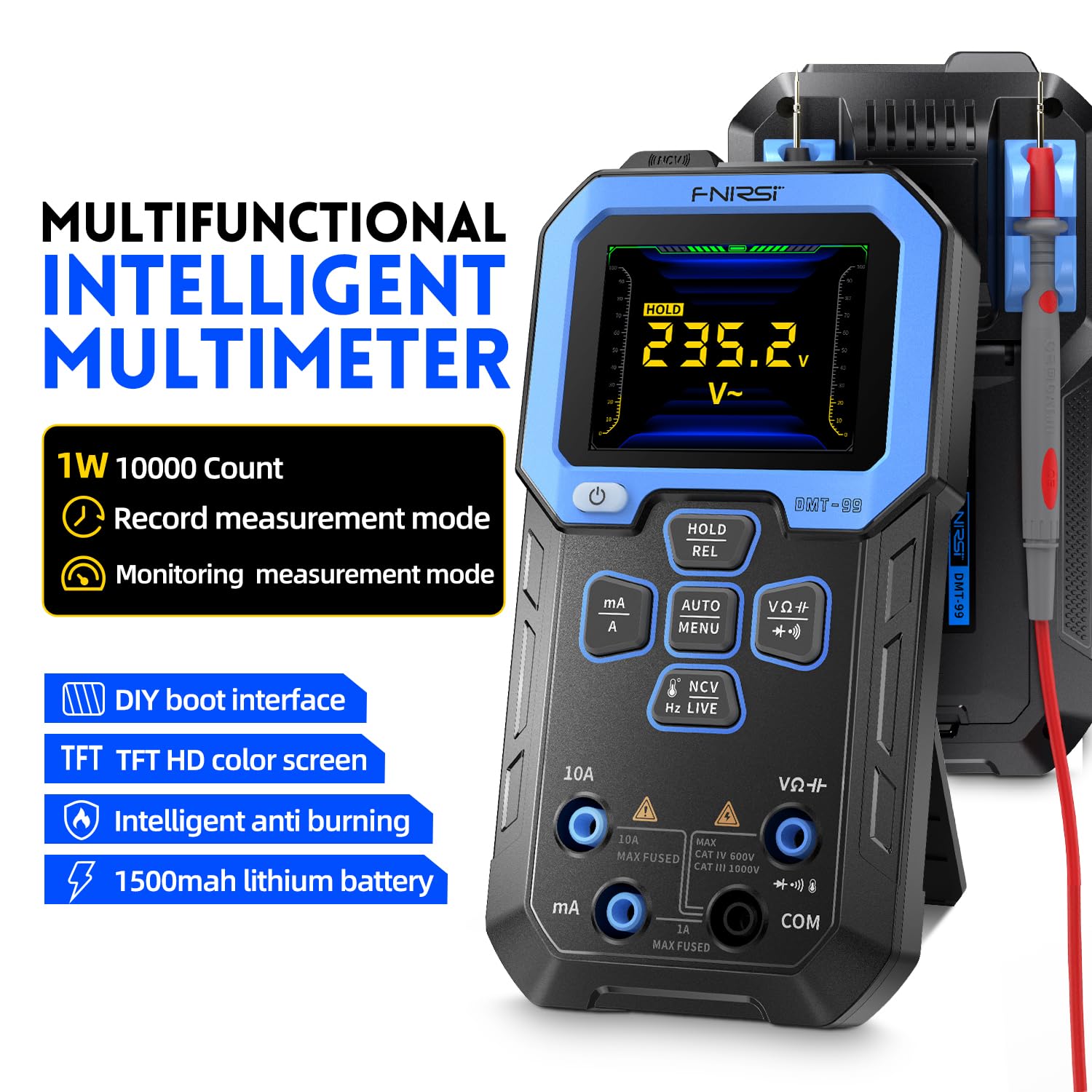
Check price on AmazonFNIRSI DMT-99 — The Graph Mode That Earns Its Stripes in Automotive Work
KAIWEETS
$37.99
In stock on Amazon
Check price on AmazonThe FNIRSI DMT-99 is a different animal. Where the KAIWEETS HT118E competes on precision-per-dollar, the DMT-99 competes on features — specifically its built-in bargraph and trend/graph display mode that plots voltage or current changes over time directly on the meter’s screen.
Owner reviews from automotive and electrical veterans with long careers in the trade point to the graph mode as the most useful feature for diagnosing intermittent parasitic battery drain. That use case deserves its own explanation, because it is a genuinely tricky diagnostic problem.
A parasitic drain is when something in a vehicle keeps drawing current after the ignition is off — slowly killing the battery overnight or over several days. The standard diagnostic procedure is to put a milliamp-capable multimeter in series with the battery negative cable and watch the reading as you pull fuses one at a time. The complication: modern vehicles have sleep modules — control units that take 10 to 20 minutes to enter low-power mode after the doors close. The current draw can spike, settle, spike again, and then finally settle into its true parasitic load. Without a way to watch the trend over time, you are trying to catch a moving target with a single snapshot.
The FNIRSI DMT-99’s graph mode lets you configure the meter, walk away, and come back to a visual record of what the current did over that window. This is not what an oscilloscope does — a scope captures high-speed voltage waveforms measured in kilohertz and megahertz. The FNIRSI is not a replacement for one. But for slow-moving, time-domain current events in automotive diagnostics, the graph mode fills a practical gap that a standard DMM cannot address.
KAIWEETS
$37.99
In stock on Amazon
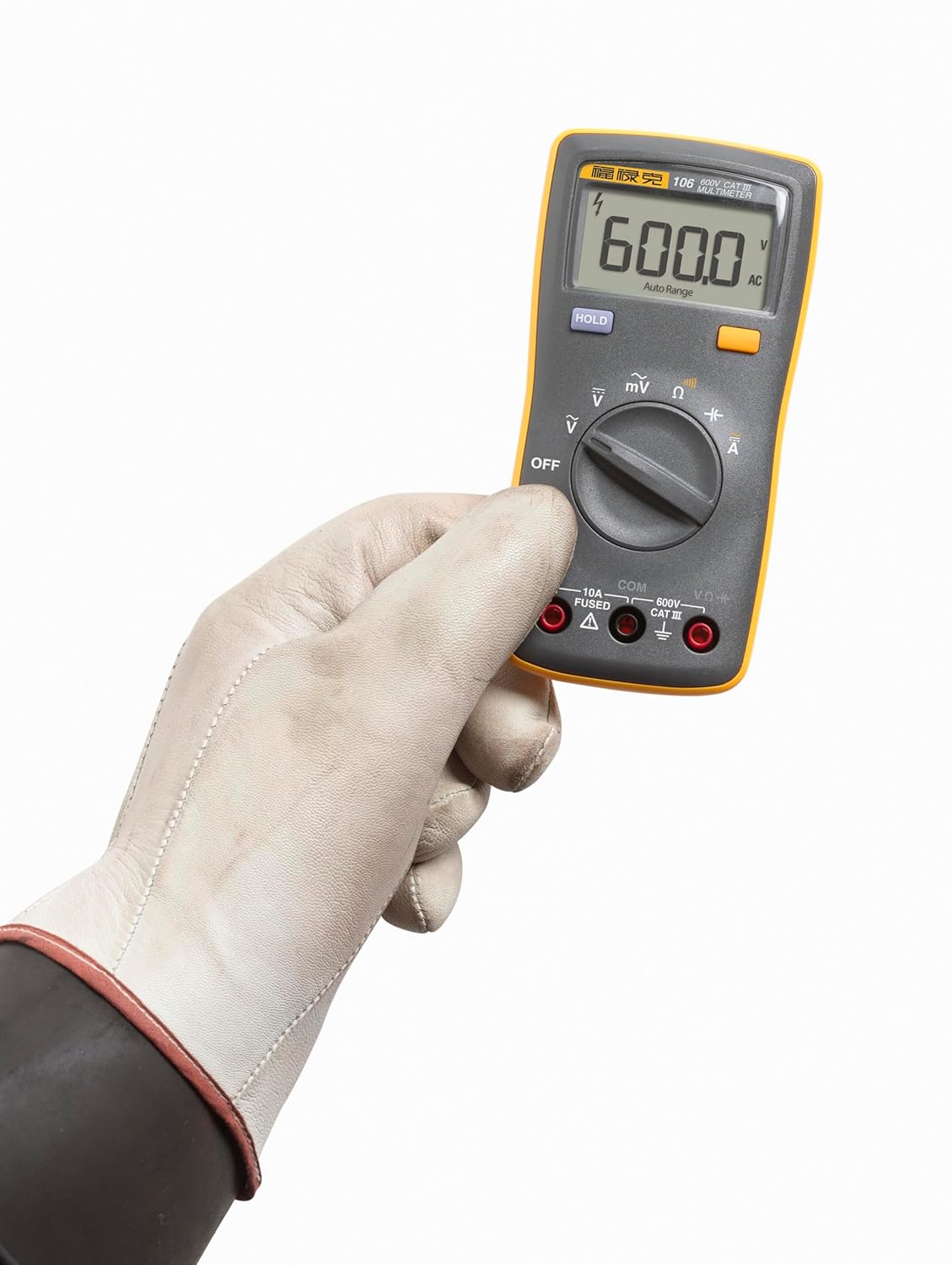
Check price on AmazonFluke 106 — The Backup That Doesn’t Feel Like a Compromise
Fluke
$90.28
In stock on Amazon
Check price on AmazonThe Fluke 106 is the outlier in this group. It is compact, it carries the Fluke name, and it costs more than either the KAIWEETS or FNIRSI — yet it still lands in the under-$50-or-so range for a Fluke, which is notable in itself. Per the Fluke 106 product datasheet, the meter delivers 6,000-count resolution, True RMS measurement, and CAT III 600 V / CAT II 1000 V safety ratings under IEC 61010-1 measurement category standards — meaning it is rated for panel-level work. The IEC 61010-1 measurement category framework, as explained in Fluke Corporation’s “What Is a CAT Rating?” safety documentation, defines CAT III as covering distribution-level wiring in buildings, including panels, bus bars, and branch circuit feeders.
Multiple owner reviews mention the magnetic hanging back without being prompted — which is telling. When a feature appears repeatedly in reviews written by people who were not asked about it, that is genuine utility registering in real workflow. Being able to hang a meter on a panel door, a metal stud, or an HVAC cabinet while you work with both hands is a workflow improvement that sounds minor until you have done panel work with a meter tucked under your armpit.
Is the Fluke 106 accurate enough to trust, or is it a lesser version of the 87V? The honest answer: it is not a lesser version. The Fluke 87V — Fluke’s workhorse industrial meter — adds 20,000-count resolution, a differential temperature input, a CAT IV service-entrance safety rating, and frequency measurement accuracy that matters for variable-frequency drive diagnostics. For that class of work, the 87V is the correct instrument. But owners who carry both report that the 106’s accuracy is indistinguishable from their flagship meters on standard residential and light commercial measurements. Per the Fluke 106 published datasheet, basic DC voltage accuracy is rated at ±0.5% — the same figure Fluke publishes for the 87V on that same measurement. It is a trusted compact backup and a tight-space primary, not a toy.
Fluke
$90.28
In stock on Amazon
Check price on AmazonSide-by-Side Specification Comparison
| Spec | Fluke 106 | KAIWEETS HT118E | FNIRSI DMT-99 |
|---|---|---|---|
| Display counts | 6,000 | 20,000 | 6,000 |
| True RMS | Yes | Yes | Yes |
| CAT rating | CAT III 600 V | CAT III 600 V | CAT III 600 V |
| Graph/trend mode | No | No | Yes |
| Magnetic hanging back | Yes | No | No |
| Approx. street price (mid-2026) | ~$50 | ~$40 | ~$45 |
Specifications drawn from published manufacturer datasheets. Street prices reflect aggregated retailer listings as of publication date and are subject to change.
Frequently Asked Questions
Is 6,000 counts enough for residential electrical work, or do I need 20,000? For the overwhelming majority of residential tasks — checking outlet voltage, testing continuity, reading breaker current, verifying 240 V circuits — 6,000 counts is sufficient. According to Test Equipment Depot’s resolution explainer, the step difference between 6,000 and 20,000 counts only becomes meaningful when you need to measure small deviations: voltage drop calculations, battery state-of-charge readings, precision motor resistance checks. If your work stays at the residential and service-level commercial tier, 6,000 counts will not hold you back.
What causes a multimeter to show no reading on the amps setting? Almost always: the red test lead is plugged into the voltage/resistance input jack instead of the current (A or mA) input jack. Every multimeter has separate physical inputs for these functions, and the current input is fused independently — a design explained in Fluke Corporation’s input protection safety documentation. Move the red lead to the correct jack. If the reading is still absent, check whether that fuse has blown — a common outcome if the meter was briefly connected across a voltage source while set to current mode.
Does the FNIRSI graph mode replace an oscilloscope for finding car battery drain? No — and the distinction matters. An oscilloscope captures high-frequency waveform detail useful for diagnosing alternator ripple, CAN bus signals, and injector patterns. The FNIRSI graph mode captures slow-moving current trends over seconds and minutes. For parasitic drain diagnosis — where you are watching a load settle over 10 to 30 minutes — the FNIRSI graph mode is genuinely useful and an oscilloscope adds no practical value. They solve different problems.
What does rechargeable vs. battery-powered mean for daily field use? A rechargeable meter means no hunting for AAAs mid-job, but it also means the meter is unusable if you forget to charge it. A battery-powered meter can be revived with any convenience-store run. For a primary field meter, most experienced tradespeople prefer standard batteries because availability is universal. Rechargeable makes more sense for a bench or shop meter with a predictable charge routine.
The Decision Frame: If X, Then Y
-
If you need the highest resolution under $50 and your work involves precision measurements — solar battery systems, motor diagnostics, voltage drop calculations — the KAIWEETS HT118E’s 20,000-count True RMS spec earns its place. Long-run reliability reports from owners who have used the platform for six or more years are the real confidence signal.
-
If you do automotive electrical work, especially parasitic drain diagnosis, and you want a tool that does something a standard DMM cannot: the FNIRSI DMT-99’s graph mode is a legitimate, workflow-changing feature. It will not replace a scope for signal work, but for current-over-time diagnostics it is exactly the right instrument.
-
If you already run Fluke as your primary and want a compact, trusted backup that hangs on a panel door and delivers the same accuracy as your flagship on everyday measurements: the Fluke 106 is the answer. The magnetic back is not a gimmick — it is a hands-free workflow upgrade that owners notice immediately and consistently.
None of these three meters replaces a Fluke 87V or a comparable industrial instrument for CAT IV service-entrance measurements, variable-frequency drive analysis, or high-accuracy motor diagnostics. That is not what they are built for. What they demonstrate is that “budget” and “trustworthy” are not opposites — when you match the tool to the task.