A clamp meter is exactly what it sounds like: a meter with a hinged jaw that clamps around a single wire and measures the magnetic field created by the current flowing through that wire — no need to break the circuit or touch the conductor directly. That one feature makes it the most-used tool on a working electrician’s belt, because you can read amperage in seconds without shutting anything down. The question for anyone early in their tool-buying journey is whether the $40–$60 budget tier can actually deliver what the job needs, or whether you’re buying a plastic paperweight with a digital display. This comparison digs into three specific meters — the KAIWEETS HT206D, the FNIRSI DMC-100, and the Klein Tools CL390 — to give you a clear answer based on published specs, aggregated owner feedback, and the tradeoffs that actually matter once you’re standing in front of a live panel.
If you’re six to twenty-four months into electrical work, you’ve probably already outgrown the “any meter will do” mindset. You know what True RMS means: the meter correctly calculates the actual effective value of a non-sinusoidal waveform — like the distorted current from a VFD or a switching power supply — instead of assuming everything is a clean sine wave. You know CAT ratings matter. And you’re starting to make tool decisions that have to hold up for real work, not just bench experiments. That’s exactly who this article is written for.
| EDITOR'S PICKKlein Tools CL390 AC/DC Digital… | Mid-tierKlein Tools CL120 Digital Clamp… | Budget pickKAIWEETS HT206D Digital Clamp M… | |
|---|---|---|---|
| AC current range | 400 A | 400 A | — |
| DC current | ✓ | ✗ | — |
| True RMS | ✓ | — | ✓ |
| Voltage test | AC/DC | AC/DC | — |
| Temp reading | ✓ | — | ✓ |
| Display type | Hi-Viz LCD | — | — |
| Price | $99.97 | $59.97 | $47.99 |
| See on Amazon → | See on Amazon → | See on Amazon → |
How These Three Meters Are Actually Different
Before you pick based on price alone, it helps to see the specs side by side. The table below places each meter in a tier based on its strongest use case.
| Meter | AC Current Range | DC Current (clamp) | True RMS | CAT Rating | Standout Feature | Tier |
|---|---|---|---|---|---|---|
| KAIWEETS HT206D | 0–600 A | No (probes only) | Yes | CAT III 600V | Auto-ranging, NCV, backlit display | KAIWEETS — $47.99 |
| FNIRSI DMC-100 | 0–600 A | Yes (Hall-effect clamp) | Yes | CAT III 600V | Color TFT graphing screen, DC clamp | KAIWEETS — $47.99 |
| Klein Tools CL390 | 0–400 A | No (probes only) | Yes | CAT III 600V | Built-in non-contact voltage tester (NCVT) | KAIWEETS — $47.99 |
That DC clamp column is the pivot point for this entire comparison. Two of these meters — the HT206D and the CL390 — cannot measure DC current through the clamp jaw. They use Hall-effect technology only for AC. If you need to measure DC through the clamp (solar strings, battery banks, EV charging circuits), the DMC-100 is the only option in this tier. That is not a minor spec-sheet detail. It is the first and most important filter to apply.
The Three Meters in Detail
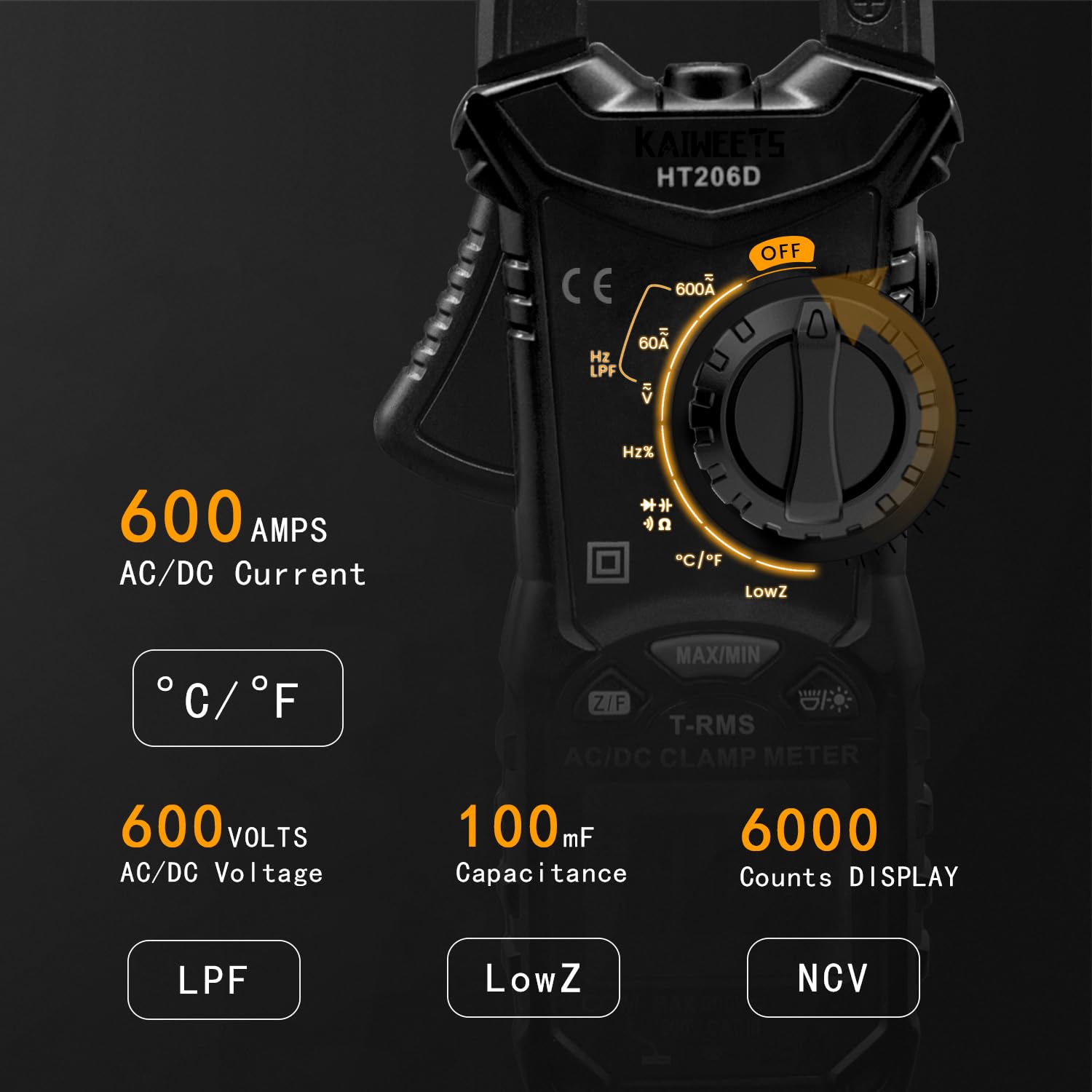
KAIWEETS HT206D: Strong Meter, Compromised Out of the Box
Across aggregated owner reviews, the pattern on the HT206D is remarkably consistent: the meter itself performs well, and the included test leads are genuinely problematic. Not “budget-tier acceptable” problematic — problematic enough that multiple owners specifically call them out as a safety and usability concern. Reviewers document immediately replacing the stock leads with aftermarket sets and describe the resulting combination as a substantially better instrument. That is worth taking seriously before you put this meter on a job site.
Why does this matter for a clamp meter? Because you still use probes for voltage, resistance, continuity, and diode checks. The clamp handles current, but probes handle everything else. Thin insulation, flimsy banana plugs, and stiff cables that do not bend well at low temperatures are real hazards, not cosmetic annoyances. Per IEC 61010-1, “Safety Requirements for Electrical Equipment for Measurement, Control, and Laboratory Use,” published by the International Electrotechnical Commission, test lead integrity is a defined component of an instrument’s overall safety rating — not a separate afterthought.
The HT206D’s other well-documented limitation is AC current resolution at low amperage. At 600 A full scale, the display resolution is not fine enough to give confident readings below roughly 10 amps. Lighting circuits, individual receptacle loads, and small parasitic draws all fall in this range. ECM Web’s clamp meter buying guidance, published at ecmweb.com, notes this as a common tradeoff in budget-tier instruments: wide range, coarse resolution at the low end. If low-amperage precision is your primary measurement need, this is the wrong tool.
The most frequently cited lead upgrade in owner feedback is the Fluke TL75 Hard Point Test Lead Set. Fluke’s own product documentation for the TL75, available at fluke.com, specifies silicone-insulated cables, reinforced strain relief, and CAT III 1000V / CAT IV 600V rated plugs — a meaningful step up from the leads bundled with most budget instruments. Budget an additional $15–$20 for the upgrade and treat it as a mandatory part of the purchase, not an optional accessory.
The honest verdict on the HT206D: It is a capable True-RMS AC clamp meter with auto-ranging and NCV built in. Add aftermarket leads at purchase, understand the low-end resolution limitation going in, and this meter performs well above its price.
KAIWEETS
$47.99
In stock on Amazon
Check price on AmazonFNIRSI DMC-100: The Solar Installer’s Budget Weapon
The DMC-100 has built a genuinely enthusiastic following in a specific niche, and the reason is simple: Hall-effect DC clamp capability at this price point is nearly impossible to find elsewhere. For solar work, this is not a nice-to-have. Solar panels produce DC. String voltage on residential arrays commonly runs 300–600V DC. Measuring string current safely through a clamp — without breaking the circuit — is exactly the task where the DMC-100 earns its place in the bag. Per the FNIRSI DMC-100 published specification sheet, the DC current range covers 0–600 A, which handles residential and most light-commercial solar installations without ranging out.
Test Equipment Depot’s clamp meter category listings, published at testequipmentdepot.com, reflect that Hall-effect DC clamp capability in the sub-$100 segment is genuinely rare. Most instruments at this price offer DC current only via probes, which requires breaking the circuit. The DMC-100’s clamp-based DC measurement is what separates it from every other option in this tier.
The color TFT graphing screen is legitimately unusual at this price. Owners describe it as unique in the budget clamp category, and based on published feature sets across the competitive landscape, that characterization holds. Whether the graphing function is useful in practice depends on your work. For trending motor start-up current or watching a load cycle over time, it is genuinely helpful. For a quick residential troubleshooting visit, it is secondary to the measurement basics.
Two features generate split opinions in owner feedback: temperature measurement and the live-wire detection function. The temperature probe is a contact-type thermocouple, and reviewers report variable results that they do not rely on for critical measurements. The live-wire detection function — which signals the presence of AC voltage without probe contact, similar to a non-contact voltage tester — receives similar skepticism. Treat both as secondary confirmation tools, not primary instruments. For any application where temperature accuracy matters, a dedicated non-contact infrared thermometer remains the correct tool.
Per the FNIRSI DMC-100 specification sheet, DC current accuracy is rated at ±(2.5% + 10 counts). That is a wider tolerance envelope than professional-grade instruments. For commissioning checks and load monitoring on residential solar installations, owner feedback indicates it performs reliably. For formal performance verification or string-level diagnostics on commercial arrays, a calibrated instrument from a professional-grade manufacturer is the appropriate choice.
The honest verdict on the DMC-100: It fills a gap that nothing else at this price genuinely fills. If DC clamp measurement is a job requirement, buy this meter and accept the wider accuracy tolerance and mixed reviews on the secondary features as the cost of entry.
KAIWEETS
$47.99
In stock on Amazon
Check price on AmazonKlein Tools CL390: The Tool-Count Reducer
Klein’s CL390 makes a different kind of argument. Its standout spec is not measurement performance — it is the built-in NCVT (non-contact voltage tester, the tool that beeps and illuminates when held near a live conductor without requiring probe contact). Klein integrates this directly into the meter body, which means you carry one tool instead of two.
Across owner reviews, the stated reason for purchasing the CL390 is almost always the same: reducing tool count, not chasing measurement specs. Residential service technicians and electricians who already carry a full pouch cite the integrated NCVT as the feature that made the purchase decision straightforward. Test Equipment Depot’s clamp meter product listings and category descriptions at testequipmentdepot.com reflect that Klein meters occupy a specific trust position with residential and light-commercial electricians that newer brands have not fully replicated in the trades.
The CL390’s 400 A maximum AC current range is lower than the other two meters in this comparison. For residential service — where most mains panels run 100–200 A — 400 A is more than adequate. For larger commercial feeders or subpanels on industrial circuits, the headroom gets thin. True RMS measurement is confirmed in Klein Tools’ published specification sheet for the CL390.
UL’s published guidance on evaluating safety certifications for electrical measurement instruments, available at ul.com, recommends that buyers verify the specific listing on any budget instrument before deploying it in industrial environments. For residential and light-commercial applications within the rated CAT III 600V envelope, the CL390’s safety profile is consistent with what owners report in the field.
The CL390 is not the strongest performer in this group on paper. It is the most convenient tool for the specific situation it is designed to address: a residential or light-commercial electrician who already carries a separate NCVT and wants to consolidate.
The honest verdict on the CL390: If NCVT integration is the feature you need, this meter makes sense. If measurement performance is the primary driver, the HT206D with upgraded leads or the DMC-100 for DC work are better choices.
KAIWEETS
$47.99
In stock on Amazon
Check price on AmazonFrequently Asked Questions
Does the KAIWEETS HT206D measure DC current with the clamp or only with probes?
Only with probes. The HT206D’s clamp jaw uses AC Hall-effect technology and cannot measure DC current through the clamp. DC voltage and DC current via probes are supported, but if you need to clamp around a DC conductor — a solar string, a battery cable, a DC motor circuit — the HT206D cannot do it. The FNIRSI DMC-100 is the correct choice for that application in this price tier.
What test leads should I replace the HT206D’s included leads with?
The most frequently cited upgrade in owner reviews is the Fluke TL75 Hard Point Test Lead Set. Fluke’s product documentation for the TL75, published at fluke.com, specifies silicone-insulated cables, reinforced strain relief, and properly rated banana plugs — the specific attributes that address the documented complaints about the stock HT206D leads. Budget the additional cost into your purchase decision from the start.
Can the FNIRSI DMC-100 measure DC solar panel string current accurately?
Based on the FNIRSI DMC-100 published specification sheet and consistent owner feedback from solar installers, the Hall-effect DC clamp delivers usable accuracy for solar string current measurement. The accuracy envelope — rated at ±(2.5% + 10 counts) on DC current per the specification sheet — is wider than a professional-grade meter. For commissioning checks and load monitoring on residential solar installations, owners report reliable results. For formal performance verification or commercial-array diagnostics, a calibrated professional instrument is the appropriate tool.
What is the real difference between the Klein CL220 and CL390?
Per Klein Tools’ published product documentation, the CL220 is the entry point for Klein’s NCVT-integrated clamp meter line. The CL390 extends the CL220’s design with a higher current range and additional measurement functions. If NCVT integration is the feature driving your purchase, both models offer it. The CL390 provides more range headroom and a broader function set for the additional cost.
Is the FNIRSI DMC-100 temperature measurement accurate enough to rely on?
Based on aggregated owner feedback, the consensus answer is no, not as a primary measurement. Reviewers consistently describe variable results from the contact thermocouple and treat the temperature function as secondary confirmation rather than a trusted standalone reading. For any application where temperature accuracy is critical — HVAC diagnostics, motor winding checks, thermal troubleshooting — a dedicated instrument is the right call.
The Decision Rule
Here is the framework, stated plainly:
You need to measure DC current through a clamp — solar strings, battery banks, EV charging circuits: Buy the FNIRSI DMC-100. Nothing else in this price tier does it. Accept the wider accuracy tolerance and the mixed reviews on secondary features as the cost of entry.
You need the best AC measurement performance at this price point and you are willing to upgrade the leads: Buy the KAIWEETS HT206D, add a quality aftermarket lead set immediately, and understand the low-amperage resolution limitation going in. It is the strongest all-around AC performer in the group once the lead issue is addressed.
You are doing residential and light-commercial work, you carry a lot of tools already, and you want to drop one item from your pouch: Buy the Klein Tools CL390. The integrated NCVT is the feature, the measurement performance is adequate for the application, and Klein’s brand reliability in the trades is well established in Test Equipment Depot’s category positioning and in consistent owner feedback alike.
None of these three is the wrong answer. They are answers to three different questions. Know which question you are actually asking before you pull the trigger.