If you’ve ever stared at a breaker panel covered in faded pencil marks, wrong labels, or—worst of all—nothing at all, you already know what a circuit breaker finder is for. Here’s the short version for anyone new to the tool: a breaker finder is a two-piece set. You plug a small transmitter (the sender) into a wall outlet, then walk to the panel with a receiver (the detector) and slowly scan it across the breakers until the receiver beeps or lights up, telling you exactly which breaker controls that outlet. No guessing, no flipping breakers on and off while someone else yells from the other room. It sounds simple because it is—but the details of which kit you buy matter a lot when you’re working in an older home with two-prong ungrounded outlets, or in a church with three sub-panels, or on new construction where nobody has filled in the directory yet.
This article compares three kits that keep showing up in real-world electrical work: the Klein Tools ET310KIT, the Klein Tools 80064 three-piece bundle, and the KAIWEETS Circuit Breaker Finder. We’ll break down what each one actually does, where owners say it shines, and—most importantly—which one fits your specific situation right now.
| EDITOR'S PICKKlein Tools 80064 AC Circuit Br… | Mid-tierKlein Tools 80016 Circuit Break… | Budget pickKlein Tools ET310 AC Circuit Br… | |
|---|---|---|---|
| GFCI tester | Digital | Outlet tester | Integrated |
| Non-contact | ✓ | ✗ | ✗ |
| Kit pieces | 3 | 2 | 1 |
| Case included | ✓ | ✗ | — |
| Model number | 80064 | 80016 | ET310 |
| Price | $69.99 | $59.98 | $49.97 |
| See on Amazon → | See on Amazon → | See on Amazon → |
What Separates These Three Kits
Before diving into head-to-head comparisons, it helps to understand that these aren’t three versions of the same product. They sit at different points on the spectrum from “get it done” to “complete workflow.”
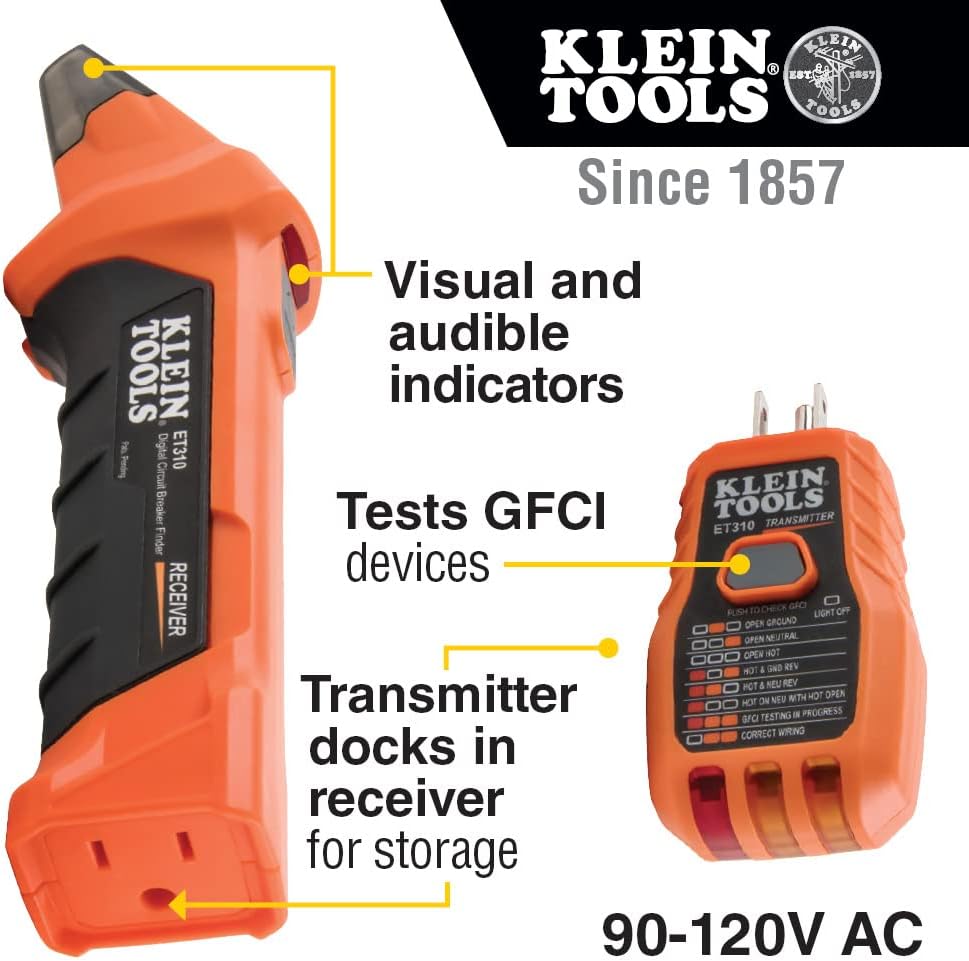
The Klein ET310KIT is the Klein ET310 breaker finder plus a full adapter set. The base ET310 transmitter plugs into a standard three-prong grounded outlet. The KIT version adds adapters for two-prong ungrounded outlets (the kind without a ground slot, common in homes built before the mid-1960s) and for medium-base bulb sockets—so you can trace circuits at light fixtures, not just receptacles. Owners doing older-construction work consistently flag this adapter set as essential rather than optional. One owner working through a 1940s bungalow described the ungrounded adapter as “the whole reason I bought the KIT instead of just the ET310.”
The Klein 80064 is a three-piece bundle: the ET310 circuit breaker finder, a non-contact voltage tester (NCV), and a GFCI outlet tester. The NCV tester lets you confirm a wire or outlet is de-energized before you touch it—a critical safety step that belongs in every workflow, not as an afterthought. The GFCI tester checks whether a ground fault circuit interrupter outlet (the kind with the TEST and RESET buttons, required in kitchens, bathrooms, and outdoors) is wired correctly and functioning. Reviewers consistently call out this bundle’s safety logic: you find the breaker, you verify it’s off, you confirm your outlets are protected. That’s a complete sequence. Klein’s published product specification sheet for the 80064 describes this as an intentional workflow bundle for service work.
The KAIWEETS Circuit Breaker Finder is a standalone finder from a value-oriented brand that has built a following among DIYers and budget-conscious buyers. Across aggregated owner accounts, the pattern is measured praise: owners describe it as “accurate enough,” “solid for the price,” and “good value.” Nobody is writing disappointed reviews about it failing outright. But nobody is describing it as a professional workhorse either, and the adapter ecosystem simply is not there.
Head-to-Head: Three Tools, Three Use Cases
The Adapter-First Option for Older Construction
Klein ET310KIT is the right answer when the building itself is the constraint. Pre-1970s residential construction in the United States frequently features two-prong ungrounded receptacles throughout—sometimes the entire house. The base ET310 transmitter cannot plug into a two-prong outlet without an adapter. Without that adapter, you cannot send the finder signal into the circuit at all, and the tool becomes useless on those runs.
The ET310KIT’s bulb socket adapter extends the same logic to light fixture circuits. In older homes, a circuit may feed only a ceiling fixture and a switched outlet, with no standard receptacle accessible on that run. Being able to plug the transmitter into the fixture socket means no circuit is off-limits.
ECM Web, the trade publication Electrical Construction & Maintenance, has covered panel labeling complications in older construction as among the most common residential service call friction points—precisely because unlabeled panels in pre-code-enforcement buildings often coincide with non-standard wiring configurations. A finder that cannot access two-prong outlets is only half a solution in that environment.
Klein’s ET310 product specification sheet does not call out the adapter set as an upgrade; in the KIT configuration, it is included in the box as a standard component.
Klein
$59.98
In stock on Amazon
Check price on AmazonThe Safety-Workflow Bundle for Mixed or Modern Construction
Klein 80064 answers a different question: not just which breaker is it, but is it actually safe to work on now. The bundle pairs the ET310 finder with a dedicated non-contact voltage tester and a standalone GFCI outlet tester. That sequence—find the breaker, verify de-energization, confirm GFCI protection—maps directly onto the steps a competent electrician or inspector runs through before touching anything.
NFPA 70, the National Electrical Code (2023 Edition), Article 408 requires panelboards to have a legible circuit directory identifying each overcurrent device by its purpose. Enforcement of that requirement on existing construction is inconsistent, as ECM Web’s ongoing panel labeling coverage has documented. That means unlabeled panels will remain a fixture of service work for years to come, and the 80064 gives you the tools to map and verify safety in a single purchase.
The NCV tester’s presence in the bag while you’re already at the panel creates a natural safety checkpoint. You’re not walking back to the truck; the tester is already in the bag. Reviewers note this as a workflow efficiency advantage, not just a safety one.
One limitation worth naming: the 80064 does not include adapters for two-prong ungrounded outlets. If your work regularly takes you into pre-1970s construction, the 80064’s GFCI tester and NCV tester won’t compensate for an ET310 transmitter that can’t plug into the outlets you’re trying to trace.
Klein
$59.98
In stock on Amazon
Check price on AmazonThe Budget-Friendly Option for Occasional Use
KAIWEETS Circuit Breaker Finder occupies the value end of this comparison with an honest set of trade-offs. Owners who bought it for a one-time panel mapping project or occasional home use consistently describe it as doing its core job: the receiver finds the right breaker, the transmitter plugs into standard grounded outlets, and the signal is strong enough to identify circuits in a typical residential panel.
What the KAIWEETS does not offer: no adapter set for two-prong outlets, no bundled NCV tester, no GFCI test function, and no manufacturer ecosystem to extend the tool’s reach. For a homeowner mapping a single panel once, those omissions are acceptable. For a tradesperson who will reach for the tool weekly or who moves between homes of varying ages, the missing adapters and safety testers become meaningful gaps.
The value proposition of the KAIWEETS is real, but it is real for a specific use case. Professionals who need the full adapter ecosystem, or who run the verify-de-energize-confirm safety sequence on every job, should spend up.
Klein
$49.97
In stock on Amazon
Check price on AmazonThe GFCI Observation Worth Noting
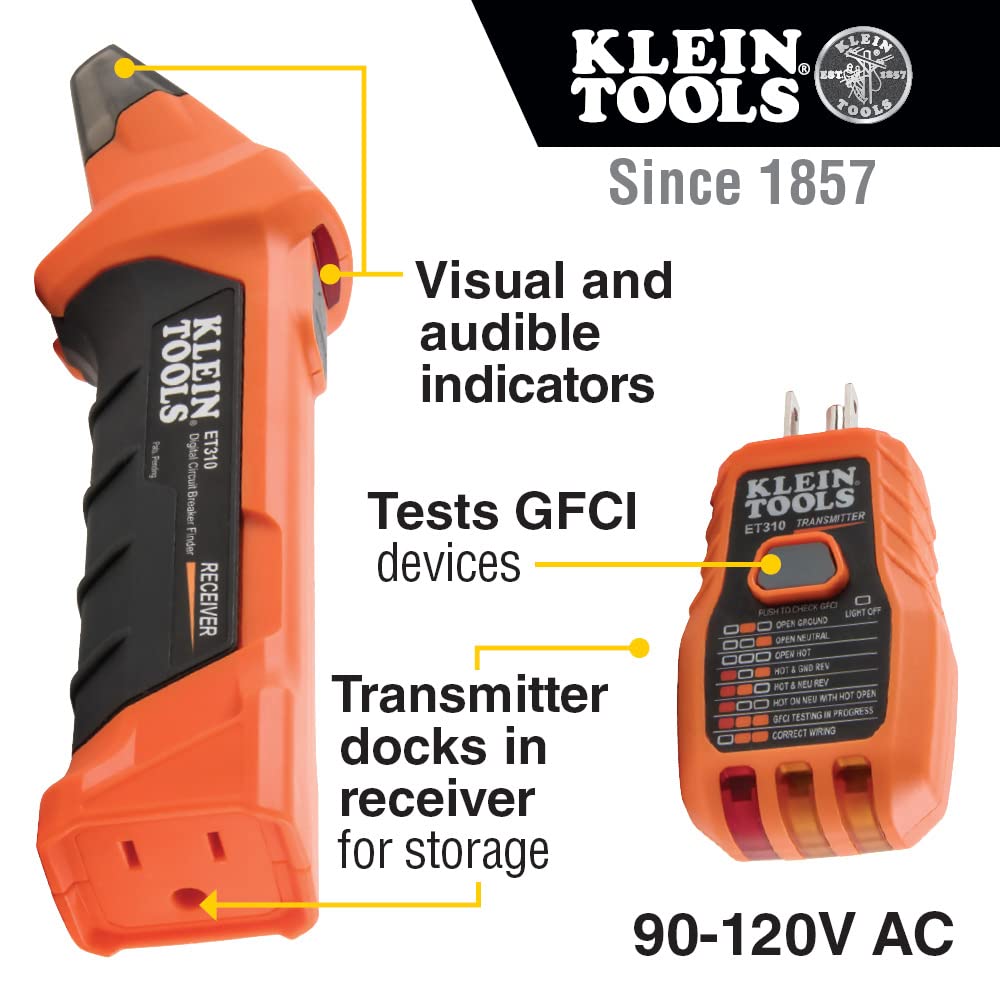
One of the more unexpected findings from owner reports involves the ET310’s transmitter button labeled “Push to Check GFCI.” This button was designed and described in Klein’s ET310 specification sheet as a test function: you press it, and a properly functioning GFCI should trip.
What is less documented is what some owners observed when dealing with a stuck or unresponsive GFCI outlet—the kind where pressing the physical RESET button on the outlet face does nothing. At least one owner documented using the ET310 transmitter’s GFCI button to successfully reset an outdoor GFCI receptacle that would not respond to manual finger pressure on the outlet’s own reset button. The working theory is that the transmitter delivers a current pulse that differs from simple mechanical button pressure, potentially clearing whatever condition was keeping the outlet latched open.
Klein’s published specification sheet for the ET310 does not advertise or guarantee this behavior—it describes the button as a GFCI test function only. Treat this as owner-observed field behavior, not a manufacturer-warranted feature. If a GFCI outlet will not reset by any method, the outlet likely needs replacement. But knowing this behavior exists may save diagnostic time on a stubborn outdoor or garage GFCI.
Side-by-Side Feature Comparison
| Feature | Klein ET310KIT | Klein 80064 | KAIWEETS Finder |
|---|---|---|---|
| Breaker finder (transmitter + receiver) | ✓ | ✓ | ✓ |
| Ungrounded outlet adapter | ✓ included | Not included | Not included |
| Bulb socket adapter | ✓ included | Not included | Not included |
| NCV non-contact voltage tester | ✗ | ✓ included | ✗ |
| GFCI outlet tester (dedicated) | ✗ dedicated | ✓ included | ✗ |
| GFCI test via transmitter button | ✓ | ✓ | ✗ |
| Price tier (2026 market) | Mid | Mid-upper | Budget |
The 80064 and ET310KIT are roughly in the same price neighborhood, but they solve different secondary problems. The KIT is optimized for older construction; the 80064 is optimized for safety-workflow completeness on any construction. The KAIWEETS competes on price and delivers on the core task.
Accuracy in Dense Panels: What Owners Report
One of the most common buyer questions is whether these finders can correctly identify a specific breaker in a packed panel—the kind where 40 or 42 slots are all occupied and the breakers are millimeters apart. Owners across all three products report that accuracy depends partly on technique: moving the receiver slowly, holding it at a consistent angle, and letting the signal stabilize before making a call. In a densely loaded panel, the receiver’s signal can bleed across adjacent breakers, which is a physics limitation rather than a product flaw.
Owners of the Klein ET310 (which underpins both the ET310KIT and the 80064) generally describe it as accurate to a single breaker position when used carefully, with occasional reports of needing a second pass to confirm. KAIWEETS owners describe similar performance in standard residential panels.
The practical workaround most experienced owners mention: if the signal peaks between two adjacent breakers, flip the one you think it is, recheck with the receiver, then recheck the outlet. Two-step confirmation adds thirty seconds and eliminates most misidentifications.
Frequently Asked Questions
Will a circuit breaker finder work on older two-wire ungrounded outlets? The basic ET310 transmitter will not plug into a two-prong ungrounded outlet without an adapter. The ET310KIT includes that adapter. The 80064 and the KAIWEETS finder do not include an ungrounded-outlet adapter. Owners doing older construction work consistently say the adapter is essential and wish they had bought the KIT version from the start rather than ordering the adapter separately.
Can the Klein ET310 transmitter trip or reset a GFCI outlet? The ET310’s “Push to Check GFCI” button is described in Klein’s specification sheet as a test function—it should trip a functioning GFCI. Owners have also reported it resetting a GFCI outlet whose physical reset button was unresponsive, but Klein’s published specifications do not describe this as an intended feature. Attribute this to observed owner behavior, not a guaranteed function.
How accurate are these finders in panels with densely packed breakers? Owners across all three products describe accuracy as generally reliable to a single breaker position with careful, slow technique. In very dense panels, signal bleed to adjacent breakers is possible. The standard field practice is to confirm by flipping the suspected breaker and rechecking the outlet.
What is the difference between the Klein ET310, ET310KIT, and the 80064? The ET310 is the base breaker finder: transmitter and receiver only. The ET310KIT is the ET310 plus adapters for ungrounded outlets and bulb sockets. The 80064 is the ET310 paired with a dedicated NCV tester and a GFCI outlet tester—but without the adapter set. All three use the same core ET310 transmitter and receiver hardware; the difference is entirely in what’s bundled alongside it.
The Decision Rule
Here’s where it lands:
- Older construction (pre-1970, two-prong outlets): ET310KIT. The adapters are not optional—they determine whether the tool works at all on those circuits.
- Modern or mixed-age work, and you don’t already own an NCV tester and GFCI tester: 80064. The safety workflow justifies the bundle, and ECM Web’s reporting on panel labeling enforcement gaps makes clear that unlabeled panels will remain common in existing construction for the foreseeable future.
- One-time home project or budget-constrained DIY: KAIWEETS. It does the core job at a lower price point. Don’t expect the adapter ecosystem or bundled safety testers.
- Already own an NCV and GFCI tester, working in modern construction: The base ET310 alone is probably sufficient—but the KIT doesn’t cost much more and future-proofs you for the older job that’s coming eventually.
Unlabeled panels aren’t going away. NFPA 70’s Article 408 directory requirements help on new work, but the existing housing stock is what it is. Pick the kit that matches the panels you’re actually standing in front of.