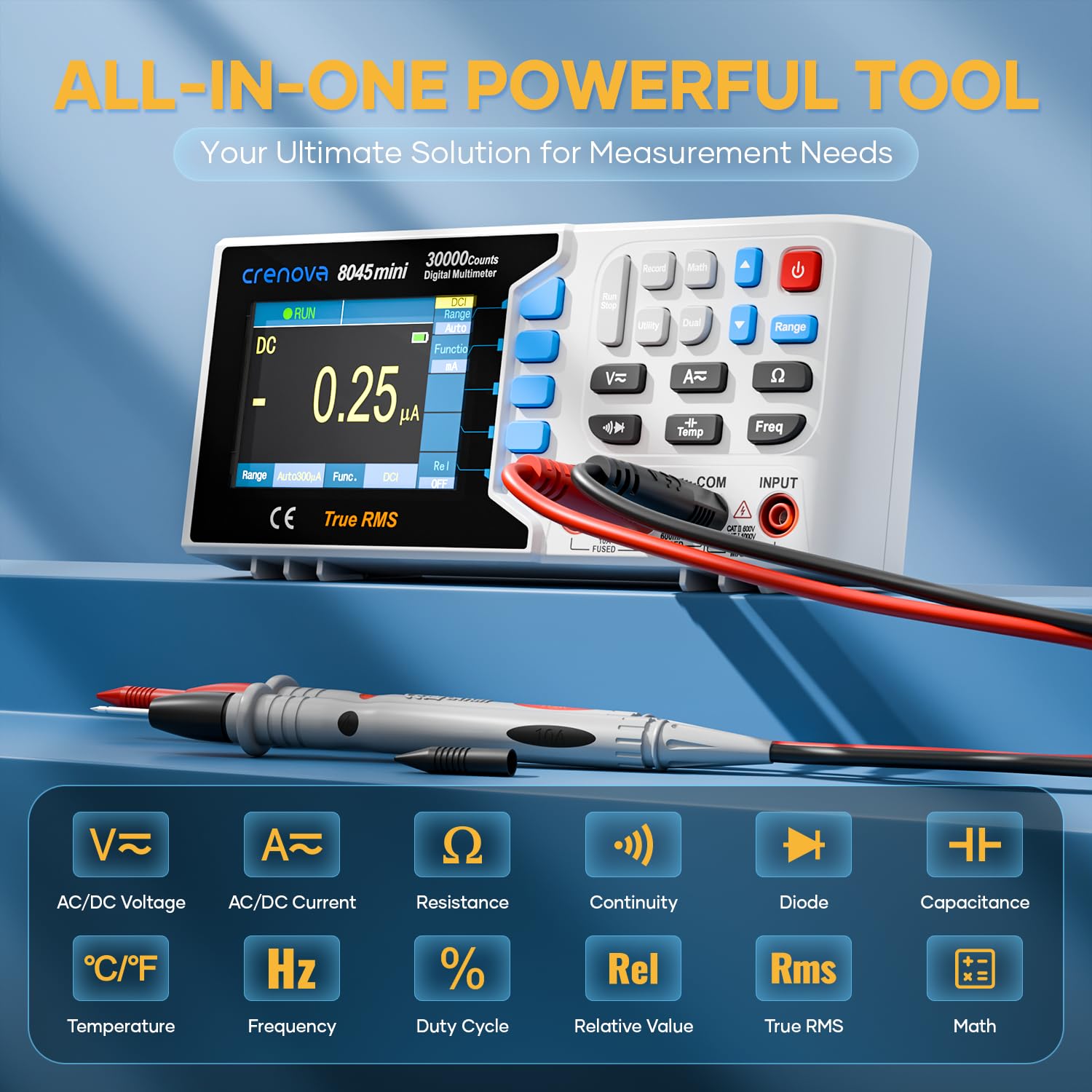
If you’ve ever tried to verify a precision resistor value with a Fluke 87V and gotten a reading that dances in the last digit, you’ve already felt the wall that handheld meters eventually hit. A handheld multimeter — the kind you clip to your belt and carry up a ladder — is a 3½ to 4½ digit instrument (that “digit” count tells you how many numerical places it displays; a 4½-digit meter shows readings like 19.999, giving you resolution to the ten-thousandths place on some ranges). That’s plenty of resolution for 99% of field work. But in an industrial maintenance shop, a calibration lab, or a precision manufacturing environment, you sometimes need readings that go to five or six significant digits, stay rock-steady for minutes at a time, and get logged automatically to a spreadsheet. That’s where bench multimeters — mains-powered desktop instruments designed to sit on a workbench rather than ride in a tool bag — step in. This guide explains when to make that call, what specs actually matter, and which instruments are worth putting on the requisition.
What Makes a Bench Meter Different From a Good Handheld
The short answer is resolution, stability, and connectivity — but each of those words hides real engineering decisions worth understanding before you spend $500–$3,000.
Resolution and digit count. Most premium handhelds top out at 4½ digits (40,000 counts). Entry-level bench meters typically start at 5½ digits (220,000 counts), and serious lab-grade instruments reach 6½ or even 7½ digits. Per the Keysight Technologies 34461A Truevolt data sheet, their 6½-digit bench meter delivers 1 µV (microvolt — one millionth of a volt) resolution on the 100 mV range. Compare that to a 4½-digit handheld doing 10 µV on the same range — a 10× jump. If you’re characterizing a precision shunt resistor, verifying a 4-20 mA transmitter, or doing battery cell matching for an energy storage installation, that difference is the margin between a usable measurement and a guess.
Measurement stability and noise floor. Bench meters use linear power supplies (or well-filtered switching supplies), shielded analog front ends, and temperature-compensated references. Owners working in calibration labs consistently report that a quality bench meter will hold its last digit steady through a 30-second aperture (measurement window) even on microvolt-level signals, where a handheld is still wandering due to battery voltage fluctuation and thermal noise from the PCB.
Connectivity and automation. Almost every bench meter above $400 includes GPIB (General Purpose Interface Bus — an old but still-universal instrument bus originally developed by HP), USB, LAN, or some combination. This is what lets you write a Python script or a LabVIEW routine that polls the meter every 100 ms and logs a thousand readings into a CSV. For trending insulation leakage over a shift, doing component sorting on a production line, or automating a calibration procedure — that bus interface is the feature that justifies the bench form factor by itself.
Safety architecture. Here’s a point ECM Web’s “Test Equipment Fundamentals for Industrial Maintenance” feature makes clearly: bench meters are not designed for line-voltage troubleshooting at a live panel. They carry input protection ratings, but they’re typically CAT I or CAT II — fine for signals already routed to a bench, not appropriate for probing a 480 V distribution bus. Your Fluke 87V still owns the panel work. The bench meter owns everything that comes back to the shop for detailed characterization.
The Specs That Actually Drive the Purchase Decision
When you’re writing a PO or filling out a capital equipment request, these are the numbers worth debating.
Digits and Counts: Know What You’re Buying
The “½ digit” convention confuses a lot of people. A “½ digit” is a leading digit that can only display 0 or 1 — so a 5½-digit meter showing 19.9999 has 199,999 counts of resolution. A 6½-digit meter goes to 1,999,999 counts. The Fluke 8846A specification sheet lists 6½ digits with 2,000,000 counts on the DCV range. Keysight’s 34461A matches that at 6½ digits. For most industrial maintenance and calibration work, 5½ or 6½ digits is the practical sweet spot — 7½-digit instruments exist (Keysight 34470A) but at $4,000+ they belong in primary metrology labs, not maintenance shops.
By the numbers — resolution comparison:
| Instrument class | Digit count | DCV counts | Approx. resolution (10 V range) |
|---|---|---|---|
| Premium handheld (Fluke 87V) | 4½ | 50,000 | 0.1 mV |
| Entry bench (Rigol DM3068) | 5½ | 220,000 | ~45 µV |
| Mid bench (Keysight 34461A) | 6½ | 2,000,000 | ~5 µV |
| Lab bench (Keysight 34470A) | 7½ | 20,000,000 | ~0.5 µV |
Accuracy Specification: Read the Fine Print
Bench meter accuracy is quoted as ± (% of reading + % of range) — for example, ”± (0.0030% + 0.0005%)” on the Keysight 34461A DCV spec. That first number (% of reading) matters most for large signals; the second (% of range — also called “floor error” or “offset”) matters most for small signals near zero. The Fluke 8846A specification sheet similarly quotes ± (0.0024% + 0.0005%) on DC volts with 10 PLC (power line cycles) integration time. Those numbers are dramatically better than any handheld’s ±(0.05% + 1 count) typical spec.
One important nuance flagged in Electrical Construction & Maintenance’s “Calibration and Traceability in Industrial Test Instruments” piece: accuracy specs are valid only at a defined temperature (usually 23°C ± 5°C) and after a warm-up period (typically 1–2 hours for a cold instrument). If you’re in an unheated maintenance bay in January, plan to let the meter stabilize before trusting the last two digits.
Aperture and Integration Time
Bench meters let you trade measurement speed for noise rejection by adjusting how long the analog-to-digital converter integrates each reading. Short apertures (0.001 PLC or “fast” mode) give you thousands of readings per second but with more noise — useful for catching transients. Long apertures (10 or 100 PLC) average out noise and give you the published accuracy spec — useful for characterizing a stable DC signal. Per the IEEE Standard 1057-2017 framework for digitizing instruments, longer integration times effectively increase dynamic range by reducing noise. Most industrial maintenance work lives in the 1–10 PLC range as a practical balance.
Bus Interface: Match Your Workflow
- USB + LAN (like the Keysight 34461A): plug-and-play with modern test software, no driver headaches on Windows 10/11, easy to log data with free tools like Keysight’s BenchVue.
- GPIB: legacy standard still required if you’re integrating with an existing automated test system built around an older rack. Bench meters typically offer GPIB as an add-on option or include it at the higher model tier.
- RS-232: aging rapidly — avoid specifying new equipment around it unless your facility already runs an RS-232 backbone.
Test Equipment Depot’s bench multimeter category buyer notes point out that for shops doing mostly spot-check calibration work (not automated test), USB alone is sufficient and saves the GPIB option cost.
Matching the Instrument to the Application
This is where the “if X, then Y” logic gets concrete.
If you’re doing calibration verification and NIST-traceable documentation — your shop calibrates transmitters, transducers, or secondary standards — then you need at minimum a 6½-digit instrument with a current calibration certificate and a known uncertainty budget. The Keysight 34461A (around $1,200–$1,500 street price in mid-2026) or the Fluke 8846A (around $2,000–$2,500) are the two instruments that consistently appear in calibration lab specs at this tier. Both carry manufacturer calibration certificates; third-party accredited calibration to ISO/IEC 17025 is available and worth the add-on cost if your quality system requires it.
If you’re doing industrial maintenance bench work — incoming inspection of motor windings, component verification, power supply characterization, 4-20 mA loop calibration — then a 5½-digit instrument is likely sufficient and meaningfully cheaper. The Rigol DM3068 (roughly $400–$500) offers 5½ digits with USB/LAN/GPIB and has become a common pick in small industrial shops and university labs where the budget is real. Aggregated user reviews on instruments forums note that Rigol’s measurement engine is solid, though some owners flag that the display and UI feel less polished than Keysight or Fluke hardware at the same price.
If you’re in solar or EV infrastructure work and need bench verification — characterizing charge controller output, verifying BMS (Battery Management System) cell voltages to tight tolerances, or calibrating CT (current transformer) inputs — the 5½-digit tier usually fits the precision requirement, and the key add-on to look for is a current measurement range that handles milliamp-level signals cleanly, plus a good LAN interface for integration with energy management logging systems.
If budget is the binding constraint and the work is “better than handheld” not “metrology” — something like a Uni-T UT8804N or similar 4½ to 5½-digit bench meter in the $150–$250 range gives you the stable power supply, the SCPI command set (Standard Commands for Programmable Instruments — the language most test automation software speaks), and the USB logging capability without the precision-grade price. These instruments won’t satisfy a calibration lab’s uncertainty budget, but for a maintenance shop doing comparative measurements, they’re a significant step up from a handheld in terms of stability and logging capability.
One tradeoff worth naming explicitly: a bench meter does not replace a clamp meter or an insulation tester. If you’re spending $1,500 on a bench meter and haven’t yet got a Megger MIT430-class insulation tester or a true-RMS clamp meter in the kit, reconsider the order of operations. The bench meter is an addition to the kit, not a consolidation of it.
Calibration, Traceability, and the Paperwork You’ll Actually Need
Every bench meter will drift over time — the question is how fast and whether you’re tracking it. Most manufacturers rate their bench meters for annual calibration intervals under normal use. If your shop is doing any work that feeds a quality system (ISO 9001, AS9100, ISO/IEC 17025), the calibration certificate needs to show traceability back to national standards — in the U.S., that means NIST (National Institute of Standards and Technology).
Electrical Construction & Maintenance’s calibration traceability article makes a point worth repeating: the instrument’s accuracy spec is only valid if it’s been calibrated within the stated interval, at a lab whose own standards are traceable. A $2,000 Fluke 8846A that hasn’t been calibrated in three years is not more accurate than a freshly calibrated $400 bench meter — it’s just a more expensive source of unknown error. Budget for the annual calibration at purchase time; it typically runs $150–$400 depending on the instrument and the lab.
The Decision Rule
Here’s the clean version:
- Resolution need ≤ 4½ digits, purely field work → your handheld is still the right tool; a bench meter adds no value.
- Resolution need is 5½ digits, maintenance bench work, spot logging → Rigol DM3068-class ($400–$500), USB/LAN interface.
- Resolution need is 6½ digits, calibration documentation required, quality system → Keysight 34461A or Fluke 8846A ($1,200–$2,500), buy with calibration certificate.
- Automated test integration, existing GPIB rack → confirm GPIB option at spec time; it’s almost always a model suffix or add-on that’s easy to overlook until the system won’t talk to the new instrument.
- Budget under $300, “better than handheld” goal → 4½ to 5½-digit bench meter from Uni-T or similar; you get stability and logging, not metrology.
The bench multimeter is a specialist tool that solves a specific problem: when the job demands more resolution, more stability, or more data than a handheld can give you. When those conditions exist, it earns its spot on the bench immediately. When they don’t, your 87V or Hioki DT4282 is still the better choice — because the best instrument is always the one that’s actually in your hand on the job.