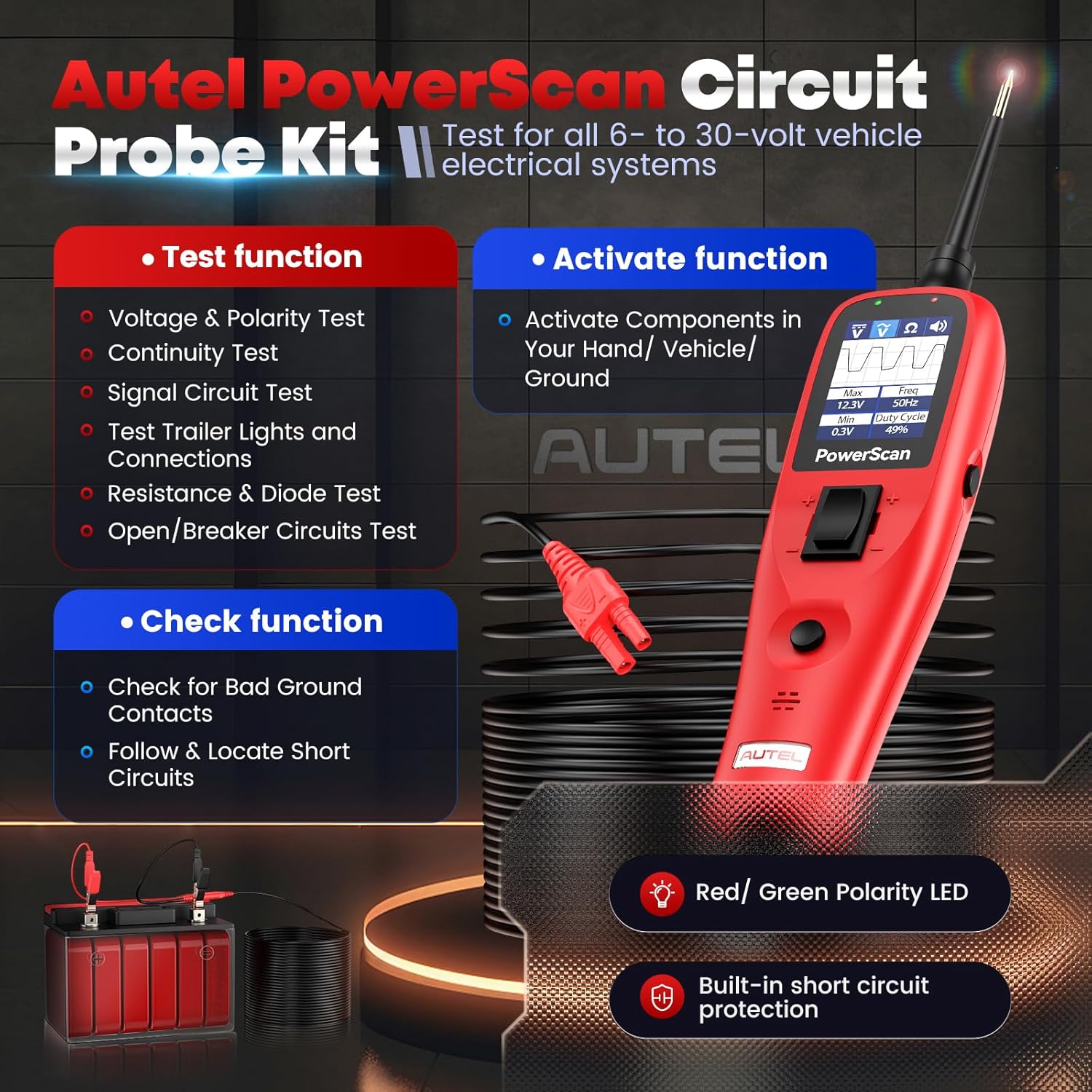
If you’ve ever stared at a car that won’t start, a dashboard light that won’t go off, or an accessory that drains the battery overnight, you already understand why automotive electrical diagnosis matters. The tools that help you find those problems — called circuit testers and probe tools — are purpose-built for working inside a vehicle’s wiring harness (the bundled network of wires running throughout the car). Unlike a standard household voltage tester, automotive probe tools are designed to handle 12V DC systems, survive tight connector spaces, and often do double-duty as both power sources and measurement devices. This guide covers the full range: from a basic power probe that tells you whether a wire has voltage, all the way up to tools with a built-in oscilloscope mode (a feature that displays how voltage changes over time as a waveform graph). You’ll come away knowing what each tier of tool actually does, when the upgrade is worth it, and which specific products earn their price tags in real-world shop and DIY use.
What Power Probe Tools Actually Do (and Why They’re Not Just Fancy Test Lights)
A test light — the kind with a sharp probe, a wire clip, and a bulb in the handle — tells you one thing: voltage is present or it isn’t. That’s useful for about 20% of automotive electrical problems. For the other 80%, you need more.
A power probe (sometimes called a circuit tester or power injector) goes further in two directions at once:
- It measures — showing you actual voltage, often with a digital readout, so you know whether you have 12.4V at rest or a sagging 9.8V under load.
- It supplies — letting you push power or ground directly to a component to see if it functions, bypassing suspect wiring.
That second capability is the one that separates a power probe from a multimeter in shop use. Say a blower motor isn’t running. With a multimeter, you confirm whether voltage is reaching the connector. With a power probe in injection mode, you can feed 12V directly to the motor’s terminals and see if it spins — in about ten seconds, without pulling the dash apart to swap components.
The Autel PS100 is a product that sits squarely in this category and has been directly compared by reviewers to Power Probe equipment — the brand most shops treat as the benchmark for this tool class. Reviewers who come to the Autel PS100 from Power Probe hardware consistently note that it matches the core feature set (voltage display, power injection, ground injection, circuit protection) at a lower entry point, while the physical build and lead quality feel slightly behind Power Probe’s more robust housings. That’s a real tradeoff worth naming: if you’re running a shop where this tool gets daily abuse, the durability gap matters. If you’re a technician building out your first kit or a mobile diagnostician who treats tools carefully, the Autel PS100’s functional parity is the better value story.
Power probe tools by the numbers (typical mid-tier specs):
| Feature | Basic Power Probe | Mid-Tier (e.g., Autel PS100) | Advanced w/ Scope |
|---|---|---|---|
| Voltage display | None / LED only | Digital LCD | Digital + waveform |
| Power injection current | 10–20A | 20–30A | 20–30A |
| Continuity / short detect | Rarely | Usually included | Included |
| Oscilloscope mode | No | No | Yes (bandwidth varies) |
The Back-Probe Problem: Why Connector Access Tools Matter More Than They Look
Here’s a scenario any technician who’s spent time on late-model vehicles knows well: you need to measure voltage at a weatherproof connector (a sealed plastic plug designed to keep moisture out), but probing across the connector faces risks damaging the seal or bending a pin. The solution is back-probing — inserting a thin, specialized pin into the back of the connector alongside the existing wire, making contact with the terminal without disturbing the seal.
Back-probe pins sound simple. They’re not trivial to execute because modern vehicle connectors span dozens of terminal sizes and shapes. The Electronic Specialties 146 connector kit is a set specifically designed to address this. A tractor technician reviewing the kit noted that it covers not just passenger car connectors but also the larger-gauge agricultural and fleet equipment terminals that passenger-car-focused kits miss entirely — a meaningful detail if your work touches anything with a diesel PTO, trailer wiring, or commercial vehicle electrical systems. Per the Electronic Specialties published product documentation, the 146 kit includes terminals and adaptors spanning common domestic, import, and heavy-equipment connector families.
Electronic Design’s coverage of back-probing techniques emphasizes a key point worth internalizing: the diameter and material of a back-probe pin affects whether you risk scoring the terminal’s contact surface. Cheap back-probe sets with undersized or too-hard pins can cause intermittent faults worse than the one you started with. The ES146 kit’s design — specifically its material spec and range — is why technicians with fleet exposure reach for it over bargain alternatives.
A Worked Example: Finding an Always-On Fuse Circuit Without Guessing
This is the kind of scenario that converts skeptics. A dash cam installer reviewing the VDIAGTOOL V200 Pro documented a specific diagnostic sequence that’s worth walking through because it shows the tool’s logic in action.
The problem: a newly installed dash cam was draining the battery. The installer needed to find a fuse circuit that stays powered when the ignition is off (an “always-on” circuit, sometimes called a constant power circuit) — the correct type of tap point for a parking-mode dash cam.
The sequence with the V200 Pro:
- Set the tool to voltage detection mode and work through the fuse box, probing each fuse socket.
- The tool lights and reads voltage on circuits that are live — ignition-off, engine off.
- Circuits that go dead when the key is out are ignition-switched; circuits that stay live are constant.
- The installer identified three always-on circuits in about four minutes, then selected the correct amperage fuse slot for a low-draw tap.
Without a probe tool, this process involves either a wiring diagram (which most installers don’t have for a specific vehicle’s fuse assignments) or repeated multimeter probe placements. The V200 Pro’s fuse-blade contact design — it clips directly onto fuse tabs — made the process faster and more reliable than a single-point probe. This is a textbook use case for the tool class: not exotic diagnostics, just removing the guesswork from a common task.
The VDIAGTOOL V500 Pro (the step-up sibling) earns an unusual compliment in aggregated reviews: multiple buyers specifically praised its instruction manual. In a product category where documentation is notoriously poor — tools shipped with a single laminated card or translated-into-near-gibberish PDFs — reviewers note that the V500 Pro’s manual actually explains the tool’s modes in logical sequence and includes real use cases. EDN Network’s coverage of budget diagnostic tools has flagged documentation quality as a leading indicator of whether a tool was designed for competent but non-specialist users versus professionals assumed to already know everything. A well-written manual signals the manufacturer thought about the user experience end-to-end, which usually correlates with more coherent feature design.
Parasitic Drain, Graph Mode, and When a Scope Actually Earns Its Price
Parasitic drain is current draw that continues after the vehicle is shut off — a component staying awake when it should sleep. At low levels (under 50 milliamps for most modern vehicles), it’s normal. Above that threshold, it flattens a battery overnight or over a weekend.
Traditional parasitic drain testing uses a multimeter in current mode, placed in series with the battery negative cable. ECM Web’s methodology guide on parasitic draw testing notes that the standard process requires waiting for the vehicle’s CAN bus (the internal communication network between modules) to “sleep” — which can take 20 to 45 minutes — then taking a steady-state current reading. This is tedious and catches only constant draws, not intermittent ones.
The FNIRSI DMT-99 has received specific attention in reviews for its graph mode — a feature that plots voltage or current over time as a scrollable waveform. Reviewers diagnosing parasitic drain report that the graph mode catches intermittent spikes: a module that wakes up every 90 seconds and pulls 400mA for three seconds won’t show up on a single-point multimeter reading, but it appears clearly as a spike on the DMT-99’s graph. That’s the legitimate use case for an oscilloscope-mode feature on a diagnostic probe tool — not reading fuel injector waveforms (you need proper bandwidth for that), but catching slow electrical events that unfold over seconds or minutes.
Which brings us to the honest answer on budget oscilloscope features:
Is a $60 oscilloscope mode actually useful? The answer is: yes, for some tasks; no, for others. EDN Network’s analysis of low-cost oscilloscope modules is clear that bandwidth claims on budget tools frequently don’t hold up at the advertised frequency. For high-frequency signal work — reading a CAN bus waveform, diagnosing an ABS wheel speed sensor output, or checking a throttle position sensor’s PWM signal — you need a proper scope with verified bandwidth above 1MHz, proper probes, and isolation. A $60 scope mode on a probe tool won’t reliably deliver that. What it will do: plot a battery voltage droop under starter load, show you an alternator ripple over a few seconds, and graph a parasitic drain event. For those tasks, it’s genuinely useful and worth paying for in a probe tool.
Frequently Asked Questions
What is a circuit probe tool and how is it different from a multimeter? A multimeter measures electrical values (voltage, current, resistance) passively — it reads what’s there. A circuit probe tool usually measures and injects: it can supply power or ground to a circuit so you can test components in place without rewiring. Multimeters are more precise instruments; probe tools are faster for hands-on diagnostic workflows in a vehicle.
Can I use a regular voltage tester for automotive electrical diagnosis? For simple checks — is power reaching this connector? — yes. For anything involving current capacity, intermittent faults, or component testing, a basic voltage tester leaves you guessing. The Fluke Corporation’s automotive application notes specifically recommend DC-capable digital measurement for any diagnosis beyond simple presence/absence checks.
What are back-probe pins and why do I need them? Back-probe pins are thin probes designed to slip into a sealed electrical connector alongside existing wires, letting you measure voltage or continuity without unplugging the connector. Modern vehicles use weatherproof connectors that shouldn’t be probed from the front without risking damage. A good connector kit — like the Electronic Specialties 146 — gives you the right size pin for the right connector, on any vehicle type.
What does power injection mean and when would I use it on a car? Power injection means using the probe tool to supply 12V (or ground) directly to a component’s terminals, bypassing the vehicle’s wiring. You’d use it to confirm that a non-functioning motor, solenoid, or relay actually works before spending time chasing wiring — or to definitively confirm that the component itself is the failure point.
Is a $60 oscilloscope mode on a probe tool actually useful or just a marketing feature? It’s useful for slow electrical events: battery voltage droop, alternator ripple, parasitic drain spikes over time. It is not a substitute for a real oscilloscope when you need to read high-speed signals like CAN bus data or sensor waveforms above a few kilohertz. Know what you need it for before deciding whether to pay for it.
The Decision Frame: If X, Then Y
You’re probably making one of three purchase decisions:
-
If your primary need is quick power/ground injection and voltage checks on 12V systems — the Autel PS100 covers the core use case at a price that makes sense for a first dedicated probe tool. Reviewers who come from Power Probe hardware note the functional parity; the tradeoff is build robustness under daily shop abuse.
-
If you work on a mix of passenger cars, fleet vehicles, or agricultural equipment — pair any mid-tier probe tool with the Electronic Specialties 146 connector kit. The back-probe coverage across vehicle types is the differentiator.
-
If parasitic drain diagnosis is a recurring job — a tool with a graph/waveform mode (the FNIRSI DMT-99 being the most-cited budget option for this specific use) earns its keep. A standard multimeter misses intermittent spikes; the graph catches them.
For oscilloscope-capable diagnostics beyond slow-event graphing, you’re into dedicated scope territory — but that’s a separate guide.