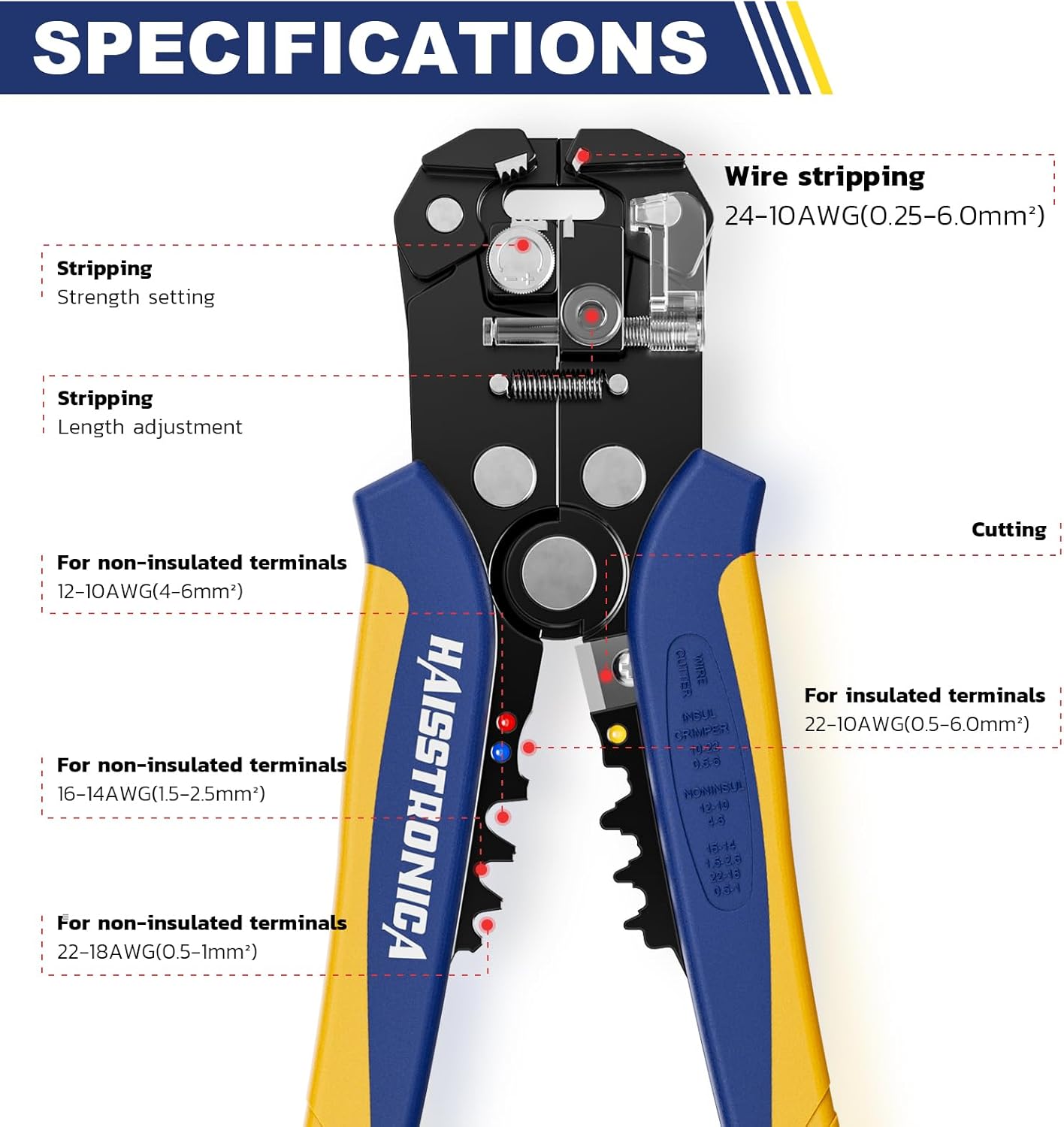
Picture this: you’re doing a full vehicle upfit — a fleet van getting a lighting harness, a secondary fuse block, and a dozen accessory circuits wired from scratch. You’re looking at stripping 50-plus individual wire ends before lunch. Your hand is already complaining after the first 15. That’s exactly the scenario one long-running reviewer describes when explaining why they reached for a self-adjusting 3-in-1 stripper-crimper-cutter. “Self-adjusting” means the tool senses the wire’s diameter automatically and sets its own bite depth — no manual dial, no swapping out for each gauge. Combined with a built-in crimper (a die that squeezes a metal terminal onto a wire end to make a secure connection) and flush cutters, the appeal is obvious: one tool, fewer steps, less grip fatigue.
But here’s the honest question worth asking before you buy: does combining three functions into one handle make each function better, or does it make all three slightly worse? The answer isn’t the same for a DIYer doing a weekend upfit as it is for a journeyman pulling Romex through a 40-unit residential build. This guide draws a clear line between those use cases — and tells you exactly where combo tools earn their keep and where a dedicated tool will serve you better.
What “3-in-1” Actually Means in Practice
The phrase covers a wide range of tools. At one end, you have the Haisstronica self-adjusting 3-in-1, which targets automotive and light-gauge wiring (roughly 10–24 AWG, where AWG — American Wire Gauge — is the standard sizing system: lower numbers mean thicker wire). It uses a spring-loaded self-adjusting mechanism that grips and strips in one squeeze, which owners consistently report nearly eliminates the hand strain that comes from manually dialing in wire gauge 50 times in a row. The same tool includes a ratcheting crimper for insulated butt connectors and ring terminals, plus side cutters for trimming wire ends.
At the other end sits Klein Tools’ 1019 Kurve, a more overtly professional combo tool with fixed-notch stripping holes, a heavier-duty crimper throat, and a build quality that Klein reviewers cite across years of ownership — some noting they’ve used the same pair for over two decades, replacing them only after significant physical wear. That kind of longevity data isn’t marketing copy; it’s the kind of thing that shows up repeatedly in long-tail owner commentary and is worth taking seriously when you’re amortizing the cost of a tool over a career.
Then there’s the Klein K12035, which sits in the middle — a compact combo tool with a mixed-function jaw. One candid owner note is worth quoting directly for what it reveals: the reviewer mentioned the cutters chipped on a live wire, then immediately said “that’s to be expected.” That moment of honest commentary is instructive. It isn’t a defect report — it’s a user correctly understanding tool limitations. Combo-tool cutters aren’t hardened to the same spec as dedicated diagonal cutters. Using them on energized conductors, on hardened steel messenger wire, or on anything outside their rated wire type will eventually chip the cutting edge. That’s not a flaw; it’s a design boundary.
The High-Volume DIY Case: Where Self-Adjusting Wins
The vehicle upfit scenario from the opener isn’t an edge case — it represents a specific, real pattern. Reviewers of the Haisstronica self-adjusting 3-in-1 describe scenarios involving 40 to 60 wire ends stripped in a single session, often with a mix of solid and stranded wire in similar gauge ranges. The self-adjusting mechanism handles that mix without the operator manually resetting anything between wires.
That’s the combo tool’s strongest argument: fatigue reduction over high wire counts in mixed-gauge, light-to-medium AWG work. Electronic Design’s coverage of hand tool ergonomics and repetitive-motion injury notes that grip force accumulates quickly on tasks requiring repeated tool repositioning and adjustment. A self-adjusting mechanism that eliminates the “find the right notch, reset, re-grip” sequence meaningfully reduces that accumulated load — especially for workers who aren’t running these tools eight hours a day and haven’t built up the grip endurance of a seasoned electrician.
One reviewer’s summary — that the Haisstronica “replaced several tools” in their kit — is worth contextualizing correctly: that’s a DIY perspective, and it’s a legitimate one. For a homeowner or enthusiast running occasional automotive wiring, consolidating to one tool that does a credible job on all three functions is a real win. But that framing shouldn’t migrate to a professional context without adjustment.
Where Dedicated Tools Win: The Romex Argument
Residential electricians who run 12 AWG and 14 AWG Romex (NM-B cable, the sheathed two-conductor-plus-ground cable used in most residential circuits per NFPA 70 NEC Article 310) tell a consistent story about the Klein 11048 dual-barrel stripper: speed on those two specific gauges is the primary value, not versatility. You hit the right notch every single time without thinking. The stroke is optimized for that wire family. You can strip 200 wire ends in a day and your hand knows exactly what’s coming.
That’s a narrow use case — 12 and 14 AWG NM-B, period — but for a residential electrician, it covers probably 80% of their stripping volume. A combo tool with a 10–24 AWG self-adjusting range is solving for variety, not for speed and consistency at a specific gauge. When your work is high-volume and narrow-gauge, a dedicated stripper optimized for that gauge wins on speed and reliability every time.
The same logic applies to crimping. A dedicated ratcheting crimper with calibrated dies matched to specific connector series — say, Molex terminals or heavy automotive lugs — will produce a more consistent crimp geometry than the general-purpose crimper jaw on a combo tool. Electrical Construction & Maintenance’s coverage of termination quality in commercial and industrial wiring consistently emphasizes that crimper die geometry is calibrated to a specific terminal series; a general-purpose crimper may produce a mechanically adequate crimp for low-stakes connections but isn’t the right tool when conductor retention is safety-critical.
By the Numbers
| Use Case | Recommended Tool Type | Why |
|---|---|---|
| Vehicle upfit, 40–60 mixed light-gauge wires | Self-adjusting 3-in-1 combo | Fatigue reduction, mixed AWG, acceptable crimp quality for insulated butt connectors |
| Residential Romex (12/14 AWG), high volume | Dedicated dual-barrel stripper (e.g., Klein 11048) | Speed, consistency, optimized for those gauges |
| Commercial panel work, varied terminations | Dedicated stripper + separate ratcheting crimper | Die-specific crimping, precision stripping, longevity per function |
| General hobbyist/light DIY, occasional use | Combo tool | Space savings, cost savings, adequate for low-frequency use |
The Longevity Question: Combo Tools as Real Professional Kit
Klein’s 1019 Kurve deserves special mention here because the ownership commentary around it is qualitatively different from most combo tools. Reviewers describe owning pairs — one at home, one at work — and replacing them after 20 years of use, not because they failed catastrophically, but because they finally wore out. That pattern is evidence of a product that was designed with professional durability in mind, not one that happened to survive light use. UL tool safety standards require testing for mechanical durability across rated use cycles, and Klein’s published specifications for the 1019 Kurve reflect a tool designed to those professional durability benchmarks.
That said, longevity is function-specific. The stripping notches on a fixed-notch tool will outlast the crimper die on the same tool, because crimping is mechanically harder on the pivot and jaw geometry. If you’re running a combo tool hard for crimping daily, expect the crimper to wear before the stripper does.
Frequently Asked Questions
Can a self-adjusting wire stripper handle both solid and stranded wire without switching settings? Generally yes, within the tool’s rated AWG range. The self-adjusting mechanism senses outer diameter rather than wire type, so a 14 AWG solid and a 14 AWG stranded conductor will both trigger a similar grip depth. Owners of the Haisstronica self-adjusting model report clean strips on both wire types in the 10–22 AWG range. The caveat is at the fine-gauge extreme: very fine stranded wire (24 AWG and smaller) is more vulnerable to nicking if the mechanism’s spring tension isn’t calibrated precisely for that diameter.
Is a built-in crimper on a combo stripper good enough for automotive butt connectors? For standard insulated butt connectors in the 18–22 AWG range used in most automotive and marine wiring, yes — the combo crimper produces a mechanically adequate connection for those applications. It’s a reasonable tool for a vehicle upfit or a boat accessory circuit. It is not the right choice for non-insulated terminals, precision control connectors, or any application where the terminal manufacturer specifies a calibrated ratcheting die.
What AWG range do I actually need for household Romex wiring versus automotive wiring? For residential Romex under NFPA 70 NEC, you’re primarily working in 14 AWG (15-amp circuits) and 12 AWG (20-amp circuits), with 10 AWG appearing on 30-amp appliance circuits. Automotive wiring typically runs 10–18 AWG for power circuits and 20–24 AWG for signal and lighting circuits. A tool rated 10–24 AWG covers both applications on paper, but as noted above, a dedicated stripper optimized for 12/14 AWG will outperform a combo tool in pure residential production work.
Why do professional electricians often prefer fixed-notch strippers over self-adjusting models? Speed and tactile confidence. On a fixed-notch stripper, experienced electricians develop muscle memory for their most-used gauge — they hit the notch without looking and strip in one clean motion. The self-adjusting mechanism adds a slight mechanical delay (the spring has to engage and set before the strip stroke completes) and removes the tactile feedback that tells an experienced user they’re in the right notch. Electrical Construction & Maintenance field productivity coverage consistently notes that for high-volume professional use, the adjustment mechanism is a feature for versatility, not for speed.
How long should a quality wire stripper last with daily professional use? A quality fixed-notch or adjusting stripper from a professional-grade manufacturer — Klein, Ideal, Greenlee — should last several years under daily professional use, with the Klein 1019 Kurve generating owner commentary citing 20-year lifespans. The realistic limiting factor in daily use is the cutting edge (which dulls from wire nicking and occasional contact with staples or sheathing material) and the pivot wear in combo tools. Combo tools with crimping functions will typically show wear at the crimper jaw before the stripper notches fail.
Will a self-adjusting stripper nick the conductors on fine-gauge stranded wire? It’s a real risk at the fine end of the range (22 AWG and below), particularly with highly stranded wire types. The spring tension that works well at 14–18 AWG can over-bite at 22–24 AWG, nicking outer strands. Owners of the Haisstronica model note this is most common when the wire is very flexible and doesn’t hold its shape against the jaw. For fine-gauge stranded wiring — signal cable, low-voltage lighting, sensor leads — a dedicated precision stripper with a specific die for that gauge will produce cleaner, more consistent results.
The Decision Rule
If you’re doing high-count, mixed-gauge light wiring — vehicle upfits, marine accessory circuits, low-voltage home automation runs — and hand fatigue is a real variable, a self-adjusting 3-in-1 combo tool is a legitimate choice. The Haisstronica self-adjusting model addresses that exact problem, and the Klein 1019 Kurve extends that proposition to users who want professional longevity alongside the convenience.
If your work is residential production wiring in 12 and 14 AWG Romex, get the dedicated dual-barrel stripper optimized for those gauges. The combo tool’s versatility is solving a problem you don’t have, and it’s slower for the problem you do have.
If you’re doing commercial or industrial work with varied terminal types and safety-critical crimps, the combo crimper isn’t the right tool regardless of how good the stripper function is. Run a dedicated ratcheting crimper alongside your stripper of choice.
The honest summary: combo tools aren’t gimmicks, but they’re also not a professional upgrade. They’re a genuine solution for a specific workload profile — high variety, moderate volume, portability, and fatigue management. Know your workload, buy accordingly.